Summary

  1. 'Immediate protection is by giving an antibiotic,' says local GPpublished at 10:34 GMT 16 March

    The immediate response to the outbreak will now focus on protecting anyone who may have been socialising with those who died from meningitis, according to a local GP.

    “Immediate protection is by giving an antibiotic," Dr Julian Spinks tells BBC Radio Kent. “Longer-term protection is by vaccination.”

    “Most people who’ve not been in closer contact, the risk is still pretty low," he adds.

    “The main emphasis is contacting people who have been at the nightclub or particular halls of residence."


  2. Local MP says she wants briefings for local schools for advice on next stepspublished at 10:27 GMT 16 March

    A headshot of Helen Whately against a blurred backgroundImage source, PA Media

    Conservative MP for Faversham and Mid Kent, Helen Whately, has told the Press Association she is expecting to receive a briefing update from the UK Health Security Agency this morning.

    "I'm trying to get information about what is being done locally to trace contacts and identify which students and school pupils are at risk," she tells the news agency.

    "Also I want schools to be given briefings on what steps they should take and the advice to give to parents."

    In a post on X, Whately sent condolences to the families of the two people who have died.

    "Just seen the shocking and sad news of two young lives lost to meningitis.

    "It’s a deeply worrying time for others in hospital or at risk of this horrible illness."

  3. Students at the University of Kent feel shellshockedpublished at 10:17 GMT 16 March

    Simon Jones
    BBC South East Today, reporting from Canterbury

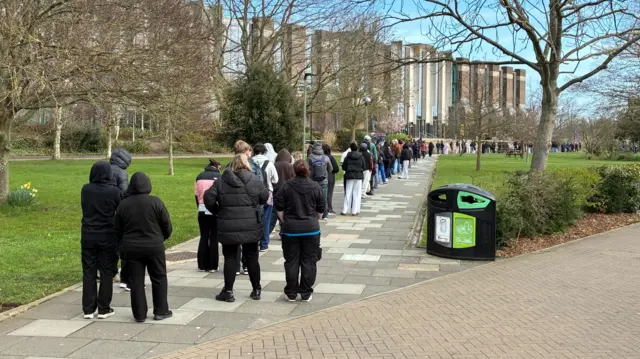
    Large group of students (over 50) queue up outside the University of Kent Senate buildingImage source, PA Media

    Students and staff here on the campus at the University of Kent feel shellshocked.

    There had been talk on chat groups that people had been taken ill. But last night students started receiving emails confirming the worst.

    Some are in the middle of exams - a stressful enough time as it is.

    Hundreds of people are queuing this morning to get antibiotics. Many are wearing masks.

    They want reassurance and they want information. The university says it’s doing all it can to keep people informed.

  4. Long queues for antibiotics seen at University of Kentpublished at 10:08 GMT 16 March

    People, many wearing face masks, have formed lengthy queues at the University of Kent campus to get antibiotics this morning.

    A long queue of people on a university campus.
    A long queue of people on a university campus.
  5. GP advises people to keep informed but not to panicpublished at 09:55 GMT 16 March

    GP Dr Fari Ahmed mid-speaking as she sits on the BBC Breakfast sofa

    Speaking to BBC Breakfast this morning, GP Dr Fari Ahmed says people do not need to panic and they will have been contacted if they had been a close contact of one of the cases.

    "When something like this happens, we've got a system in place," she explains.

    "They're now contacting potential contacts - and they've got to be close contacts - and I think they're all being offered antibiotics [as a] prevention to clear any of the bacteria you have.

    "If people are worried there are good sources of information around - the NHS website, some meningitis organisations.

    "It never hurts to be aware or be informed but I wouldn't be rushing or panicking about it unless you've been contacted."

    Our previous posts have more on the symptoms of meningitis and the advice from the UK Health Security Agency (UKHSA).

  6. Canterbury nightclub says 'some people' who may have been at club could have been affected by outbreakpublished at 09:44 GMT 16 March

    Brick building hosting a nighclub, the sign Chemistry features at the top of the main door, two cars parked slightly to the left of the entranceImage source, PA Media

    The BBC understands the outbreak is thought to be linked to a social event in Canterbury.

    A local nightclub, Club Chemistry, issued a statement on Sunday saying: "Some people who may have attended Club Chemistry could have been affected by the current outbreak."

    The nightclub says their thoughts are with the families of those who have died and all those affected.

    It advises people to call 111 urgently if they present with certain symptoms.

    "We are awaiting further information from the Health Security Agency, which we will share with you as soon as we have it," the nightclub adds.

    "Please look out for each other, our thoughts are with everyone affected by this."

  7. University of Kent working to move in-person events onlinepublished at 09:34 GMT 16 March

    An birdseye view of a leafy university campus.Image source, PA Media

    The University of Kent says it is working to move in-person events online following the death of a student from meningitis.

    In a message to students seen by the BBC, the university says the UK Health and Safety Authority had advised the campus should stay open.

    "We are however very aware that this situation may cause significant anxiety to many of you," the university writes. "Some Canterbury students (or staff) may not feel comfortable coming into classes/reviews/assessments tomorrow.

    "We are there working to move in-person events taking place tomorrow to online delivery if possible, or if not then postponing."

    However, the university adds that "given the late notice" it may not be possible for some events to shift online.

  8. Faversham grammar school 'absolutely devastated' by loss of studentpublished at 09:24 GMT 16 March

    Entrance to Queen Elizabeth's Grammar School in Faversham, view of the main building from the parking lot

    A grammar school in Faversham has confirmed one of its Year 13 students is the second person to have died of meningitis in the Kent outbreak.

    Queen Elizabeth’s Grammar School says in a statement they are "absolutely devastated" by the loss of "one of our much loved students".

    Headteacher Amelia McIlroy adds that the school is now working with the UK Health Security Agency (UKHSA) "to ensure that all appropriate actions are taken to protect our students and staff".

    "We would like to respect the family's privacy at this time and will provide a further statement in due course," she adds.

  9. 'Precautionary' antibiotics given to close contacts of cases - UKHSApublished at 09:15 GMT 16 March

    On Sunday, the UKHSA regional deputy director for the South East said that antibiotics had been given to close contacts of the cases as a "precautionary measure".

    In a statement, Trish Mannes said advice and support was also being offered to the wider student community in Kent as well as to local hospitals and the NHS 111 service.

    "Meningococcal disease can progress rapidly, so it’s essential that students and staff are alert to the signs and symptoms of meningococcal meningitis and septicaemia," Mannes said.

    "Students are particularly at risk of missing the early warning signs of meningitis because they can be easily confused with other illnesses such as a bad cold, flu or even a hangover."

    Mannes added that students should check on their friends regularly if they go to bed unwell and urged them not to hesitate before seeking medical help via their GP or the 111 service.

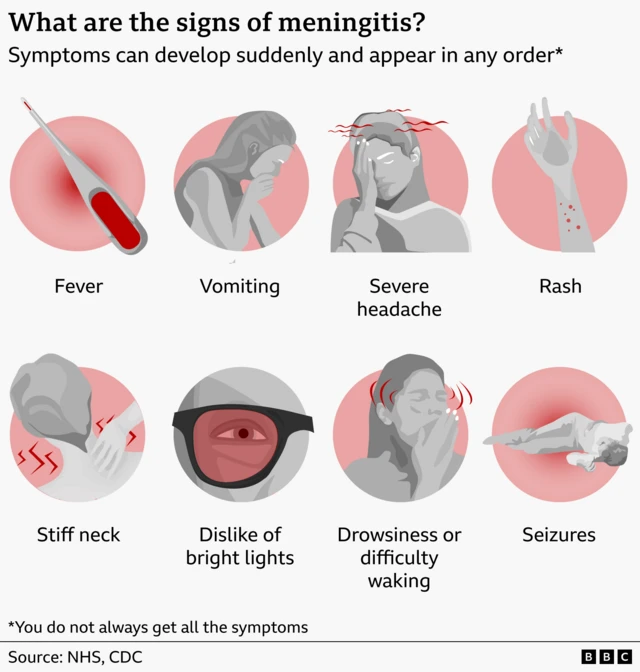
  10. What are the symptoms of meningitis?published at 09:03 GMT 16 March

    These are the symptoms of meningitis and sepsis, according to the NHS.

    • high temperature
    • cold hands and feet
    • vomiting
    • confusion
    • breathing quickly
    • muscle and joint pain
    • pale, mottled or blotchy skin (this may be harder to see on brown or black skin)
    • spots or a rash (this may be harder to see on brown or black skin)
    • headache
    • stiff neck
    • a dislike of bright lights
    • being very sleepy or difficult to wake

    An infographic titled “What are the signs of meningitis?” listing symptoms that can appear suddenly and in any order. It includes illustrations for: fever shown with a thermometer; vomiting depicted by a person leaning forward; severe headache shown with red lines around the head; a rash on an arm; a stiff neck illustrated by someone touching their neck; dislike of bright lights shown with an eye shielded by a dark band; drowsiness or difficulty waking shown with a person resting a head on a hand; and seizures illustrated by a figure lying on their side. Text at the bottom notes: “You do not always get all the symptoms.” Sources: NHS, CDC
  11. UKHSA reaches out to 30,000 in Canterbury as two die in meningitis outbreakpublished at 08:59 GMT 16 March

    Malu Cursino
    Live reporter

    More than 30,000 people in the Canterbury area are being contacted about a meningitis outbreak, in which two young people have died.

    One was a student at the University of Kent, while the other was a Year 13 student at Queen Elizabeth's Grammar School Faversham.

    Eleven others are seriously ill in hospital, BBC South East understands. It is understood that most are aged between 18 and 21, and a number of them are students at the University of Kent.

    Meningitis is an infection of the protective membranes that surround the brain and spinal cord and can be serious if not treated urgently.

    The UK Health Security Agency (UKHSA) says it is arranging antibiotics for some students in the Canterbury area, and the specific strain of the disease has not been identified.

    We'll be bringing you the latest on this story, as soon as we know more.