Summary

  1. 'We're avoiding campus', says studentpublished at 14:11 GMT 16 March

    A 20-year-old woman with blonde hair.Image source, Lucy Keen

    A University of Kent student tells the BBC campus is like a "ghost town" following the meningitis outbreak.

    Lucy Keen, who studies film and media, says she "did not clock" how big the situation was when her mum first messaged her on Sunday that a student had died from the illness.

    But she adds she soon found it scary: "People are shocked."

    "Nobody is on campus," the 20-year-old adds."We are avoiding it like the plague."

    "Hopefully it won't get any worse."

  2. Identifying the strain of this outbreak may take time, expert tells BBCpublished at 14:03 GMT 16 March

    Malu Cursino
    Live reporter

    I've just spoken to Dr Zina Alfahl, who is a lecturer in bacteriology at the University of Galway in Ireland.

    Dr Alfahl says it's not unusual to see the UK Health Security Agency take time to confirm the strain of this meningitis outbreak.

    When a meningococcal outbreak is detected, specialist laboratory testing is required. Labs will identify the strain through testing patient samples, usually blood or cerebrospinal fluid, she says.

    Specialist labs can then determine the serogroup of the bacteria and sequence its genome - this information is vital as it helps public health teams see if cases are linked, and confirm which strain is circulating. It also helps them plan whether a targeted vaccination programme, or other interventions, are needed to halt the spread.

    "This takes time," she adds. Asked what would be an expected wait-time, Dr Alfahl says it can take anywhere between three and four days, or even a week.

    It takes time because public health teams need to prioritise treating infected patients, identifying their close contacts, while in parallel lab technicians process samples and firm up what strain the outbreak belongs to.

    The UKHSA says close contacts to those infected are being given antibiotics as a "precautionary measure".

    I asked Dr Alfahl whether that triggers any concerns about antimicrobial resistance, given the prophylactic use of antibiotics. It's all about weighing the benefits and risks, she explains.

    These courses of antibiotics are usually short-term and targeted, Dr Alfahl points out, adding that it is much safer for those who might be at risk to take the medication than to avoid it. The issue with antimicrobial resistance comes from "long-term courses of antibiotics and repeated exposure," and that's not the case here, she points out.

  3. What to know about meningitispublished at 13:50 GMT 16 March

    This Flourish post cannot be displayed in your browser. Please enable Javascript or try a different browser.

  4. Analysis

    Students could easily confuse meningitis symptoms with something less seriouspublished at 13:43 GMT 16 March

    Branwen Jeffreys
    Education Editor

    The National Union of Students has repeatedly called for awareness of meningitis to be increased, and for universities to consider offering the MenB vaccine to students.

    The Men B vaccine was introduced into childhood vaccinations just over a decade ago, so many young adults now will not have received it.

    University is often the first time that young adults are responsible for looking after their own health away from their families.

    Living in big groups in student accommodation or in rented houses they are more vulnerable to infections and could easily confuse the symptoms of less serious ones in the early stages with something far more serious.

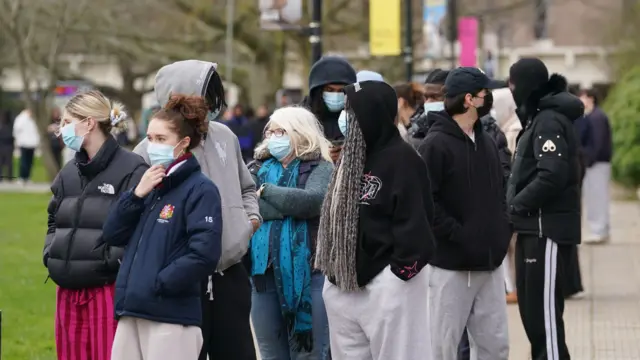
  5. 'We're pretty shocked', says student queuing for antibiotics on Kent campuspublished at 13:34 GMT 16 March

    A queue of students wearing face masks line up on the campusImage source, PA

    "I feel reassured because the school cares, I feel safer than not any action taking place," says Kirab Rhoda, who is one of the hundreds of students queuing up on the University of Kent campus to collect meningitis antibiotics.

    The 18-year-old says her mother had offered to book her a flight back home to Uganda after hearing about the outbreak, but thinks it's "really reassuring to all students" that medicine is being handed out.

    Millie Inglis, who is a 21-year-old law student, says she's getting the meningitis medication because someone in her dance class "had some issues with it".

    "We were just pretty shocked. It just feels like a repeat, it feels very Covid-esque," she says.

    "As long as everyone's alright, though, I guess that's all that matters really. We're just making sure that it doesn't get any worse."

  6. 'No reason' to change school routine, UKHSA tells Faversham parentspublished at 13:21 GMT 16 March

    The UKHSA has told parents of children who attend schools in the Faversham area, around 10 miles from Canterbury, that there is "no reason" to change school routines or keep children at home.

    In a letter, the agency explains "school contacts are only very rarely at risk," but asks parents to be aware of symptoms to look out for.

    It follows the death of a student at Queen Elizabeth's Grammar School - with the agency saying the chance of another case at the school is "very small".

    "We are investigating this death as part of a rapidly [evolving] cluster in the Canterbury area. Further information regarding potentially affected settings will be communicated in the coming days."

  7. 'My sister is in hospital with suspected meningitis - we've come for antibiotics as a precaution'published at 13:10 GMT 16 March

    One of those waiting in the queue at the University of Kent for antibiotics is Josh - who is not a student there but was with his sister yesterday. She is now in hospital with a suspected case of meningitis.

    Speaking to the BBC, Josh says: "From our perspective, we've got to come up here as a precaution.

    "Me and my partner both feel fine, my sister is in hospital with a rash and a couple of other symptoms - it's suspected at the moment."

    He explains his sister appears to be doing fine at the moment.

    "Considering my sister didn't go to this university [...] as far as I can tell she's picked it up from somewhere else - that is quite concerning," he adds.

    Media caption,

    Kent resident's concern for his sister with suspected meningitis

  8. Ashford Year 13 pupil in hospital with suspected meningitis - schoolpublished at 12:53 GMT 16 March

    Parents and guardians from Norton Knatchbull School in Ashford, Kent, have been notified that a Year 13 student has been admitted to hospital with a suspected case of meningitis.

    "At this stage, we have no confirmed diagnosis," the school says in a letter seen by the BBC, adding that they are taking "precautionary steps in line with public health guidance".

    The update to parents and carers goes on to warn them of the symptoms of meningitis, instructing them to seek urgent medical help if symptoms are severe.

    Norton Knatchbull School say they are following Public Health England's (PHE) advice, which includes reinforcing hygiene measures across the school and ensuring any close contacts of the affected student are identified and advised. For now, the school adds, "PHE has not advised any school closure or additional measures beyond those listed above".

    The BBC understands that 11 people were seriously ill with the disease. As things stand, it is unclear how many people are infected and the UK Health Security Agency (UKHSA) has not yet identified the strain of the disease.

  9. National Union of Students says there is 'not enough' awareness of meningitispublished at 12:40 GMT 16 March

    Amira Campbell, president of the National Union of Students, says the union is "saddened" to hear of all those affected by the outbreak as she encourages people to follow advice being shared by health professionals.

    "There is simply not enough awareness of meningitis, especially as young people head off to university," she adds.

    "While we all expect the inevitable freshers flu, there are deadly viral strains also circulating, which students need to be protected against and aware of."

  10. Analysis

    Why such a large outbreak?published at 12:34 GMT 16 March

    James Gallagher
    Health and science correspondent

    It is rare to have a large outbreak of meningitis like this in the UK - so what could be going on?

    The most likely answer is a lack of immunity to the strain of bacteria causing the outbreak.

    It will take laboratory analysis to be certain, but senior scientists have told me the most likely culprit is group B meningococcus bacteria.

    These are the most common cause of invasive meningitis in the UK and crucially this group of teenagers and young adults have not been vaccinated against it.

    A Men B vaccine was introduced a decade ago, but only for babies.

  11. Queues continue at University of Kentpublished at 12:26 GMT 16 March

    Long queues of people waiting for antibiotics have continued to snake around the University of Kent campus, following the death of a student from the illness.

    Many people are wearing face masks and standing apart in scenes reminiscent of the Covid pandemic.

    A group of people with blue face masks on.Image source, PA Media
    A long queue of people outside a big building.Image source, PA Media
    Aerial view of long queue of people waiting outside an octagonal cement building hosting the University of Kent SenateImage source, PA Media
  12. Sixth form student who died from meningitis namedpublished at 12:04 GMT 16 March
    Breaking

    Nick Johnson
    BBC News

    We've just heard from Amelia McIlroy, headteacher at Queen Elizabeth’s Grammar Faversham, who has named the Year 13 student who died due to the meningitis outbreak as Juliette.

    McIlroy says: "She loved our school and was very happy.

    "She embraced everything the school had to offer and was genuinely caring - love and thoughts with family and friends."

  13. Vaccines and meningitis - what we knowpublished at 11:51 GMT 16 March

    Malu Cursino
    Live reporter

    Last October, the government warned that, external vaccinations offer "crucial protection" against meningitis. The remarks were made as the UK Health Security Agency (UKHSA) recorded an increase in meningitis cases, with MenB accounting for 82.6% (313 of 378) of all cases.

    Most jabs are offered freely on the NHS to newborns and infants, and children should receive most vaccines as part of the NHS vaccination schedule.

    The specific strain of meningitis responsible for the Kent outbreak has not yet been identified.

    Meningitis Now, a UK charity that specialises on the disease and its impact, explains that jabs against MenB are not available on the NHS for teenagers and young adults. "Currently the vaccine is only available privately through high-street and supermarket pharmacies," the charity explains.

    The disease can affect anyone, but it is most common among babies, teenagers and young adults, the charity adds.

    Here's what the NHS says about jabs available, and who can get vaccinated:

    • MenB vaccine: offers protection against meningococcal group B bacteria, which are a common cause of meningitis in young children in the UK. This vaccine is recommended for babies aged eight weeks, followed by a second dose at 12 weeks and a booster at one year
    • 6-in-1 vaccine: offers protection against diphtheria, tetanus, whooping cough, hepatitis B, polio and Haemophilus influenzae type b (Hib). Hib are a type of bacteria that can cause meningitis. The vaccine is given on four separate occasions - when children are eight weeks, 12 weeks, 16 weeks and 18 months old
    • Pneumococcal vaccine: offers protection against serious infections caused by pneumococcal bacteria, including meningitis. Babies are offered the jab at 16 weeks, with a booster at one year of age. Adults aged 65 or over are offered a single dose
    • MMRV vaccine: offers protection against measles, mumps, rubella and chickenpox. Meningitis can sometimes happen as a complication of one of these infections. The vaccine is offered to children in two doses, when they're one year old and 18 months old
    • MenACWY vaccine: offers protection against four types of bacteria that can cause meningitis. It's offered to teenagers aged 14 years old and those aged 25 and under who have never had a vaccine containing MenC
  14. Canterbury school says it is 'monitoring' studentspublished at 11:37 GMT 16 March

    A school in Canterbury says it is monitoring its students following a meningitis outbreak in the area.

    Dr Ken Moffat, headteacher at Simon Langton Boys School, says Year 13 pupils are studying at home today.

    "This is an ongoing situation," he says. "We are in contact with UKHSA [the UK Health Security Agency] and are monitoring our students.

    It comes after Queen Elizabeth's Grammar School in Faversham said one of its sixth form pupils died on Saturday from meningitis.

  15. Send us your questions about the meningitis outbreakpublished at 11:26 GMT 16 March

    Have you been affected by the meningitis outbreak? Do you have any questions about this? You can get in touch in the following ways:  

    Please read ourterms & conditionsandprivacy policy

    In some cases a selection of your comments and questions will be published, displaying your name and location as you provide it unless you state otherwise. Your contact details will never be published.

    your voice branding
  16. 'That could have been one of my mates,' says Kent studentpublished at 11:17 GMT 16 March

    Simon Jones
    BBC South East Today, reporting from Canterbury

    A young man in a hoodie is standing against a building.

    A man studying at the University of Kent says he is "lost for words" after it was announced a student had died from meningitis.

    "It's crazy," Sawyer tells the BBC. "It's come out of nowhere".

    He says the death had hit him "hard" because it was "so close to home".

    "That could have been one of my mates," Sawyer continues.

    The student, who was meant to have exams this week, adds that the university had handled the situation well. "They're doing what they can," he says.

    The University of Kent said earlier it was working to move in-person events online following the outbreak.

  17. Watch: 'It's been a difficult morning here at the University of Kent'published at 11:10 GMT 16 March

    The BBC's Simon Jones has been at the University of Kent this morning, where one student has died from meningitis.

    Watch his full report below:

    Media caption,

    Meningitis outbreak kills two people in Kent

  18. Club Chemistry contacted by UKHSA, will stay closed until further noticepublished at 11:01 GMT 16 March

    Close up of main entrance of Club Chemistry in Canterbury. The nightclub is located in a Victorian red-brick buiildingImage source, PA Media

    The owner of Club Chemistry says the UK Health Security Agency (UKHSA) informed them that somebody who was in their nightclub has "since been diagnosed with meningitis".

    Louise Jones-Roberts tells the Press Association that the UKHSA has asked if they have any methods for tracing who has been in the premises, but there are some hurdles.

    "We have an ID scanner but that is more of a security measure... It takes pictures of some driving licences, ID cards and so on." They could trace ticket holders, but she explains that most people pay on the door.

    The club will stay closed until they get further advice from the UKHSA, she adds.

    "I can't imagine what the families are going through," she says, adding: "Meningitis affects healthy, young people and this is devastating."

  19. Two people dead and 11 seriously ill - what we know about the meningitis outbreak so farpublished at 10:51 GMT 16 March

    Two people have died following an outbreak of meningitis in Kent and the BBC understands 11 more in the Canterbury area are in hospital and are seriously ill.

    If you're just joining us, here's what we know so far:

    An aerial map showing where the University of Kent campus is located in relation to the city of Canterbury and in the top left corner a red dot shows where it is located within the UK
  20. How is meningitis spread?published at 10:41 GMT 16 March

    Some people can carry bacteria in their nose without getting sick, but can spread it to others in spit or saliva through coughs and sneezes, kissing and sharing utensils.

    The infection can also be spread by someone with meningitis, although this is less common.

    It's possible to get meningitis more than once.

    The BBC understands the outbreak in Kent is thought to be linked to a social event in Canterbury, which some of those who fell ill attended.

    Outbreaks of meningococcal disease are rare, but can occur in settings where people group together, such as college campuses.