Summary

  1. Should the alarm have been raised sooner?published at 09:55 GMT 17 March

    Nick Triggle
    Health correspondent

    There are certain illnesses that mean the NHS should issue an alert to the UK Health Security Agency and local council when cases are suspected.

    Meningococcal septicaemia where patients become seriously ill with blood poisoning and inflammation of the brain – as has happened in Kent – is classed as one of these urgent notifiable diseases.

    UKHSA says it was notified of 13 cases of young people ill with the disease between Friday and Sunday. Two of those have sadly died and the remaining 11 are in hospital.

    But the BBC understands these young people started being admitted well before the weekend – so questions are being asked why the alarm was not raised earlier.

    Was there a delay? One public health source involved in the outbreak tells me that it was clear there was a cluster developing before the weekend and that something seems to have gone wrong with the process.

    “We have to ask if the measures being taken now to contain the spread and hand out preventative antibiotics should have started sooner,” they add.

    We are following these claims up and asking the NHS and UKHSA for responses, and we'll let you know what they say.

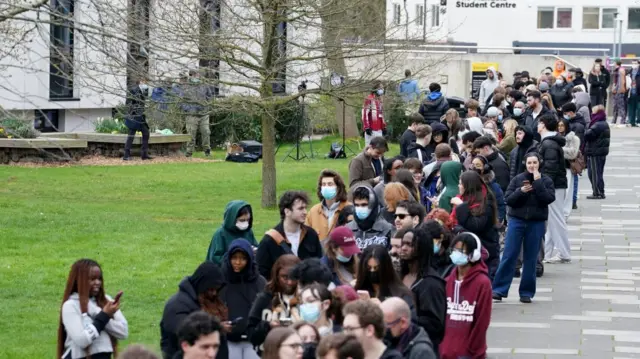
    Students queuing for antibiotics outside a building at the University of Kent in Canterbury on MondayImage source, PA Media
  2. 'Heartbreaking to know a vaccine could have saved our daughter's lives'published at 09:52 GMT 17 March

    Lee draper wearing a white top and grey jacket, Helen wearing a striped black and white blouse. Both are wearing glasses.

    Helen and Lee Draper lost their daughter Meg to meningitis in October 2025. She was a student at Bournemouth University.

    Speaking to BBC Breakfast, Helen says seeing the outbreak in Kent is "absolutely tragic" and recalls the moment she first found out her daughter was unwell.

    "Megan had called us on the Friday night to say she was feeling a bit lethargic, she didn't really want to go out that evening. That rang alarm bells with us because Megan always wanted to go out and socialise, so that was the first point. She'd gone to bed, she'd woken up in the morning and she was nauseous and she had a rash on her stomach".

    Later the next day she'd felt really unwell, the rash had spread, so her parents urged her to call 111. They then told her to go to A&E to seek medical help.

    Meg's father Lee says it's important for parents to be aware "the meningitis vaccinations that [their children] have doesn't cover them against all strains". That's where communication has been "really poor over the years".

    "We assumed that Megan had had a meningitis vaccination, and to us we sent her off to university thinking that," he says it was only afterwards that they'd found out she wasn't vaccinated against the strain she had - meningitis B.

    MenB jabs are offered freely on the NHS to all babies born on or after 2015. Anyone else looking to get vaccinated against this strain needs to pursue it privately, through high street pharmacies.

    "It's heartbreaking to find out afterwards that there was a vaccine available, we just weren't aware that she needed it," Lee says.

  3. UKHSA deputy director denies there has been a delay in responsepublished at 09:39 GMT 17 March

    A senior figure in the UK Health Security Agency denies there was any delay in responding to the outbreak.

    One of the organisation's deputy directors Dr Gayatri Amirthalingam tells Radio 4's Today programme initial cases were reported to the UKHSA on Saturday 14 March.

    More came forward the following day and the public warning was made on the evening of Sunday 15 March.

    "Early on, there were only individual cases and it actually needs further detailed follow-up with those cases to work out the links between [them]," she says.

    She says it can be "difficult" to do this with some of the patients who are "extremely unwell" in hospital but says, "those individuals who were in closest contact with the cases were contacted immediately and were offered preventative antibiotics as we would expect with any outbreak of meningococcal disease".

    "On reflection, people in the local teams acted very, very quickly... I don’t believe there’s been any delay in terms of the public health response," Dr Amirthalingam adds.

  4. What is the significance of MenB?published at 09:22 GMT 17 March

    James Gallagher
    Health and science correspondent

    There are different types of bacterial meningitis caused by different strains of bacteria.

    Meningitis B, or MenB, is now the most common in the UK - accounting for over 80% of invasive infections - since vaccination made other forms much rarer.

    Group B bacteria are not a single strain, but encompass many different forms of meningococcal B bacteria.

    There is a vaccine given to babies that protects against the most common, but not all, group B bacteria.

    Since it was introduced in 2015, MenB infections have been reduced by around 75% in those immunised.

    However, anyone over the age of 11 has not been protected unless their parents paid for the vaccine privately.

    The risk from MenB is highest in very young children and older teenagers and young adults - often linked to going to university.

    However, a vaccination campaign for teenagers was not considered to be cost-effective. This is because the vaccine is expensive and does not stop you spreading the infection, but rather stops you getting seriously ill.

    Vaccines can be used to help control an outbreak, but health officials will need to know if available vaccines match the specific type of group B that is spreading.

  5. How the last few days unfoldedpublished at 09:16 GMT 17 March

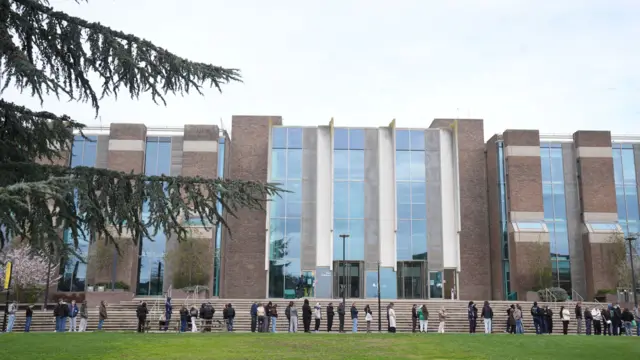
    Students queuing for antibiotics outside a building at the University of Kent in CanterburyImage source, PA Media

    We now know the meningitis strain responsible for cases in Kent, but let's take a look at what has happened in recent days:

    Sunday 15 March

    • The UK Health Security Agency (UKHSA) says two people have died in a meningitis outbreak in the Canterbury area of Kent
    • The UKHSA says it was notified of 13 cases with signs and symptoms of meningitis and septicaemia from Friday to Sunday in the Canterbury area
    • The health agency contacts more than 30,000 people, including University of Kent students, staff and their families

    Monday 16 March

    • An 18-year-old sixth form pupil is named as one of the young people who died from meningitis. Juliette's father tells the BBC the family are "beyond devastated and they have no words to express their loss"
    • A 21-year-old University of Kent student is confirmed as the other person who died from the disease
    • Close contacts of those infected are offered prophylactic antibiotics as a "precautionary measure", with hundreds queuing up at the university's Canterbury campus
    • NHS Kent and Medway say those who visited Club Chemistry on March 5, 6 and 7 are eligible for free medication
    • Three schools in Kent - Simon Langton Grammar School for Boys, Queen Elizabeth's Grammar Faversham and Norton Knatchbull School - confirm cases

    Tuesday 17 March

    • The strain behind cases in Kent has been identified as Meningitis B, the UKHSA tells the BBC
  6. How does meningitis spread?published at 08:20 GMT 17 March

    Some people carry bacteria in their nose or throat without getting sick, but spread it to others in spit or saliva through coughs and sneezes, kissing and sharing utensils.

    The infection can also be spread by someone with meningitis, although this is less common.

    It's possible to get meningitis more than once.

    We understand the outbreak in Kent is thought to be linked to a social event in Canterbury, which some of those who fell ill attended.

    Outbreaks of meningococcal disease are rare, but can occur in settings where people group together, such as university campuses.

  7. People already queuing for antibiotics this morningpublished at 07:58 GMT 17 March

    Simon Jones
    Reporting from the University of Kent

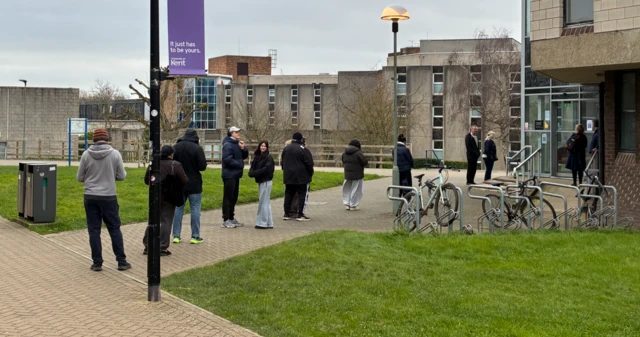
    People queue outside a clinic

    People have started arriving for the clinic to get antibiotics at the University of Kent - even though it doesn’t open for another hour.

    It reflects the ongoing concerns of students - and now we know just how deep that goes: around 1,300 doses were given out yesterday.

    Today more clinics will be opened in Canterbury and Broadstairs.

    These are aimed at people who went to a club, called Club Chemistry, on 5, 6 and 7 March.

    The additional clinics don’t signify that new cases have arisen, but they do show the authorities are keen to get on top of this outbreak - just like the students here are too.

  8. Outbreak is still contained in Kent - health officialpublished at 07:47 GMT 17 March

    Let's get a little more from the UK Health Security Agency's Dr Gayatri Amirthalingam, who has been speaking to BBC Radio 5 Live.

    "As serious and devastating as this current outbreak is, it’s very much contained in the local area in Canterbury and Kent, we’re not seeing this spread more widely," she says.

    She adds that the disease doesn’t spread easily: "It really requires very close, prolonged contact or intimate contact such as kissing."

  9. Has the health agency been too slow to act?published at 07:43 GMT 17 March

    The UK Health Security Agency says its response to the MenB outbreak has been "very swift", after some raised questions about the speed of response.

    Dr Gayatri Amirthalingam, from the agency, tells BBC Radio 5 Live the first cases were identified on Saturday.

    Pressed on whether officials reacted quick enough, she says "absolutely".

    She says the initial cases "were taken extremely seriously", with local public health teams immediately "identifying the closest contacts who would benefit from preventative antibiotics".

    Dr Amirthalingam says the pace of this outbreak is “certainly unusual”, with several cases appearing in a short period of time.

  10. Routine jabs against Meningitis B are relatively new - older teens aren't vaccinatedpublished at 07:24 GMT 17 March

    Hugh Pym
    Health editor

    The UK Health Security Agency has confirmed that the strain of the disease identified in Kent is Meningitis B.

    MenB is the most common cause of meningococcal meningitis in the UK, experts say.

    Routine vaccination against Men B for babies and young children was rolled out from 2015, so the current generation of students and others in their late teens would not have been covered.

    Children aged 13 or 14 are offered vaccination against other meningitis strains in a programme run through schools.

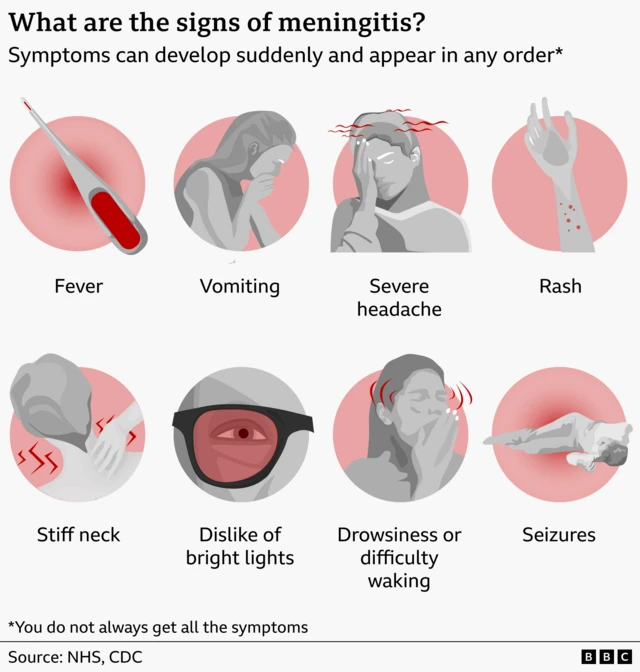
  11. What is meningitis - and what are the symptoms?published at 07:14 GMT 17 March

    Meningitis is an infection of the protective membranes that surround the brain and spinal cord.

    It can affect anyone but is most common in babies, young children, teenagers and young adults. It can be very serious if not treated quickly.

    Bacterial meningitis is rarer but more serious than viral meningitis - officials have confirmed the strain in Kent is the group B bacteria.

    It can lead to blood poisoning or sepsis, and can affect the brain.

    An infographic titled “What are the signs of meningitis?” listing symptoms that can appear suddenly and in any order. It includes illustrations for: fever shown with a thermometer; vomiting depicted by a person leaning forward; severe headache shown with red lines around the head; a rash on an arm; a stiff neck illustrated by someone touching their neck; dislike of bright lights shown with an eye shielded by a dark band; drowsiness or difficulty waking shown with a person resting a head on a hand; and seizures illustrated by a figure lying on their side. Text at the bottom notes: “You do not always get all the symptoms.” Sources: NHS, CDC
  12. Strain of meningitis behind Kent outbreak is group B, UKHSA tells BBCpublished at 07:03 GMT 17 March
    Breaking

    The UK Health Security Agency (UKHSA) tells the BBC that the strain of meningitis behind the cases identified in Kent is group B - known as MenB.

    We'll bring you more on this shortly.

  13. Two dead after meningitis outbreak in Kentpublished at 21:06 GMT 16 March

    Freya Scott-Turner
    Live reporter

    A queue of studentsImage source, PA Media
    Image caption,

    People queue for antibiotics at the University of Kent in Canterbury

    A meningitis outbreak in Kent has claimed the lives of two young people, and put the community on high alert.

    One of the dead has been named as 18-year-old Juliette, a Year 13 student. Her family say they are "beyond devastated and they have no words to express their loss".

    A student at the University of Kent has also died.

    The university has cancelled in-person exams this weeks and the student union has called off events. Hundreds of students and others queued at the campus on Monday to receive precautionary antibiotics.

    A grammar school for boys is the third Kent school to confirm a meningitis case, after a school in Ashford said that one of its Year 13 students had been admitted to hospital.

    According to the UK Health Security Agency (UKHSA), 11 people are in hospital due to the Kent outbreak.

    Meanwhile, the owner of nightclub Club Chemistry in Canterbury says that someone who'd been at the venue - likely between the 5 and 7 March - had a confirmed diagnosis of meningitis.

    As a precaution, the NHS is urging people who visited the nightclub that weekend to come forward for antibiotics.

    The UKHSA says it is "monitoring the situation closely", telling the university and the wider community to stay "alert to the signs and symptoms".

    We're ending our live coverage here, but you can keep up-to-date with the latest on the meningitis outbreak in our news story.

  14. More than 2,000 people visited nightclub over weekend linked to meningitis case, says ownerpublished at 20:50 GMT 16 March

    Club Chemistry in CanterburyImage source, PA Media
    Image caption,

    Club Chemistry in Canterbury

    As we've been reporting, the NHS is urging people who visited the Club Chemistry nightclub in Canterbury between 5 and 7 March to get antibiotics, after the venue was linked to a confirmed meningitis case.

    The club's owner Louise Jones-Roberts says more than 2,000 people would have visited the venue between 5 and 7 March.

    "I wouldn't have opened this weekend if I'd known, but I didn't know," Jones-Roberts tells Press Association.

    "I'm devastated for the families affected. It's so incredibly sad," she adds. "I just really hope people know the symptoms and no more lives are lost."

    The club will remain close until further notice, she says.

  15. How high is the uptake of meningitis vaccines?published at 20:41 GMT 16 March

    Philippa Roxby
    Health reporter

    About 73% of 13-year-olds were vaccinated against meningitis (MenACWY vaccine) last year in England. Among 14-year-olds, uptake was 75%.

    The figures dropped off during the pandemic and have risen again - but around a quarter of teenagers still aren't protected against a potentially very serious infection.

    When young people and students are mixing and in close contact - in halls of residence, at parties and other social events, for example - the bacteria can spread more easily.

    Uptake of the MenB vaccine doses in babies is higher - latest figures show 90% of children in England have had the jab.

    It's not clear the particular strain of meningitis behind this Kent outbreak and health officials will be trying to pin that down quickly.

    The vaccines are very effective and help protect against many different types of meningitis, but not all - which is why health experts say it's important to know the signs and symptoms even if you're vaccinated.

  16. UKHSA confirms 13 cases recorded in Kent so farpublished at 19:59 GMT 16 March

    Echoing an update we received a little earlier from NHS Kent and Medway, the UK Health Security Agency (UKHSA) says that anyone who visited the Canterbury nightclub Club Chemistry on March 5, 6 or 7 should "come forward for preventative antibiotic treatment as a precautionary measure".

    The number of confirmed cases remains at 13, according to the update.

    Trish Mannes, the UKHSA's regional deputy director for the south east, says that “investigations have identified that some cases visited Club Chemistry in Canterbury" on those three dates.

    "It is important that anyone who visited the club between 5th and 7th March now comes forward," she says.

    The UKHSA says it acted as soon as it was notified of a sudden rise in cases in the south east.

    "UKHSA was notified of a cluster of cases late on Saturday. We acted immediately and communication to those at risk took place on Saturday evening and Sunday," a spokesperson says.

  17. Family shares photo of A-level student who diedpublished at 19:26 GMT 16 March
    Breaking

    Nick Johnson
    Reporting from Kent

    The BBC has been given permission to share this picture of 18-year-old Juliette, a sixth form student who died after contracting meningitis.

    Her father tells the BBC that the family are "beyond devastated and they have no words to express their loss."

    Her family has requested her surname not be publicised.

    Earlier, we heard from Amelia McIlroy, the headteacher at her school, who said Juliette "embraced everything the school had to offer and was genuinely caring".

    A picture of JulietteImage source, Supplied
    Image caption,

    Juliette's family have given the BBC permission to share this picture of her

  18. 'I had infection at uni - more needs to be done'published at 19:01 GMT 16 March

    James Kelly
    UGC Hub

    Matt Woolford smiles upwards at the cameraImage source, Matt Woolford

    Matt Woolford, 25, from Reading, suffered a life-threatening meningococcaemia infection when he was at university.

    Following on from news of the Kent outbreak today, Woolford tells the BBC "more really needs to be done".

    "From the John Radcliffe Hospital in Oxford, I was sent back to my university halls prematurely, confused and still severely ill resulting in the UKHSA having to contact my flatmates," he explains.

    "I was told that these outbreaks happen regularly at universities.

    "I then asked about vaccines. Most people my age have their MenACWY vaccine. None have been given MenB [because of] cost effectiveness and so the NHS says they will only give this out to young children.

    "That is simply not good enough, and more people will die the longer awareness isn’t raised, and people aren’t vaccinated."

  19. Families join students queuing for antibiotics at universitypublished at 18:47 GMT 16 March

    A long line of people outside a university building.Image source, PA Media

    As we've been reporting, people have been queuing throughout the day at the University of Kent to collect antibiotics.

    A mix of ages and young families with buggies have been among those lining up for medicine there, the Press Association reports.

    Dan Turner brought his two children, aged one and two years old, and partner to get antibiotics after calling NHS advice line 111 on Monday afternoon.

    The 40-year-old says his stepdaughter's sister had been rushed to hospital with a suspected case of meningitis and the family were told to get checked out.

    "Better to be safe than sorry," he says.

    Some waiting in line were seen wearing masks, carrying shopping bags, while others could be seen sharing vapes elsewhere, PA reported.