Summary

  • This live coverage has finished - follow this link for the latest updates

  • US Secretary of State Marco Rubio says America is not at war with Venezuela, a day after US strikes on the country

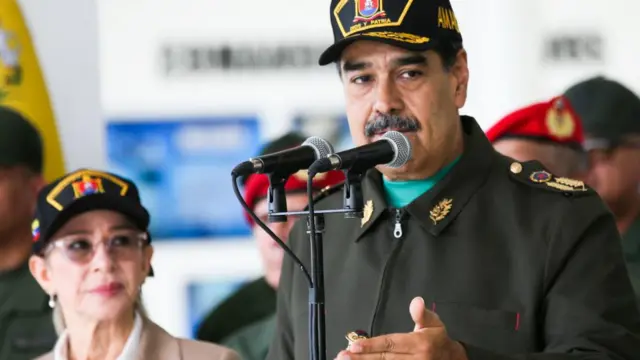
  • Venezuelan President Nicolás Maduro and his wife Cilia Flores, who were captured by the US, are set to appear in court on Monday, according to a spokesperson

  • Venezuela's Defence Minister Vladimir Padrino says a large part of Maduro's security team and "innocent civilians" were killed in the US operation

  • Venezuela has denounced the "military aggression", and the army says it backs interim President Delcy Rodríguez

  • This is important because it is a confirmation that - despite Donald Trump saying the US will now run the country - Maduro's allies are still in charge, writes our South America correspondent

  • Donald Trump tells The Atlantic that Rodríguez will "pay a big price" if she "does not do what is right". The president also told reporters aboard Air Force One that Venezuela was "our area" invoking the Monroe Doctrine

  • Venezuelans have been sharing their worries about the uncertainty and prospects for a peaceful transition of power with the BBC

  1. Is Trump's extraction of Maduro legal - and can he really run Venezuela?published at 12:50 GMT 4 January
    Katie Williams
    Live reporter

    I've just been speaking with Marc Weller, director of the international law programme at the think tank Chatham House.

    I asked him about the legality of Maduro's extraction, and whether the US can legally "run" Venezuela - a word used by Donald Trump yesterday.

    Weller says the US position is that it can claim jurisdiction over drugs trafficking and apply criminal law, even if the act is committed by a foreigner abroad.

    The question is whether this has been "tainted" by how Maduro was taken, he says, describing yesterday's operation as an "armed invasion".

    The position of the US is that it doesn't matter how they get the suspect into court, he says, even if it is done through "internationally unlawful means", such as "abduction from a foreign jurisdiction".

    The international position is different.

    In international law, there is "no legal justification for use of force", either to "apprehend a drug suspect" or to "advance democracy in Venezuela", Weller says. The only available justification would be a UN mandate, which was not given, or self defence, he adds.

    Meanwhile, Weller calls the proposal that the US will run Venezuela "very odd". It is "difficult to find a legal label that describes that arrangement," he says. For now, it does not seem to refer to armed occupation, but rather to “ongoing political interference" backed by the "threat of further US force”, he says.
  2. Watch: Aftermath of US strike on Venezuelan airbasepublished at 12:21 GMT 4 January

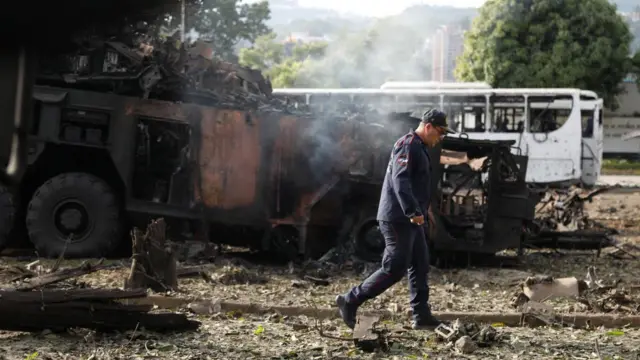
    We've just reported on new images shared with CBS showing charred vehicles in Caracas following US strikes on Venezuela's capital.

    We can also now bring you some footage from Saturday of the aftermath at an airbase in Caracas, watch below:

  3. Pressure could mount on US allies if civilians hit in Venezuela strikespublished at 12:00 GMT 4 January

    Ione Wells
    South America correspondent

    The Venezuelan government accused the US of hitting some civilian areas in Saturday’s strikes and has said it is collating figures of casualties and deaths.

    The New York Times has reported that an apartment complex was hit, that an older woman was killed and others injured, and that there have been at least 40 casualties - although it is not clear whether these are civilians or military targets. The BBC has not been able to independently verify these reports.

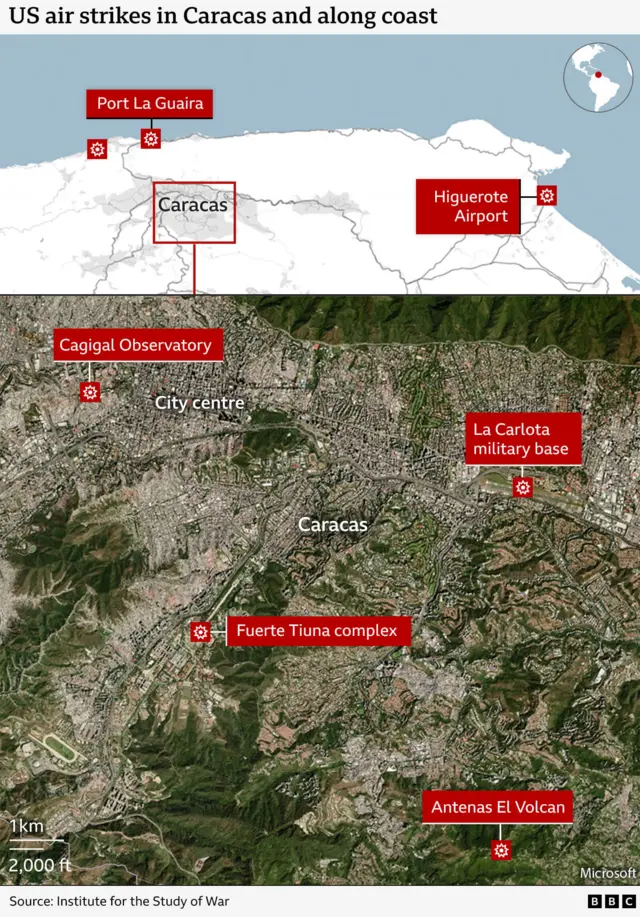
    A map showing US air strikes in Caracas and along the Venezuelan coast. The top section show map of northern Venezuela with Caracas marked, along with Port La Guaira and Higuerote Airport. The bottom section is a detailed satellite view of Caracas, highlighting key locations targeted: Cagigal Observatory near the city centre, La Carlota military base to the east, Fuerte Tiuna complex to the south, and Antenas El Volcan further southeast.

    If it is confirmed there have been civilians hit in these strikes that will heap more pressure on the US’s allies - some of whom are weighing up how they respond to this.

    Some, like the UK government, don’t have much sympathy for President Maduro, but also haven’t openly welcomed his removal. Some of the US’s critics have openly accused it of breaching international law.

  4. Charred vehicles in Caracas - images show aftermath of strikespublished at 11:49 GMT 4 January

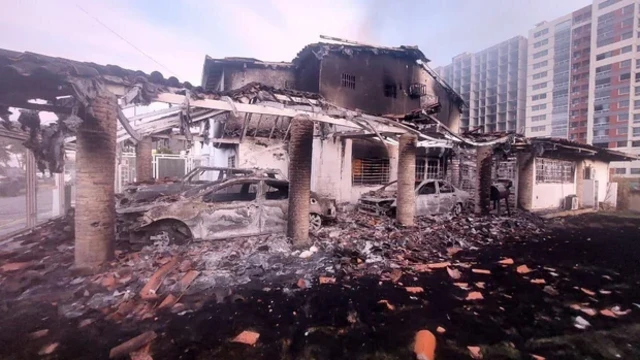
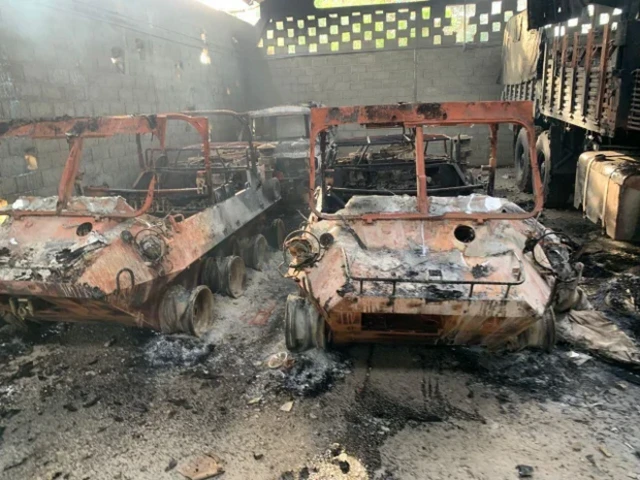
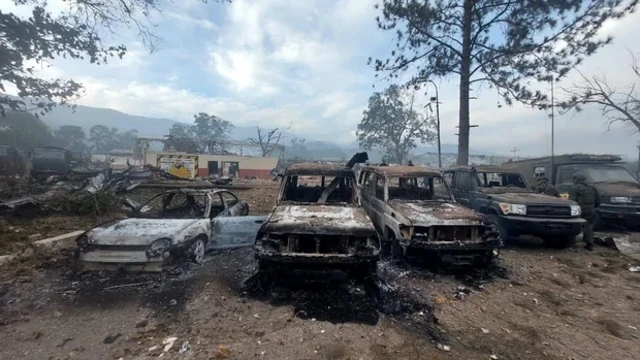
    Images shared with CBS News, the BBC's US partner, show the aftermath of US air strikes on Saturday at Fuerte Tiuna, a key military facility in Caracas.

    In our next post, our South America correspondent will take us through what the implications could be for the US, and its allies, if civilians have been hit in the strikes.

    Burned vehicles and damaged structures following US airstrikes at Fuerte TiunaImage source, CBS News
    Burned vehicles and damaged structures following US airstrikes at Fuerte TiunaImage source, CBS News
    Burned vehicles and damaged structures following US airstrikes at Fuerte TiunaImage source, CBS News
  5. Analysis

    Maduro's allies still run Venezuela, despite Trump's claimspublished at 11:30 GMT 4 January

    Ione Wells
    South America correspondent

    Venezuela’s interim president Delcy Rodríguez is - and was - part of Maduro’s inner circle of loyalists. She was sworn in by the Supreme Court, also loyal to Maduro’s movement and packed with loyalists.

    It is worth stressing that despite Donald Trump’s claims that the US is going to “run” Venezuela - it is still Maduro’s allies, not the US, in charge.

    Despite Rodríguez saying that Venezuela would defend itself, Trump seemed to suggest she would work with the US to, for example, allow more US access to Venezuelan oil reserves.

    So, what does the US mean?

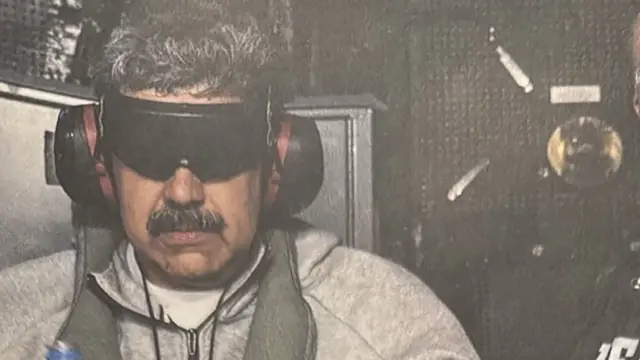
    It hasn’t got boots on the ground yet, although Trump hasn’t ruled that out. But it does have another form of control right now - it has dangled an image of Maduro being dragged to the US blindfolded to detention in front of the loyalists who remain.

    Maduro loyalists will be acutely aware they could be next if they don’t do what the US wants. On paper they are in power, but will they feel they can say no to the US?

  6. 'It's calm in Caracas day after strikes, but we want to live without fear'published at 11:08 GMT 4 January

    Shaun Ley
    Live reporter

    A resident of the Venezuelan capital, Caracas, has told the BBC that people in the country "just want to live without fear".

    The woman, who asked not to be named on air, told Newshour that what was important was "not oil, but the freedom of Venezuela and a better future for ourselves".

    Nobody would have chosen this way for a political transition, but something needed to happen".

    She said that the situation in the city on Saturday had been "very calm with no visible police or army presence in the street".

    She added that there was a feeling of "uncertainty but no celebrations whatsoever or protests".

  7. Analysis

    Trump pledged to stop wars, not start them - so what's next for Venezuela?published at 10:56 GMT 4 January

    Lyse Doucet
    Chief international correspondent

    As always in these moments, the question remains: what's next? What happens "the day after?"

    On this, there is great ambiguity, uncertainty - and risk. President Trump’s first vague comments have stunned many in the US and far beyond.

    In his words, the US will “run Venezuela” until there is a “safe, proper and judicious transition”.

    He hinted that conversations have already taken place with Maduro’s allies and officials who remain in power including Vice-President Delcy Rodríguez who has now been appointed in Caracas as acting president.

    Trump described their response as “gracious".

    Their own statements have been far from warm and welcoming.

    "We are not going to be a colony of an empire,” Rodriguez declared, insisting there was only one Venezuelan president - Nicolás Maduro.

    In another comment which stunned many, Trump also dismissed the Venezuelan opposition - including Nobel laureate María Corina Machado, who had heaped praise on the US president and said he deserved her peace prize.

    So how will a “transition” happen? The Venezuelan military was a bulwark of Maduro's regime; how will they move in this moment?

    Trump also indicated he was not worried if there had to be US “boots on the ground.”

    All his statements mark a reversal of what he vowed not to do in his second term in power - a pledge to be a president who would stop wars, not start them.

  8. Maduro's indictment and allegations against him - what you need to knowpublished at 10:47 GMT 4 January

    Maduro speaks into mic next to his wifeImage source, HANDOUT
    Image caption,

    Maduro (R) pictured with his wife Cilia Flores

    US Attorney General Pam Bondi yesterday outlined the charges brought against the Venezuelan President and his wife Cilia Flores.

    Nicolás Maduro has been charged with "Narco-Terrorism Conspiracy, Cocaine Importation Conspiracy, Possession of Machineguns and Destructive Devices, and Conspiracy to Possess Machineguns and Destructive Devices against the United States".

    Later, US President Donald Trump summed these charges up as Maduro's "campaign of deadly narco-terrorism" against the US and its citizens.

    Maduro has previously denied being the leader of a drug cartel.

    He also called Maduro an "illegitimate dictator", adding that he had asked the Venezuelan leader to "surrender" a week before the strikes.

    Bondi says that Maduro and his wife will "face the full wrath of American justice on American soil in American courts".

    The pair are now in custody at a New York detention centre where they will appear in court as soon as Monday.

  9. 'Mixed bag of reactions to interim government in Venezuela' - former UK envoypublished at 10:21 GMT 4 January

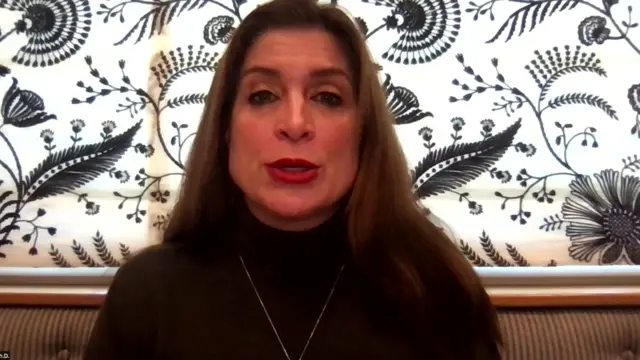
    Vanessa Neumann, former Venezuelan opposition envoy to the UK, speaks to BBC News

    Vanessa Neumann, former Venezuelan opposition envoy to the UK, tells BBC News there is a lot of confusion in Venezuela today about what is meant by the term "interim government".

    She says the reaction to Trump's attack on the country and the charges later brought against President Maduro has been a "mixed bag".

    Neumann says the image of Maduro on the USS Iwo Jima on his way to New York has "inspired a lot of hope" for some Venezuelans. But she adds there is also frustration that Trump "dissed" opposition leader Machado by claiming she is not popular.

    We've taken a closer look at the division of opinions within Venezeula.

    Neumann tells the BBC she doesn't necessarily believe the new interim president, Delcy Rodríguez, is an improvement. She adds that there is a risk that hard-line players could "betray" her and "take her place" if she co-operates with Trump.

    If this happens, Venezuelans are no better off, she says, adding that "repression and torture are still on the books for Venezuelans".

  10. Trump's plans to run Venezuela remain unclearpublished at 09:54 GMT 4 January

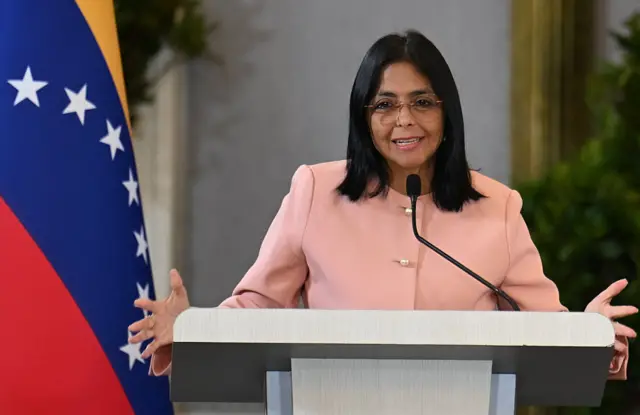
    Venezuela's Vice President Delcy Rodriguez.Image source, Getty Images
    Image caption,

    Venezuela's Vice-President Delcy Rodriguez

    Trump said on Saturday the US was going "to run the country until such time as we can do a safe and proper and judicious transition".

    It is unclear exactly how the US plans to run Venezuela or who will be involved, but Trump said it would be a "group" effort.

    He added that US Secretary of State Marco Rubio had been talking to Delcy Rodríguez, Venezuela's vice-president, who has since been named interim president by Venezuela's Supreme Court.

    Trump said she had expressed her willingness to do "whatever the US asks".

    Rodríguez later appeared on state television to demand Maduro's release, saying he was the "only president".

    Trump also said he had not spoken to Venezuela's opposition leader María Corina Machado, who he characterised as having neither the support nor the respect within Venezuela to become its leader.

    Machado had earlier called for Edmundo González to assume power. She had rallied support for González in the 2024 presidential election and vote tallies released by her party suggest he won by a landslide.

    In our next post, we'll bring you comments on Rodríguez from former Venezuela opposition envoy to the UK Vanessa Neumann. Stay with us.

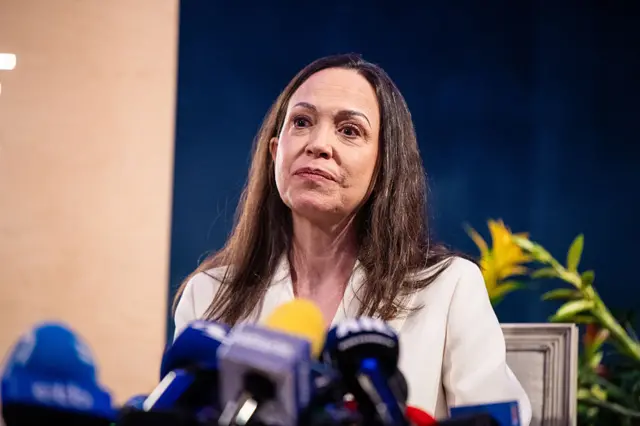
    Maria Corina Machado.Image source, Getty Images
    Image caption,

    Venezuela's opposition leader María Corina Machado

  11. Where is Maduro now and what's next for him?published at 09:07 GMT 4 January

    Image of captured Venezuelan President Nicolas Maduro on board the USS Iwo Jima, shared by Donald Trump on Truth SocialImage source, @realDonaldTrump/Reuters

    After his arrest in Venezuela, Maduro was flown out of Caracas on a US helicopter and taken aboard the USS Iwo Jima, where he appeared in a photograph - shared by Donald Trump on Truth Social.

    He was then taken to New York via Cuba - here's a full breakdown of his journey.

    After arriving in New York, he was taken to the offices of the US Drug Enforcement Administration (DEA). The below video shows him arriving in the US and being escorted through the DEA:

    Maduro has since been transferred from the DEA office in Manhattan to Brooklyn's Metropolitan Detention Center.

    The Venezuelan president is expected to appear in court on drugs and weapons charges, which could happen as soon as Monday.

    He has previously denied being the leader of a drug cartel.

  12. Why Trump has targeted Venezuela - in 170 wordspublished at 08:38 GMT 4 January

    A firefighter walks past a destroyed anti-aircraft unit at La Carlota military air base.Image source, Reuters

    There has been a build up of pressure on the Venezuelan government since Trump began his second term in office last January.

    First, the Trump administration doubled the reward it offered for information leading to the capture of Maduro.

    In September, US forces began targeting vessels it accused of carrying drugs from South America to the US.

    There have been more than 30 strikes on such vessels in the Caribbean and the Pacific since then, killing more than 110 people.

    The Trump administration blames Maduro for hundreds of thousands of Venezuelan migrants entering the US.

    Without providing evidence, Trump accused Maduro of "emptying his prisons and insane asylums" and "forcing" its inmates to migrate to the US.

    The US president also claims the Venezuelan government is allowing oil money to fund drug-related crime, alleging that Maduro himself is a cartel leader.

    Maduro vehemently denies this and accuses the US of using its "war on drugs" as an excuse to try and overthrow him and access Venezuela's vast oil reserves.

  13. Trump assumes US will keep Venezuela's oil - how much do they have?published at 08:13 GMT 4 January

    Vanessa Buschschlüter
    Latin America editor

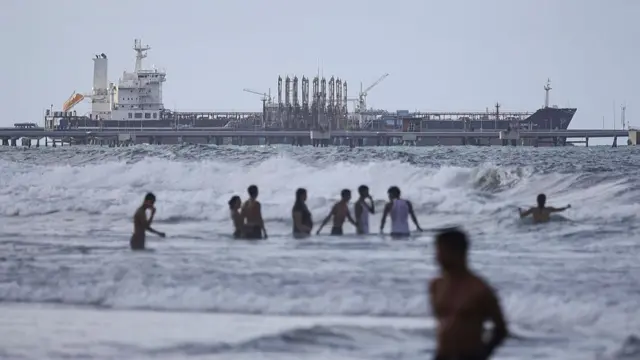
    An oil tanker anchored in Puerto Cabello off the coast of VenezuelaImage source, Getty Images
    Image caption,

    An oil tanker anchored in Puerto Cabello off the coast of Venezuela

    Maduro has long accused the Trump administration of attempting to depose him so the US could gain control of Venezuela's oil riches, pointing to a remark Trump made after the US seized the first oil tanker off Venezuela's coast.

    When quizzed by reporters as to what would happen with the tanker and its cargo, the US president said: "I assume we're going to keep the oil."

    However, US officials have previously denied Venezuela's allegations that moves against Maduro's government were an attempt to secure access to the country's untapped reserves.

    As my colleague just reported, Venezuela has the world's largest proven crude oil reserves and profits from the oil sector finance more than half of its government budget.

    However, its exports have been hit by sanctions and a lack of investment and mismanagement within Venezuela's state-run oil company.

    In 2023, Venezuela produced only 0.8% of global crude oil, according to the US Energy Information Administration (EIA). It currently exports about 900,000 barrels per day and China is by far its biggest buyer.

  14. Whatever the future holds for Venezuela, oil is likely to play a key rolepublished at 08:03 GMT 4 January

    Marc Ashdown
    Business correspondent

    Trump has made clear he wants US access to Venezuela’s oil fields.

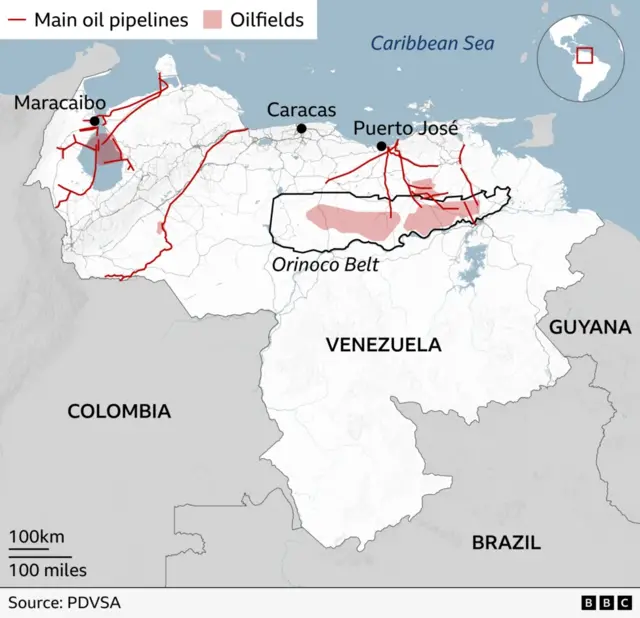
    Venezuela’s oil reserves are estimated to total more than 300 billion barrels - the largest on earth.

    It is primarily extra-heavy crude, costly and difficult to extract, yet Venezuela remains the world’s fifth largest exporter.

    Even with the growing number of US navy vessels being stationed in Caribbean Sea, last month still saw nearly a million barrels a day flowing to China, southern Europe and the US.

    Production has been hit in recent years by political unrest. And for decades, the country's state-owned oil and natural gas company – Petroleos de Venezuela – has been hit by strikes and accusations of poor safety standards.

    The US has accused President Maduro of using oil money to fund drug-trafficking. Maduro has accused Washington of being intent on taking control of his country’s oil reserves.

    The oil fields seem to have escaped any damage from the air strikes for now, but whatever the future holds for Venezuela, its oil industry is likely to play a key role.

    A map showing Venezuela, with oil pipelines and oilfields marked across the country.
    Image caption,

    With an estimated 303 billion barrels, Venezuela is home to the world's largest proven oil reserves

  15. Maduro in custody, Trump 'running' Venezuela - how did we get here?published at 07:43 GMT 4 January

    Nabiha Ahmed
    Live reporter

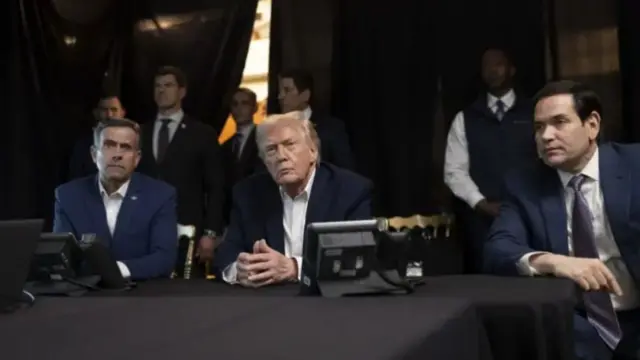
    Three men dressed in shirts and blazers watching into distanceImage source, US GOVERNMENT
    Image caption,

    Yesterday, Trump shared photos appearing to show US officials watching strikes on Venezuela - which he described as being "like a television show"

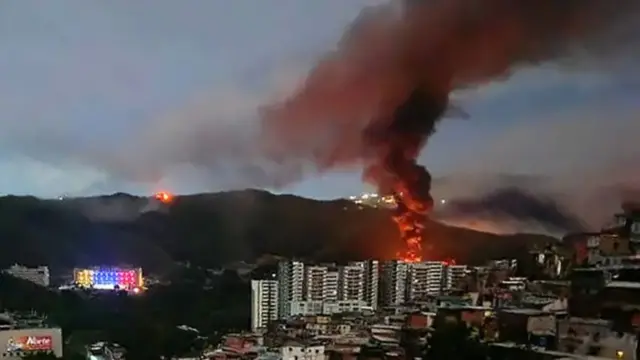
    On Saturday, explosions were heard across Venezuela's capital, Caracas, as early as 02:00 local time (06:00 GMT).

    As the day progressed, updates came in thick and fast - here's a recap:

    • As fires raged and smoke rose above Caracas, President Trump confirmed a "large-scale strike" by the US
    • In a Truth Social post, the US president said that Venezuelan President Nicolás Maduro and his wife Cilia Flores had been captured
    • Venezuela declared a national emergency, as the country's defence minister announced immediate deployment of military forces
    • Later, Trump said in a news conference that the US will run Venezuela, including taking care of the country's oil infrastructure - we'll have more on this shortly
    • Venezuela's Vice-President Delcy Rodríguez vowed the government is ready "to defend" the country, and condemned "armed agression"
    • Maduro and his wife arrived at Brooklyn's Metropolitan Detention Center after landing in New York's Stewart Air National Guard Base

    For some analysis, our correspondents have been unpicking what this all means:

    Fire at Fuerte Tiuna, Venezuela's largest military complex, is seen from a distanceImage source, Getty Images
    Image caption,

    Fire at Fuerte Tiuna, Venezuela's largest military complex, is seen from a distance

  16. 'A lot of uncertainty': Former US adviser on what's next for Venezuela's leadershippublished at 07:05 GMT 4 January

    Evan Ellis, former adviser to the US state department on Venezuela, speaks to BBC News

    Evan Ellis, former adviser to the US on Venezuelan policy, tells the BBC there is "a lot of uncertainty" around what's next for the country's leadership.

    He says the Trump administration appears to be moving into a "new period of coercive negotiation" with Venezuela, rather than an immediate transition to democracy.

    Maduro's Vice-President Delcy Rodríguez has been named interim president but the key question, Ellis says, is whether Trump can work with her.

    It may be difficult for leaders from Maduro's government to give President Trump what he wants, including co-ordination on things like oil, he says.

    Ellis adds though that there could be incentives for Maduro's allies, given the president's detention, to co-operate with the US and "search for deals".

  17. More countries react to Maduro's capturepublished at 06:21 GMT 4 January

    Japan's Foreign Ministry has responded to the US strikes and intervention by reiterating its position as a G7 country, and offering support "toward the restoration of democracy and the stabilisation of the situation in Venezuela."

    Malaysia's Ministry of Foreign Affairs uses stronger language in their response, saying it "opposes all forms of foreign intervention in the internal affairs of other States, as well as the threat or use of force".

  18. What is the 'Donroe Doctrine'?published at 06:04 GMT 4 January

    During Saturday's news conference at the Mar-a-Lago resort in Florida, the US president commented on how the Venezuelan operation advanced his "American First" priorities.

    The action in Venezuela, Trump said, shows that "American dominance in the Western Hemisphere will never be questioned again".

    Trump has said the attack closely aligns with the "Monroe Doctrine" - named after the fifth president of the US, James Monroe, which Trump rebranded the "Donroe Doctrine".

    The Monroe Doctrine was an early 19th Century American foreign policy that asserted the Western Hemisphere should be free from influence by European powers.

    In 1904, when European creditors threatened Latin American countries, then President Theodore Roosevelt expanded the doctrine, allowing the US to step in if the countries could not manage their own stability.

    Over the next two decades, it served as justification for US intervention in Haiti, Nicaragua and the Dominican Republic.

  19. What we know so farpublished at 05:45 GMT 4 January

    If you're just joining us now, here's a quick look at what you need to know to get you up to speed:

    • While Brazil's President Lula described the US's actions as crossing "an unacceptable line" and called on the international community to "respond vigorously"

    Stay with us as we bring you the latest news.

  20. 'Deeply alarmed': The world reacts to Maduro's capturepublished at 05:33 GMT 4 January

    We've been bringing you some of the varied reactions to the US capture of Maduro, from countries around the world. Here are a few more:

    • UK: Prime Minister Keir Starmer said his government would "shed no tears" for the end of Maduro's regime, but refused to be drawn into whether or not the military action may have broken international law
    • Russia: The foreign ministry called on the US "to reconsider their position and release the legitimately elected president of a sovereign country and his spouse", and said there needed to be a "dialogue" between Venezuela and the US
    • China: The foreign ministry said it was "deeply shocked by and strongly condemns the US's blatant use of force" and called on the US to "abide by international law"
    • UN: Secretary General António Guterres said he was "deeply alarmed" and warned of a "dangerous precedent", urging respect for international law