Summary

  • This live coverage has finished - follow this link for the latest updates

  • US Secretary of State Marco Rubio says America is not at war with Venezuela, a day after US strikes on the country

  • Venezuelan President Nicolás Maduro and his wife Cilia Flores, who were captured by the US, are set to appear in court on Monday, according to a spokesperson

  • Venezuela's Defence Minister Vladimir Padrino says a large part of Maduro's security team and "innocent civilians" were killed in the US operation

  • Venezuela has denounced the "military aggression", and the army says it backs interim President Delcy Rodríguez

  • This is important because it is a confirmation that - despite Donald Trump saying the US will now run the country - Maduro's allies are still in charge, writes our South America correspondent

  • Donald Trump tells The Atlantic that Rodríguez will "pay a big price" if she "does not do what is right". The president also told reporters aboard Air Force One that Venezuela was "our area" invoking the Monroe Doctrine

  • Venezuelans have been sharing their worries about the uncertainty and prospects for a peaceful transition of power with the BBC

  1. Analysis

    Who is in charge in Venezuelapublished at 16:36 GMT 4 January

    Daniel Pardo Vegalara
    BBC Mundo

    Interim President Delcy Rodríguez has taken over Maduro’s position with the support of all judicial and political institutions.

    Rodríguez and her brother Jorge, now head of Congress, have been rising figures since Maduro took office in 2013.

    Then there’s Diosdado Cabello, a former army captain close to the late Hugo Chávez, who’s remained a key military and business power broker.

    All of them appear united in denouncing Maduro’s "kidnapping" and seem determined to preserve the power structures of recent years.

    Behind the executive branch, there’s a huge - almost decisive - influence from the military, led by Vladimir Padrino, the commander-in-chief of the Armed Forces.

    Over the last decade, the military has steadily gained power across all areas of life in Venezuela. For now, there’s no sign that this will change.

    Donald Trump has said the US is in charge of the situation in Venezuela, and while it’s very likely he’s negotiating oil-extraction concessions with Rodríguez, on the ground it’s the military that continues to exercise power.

    There, increasingly, illegal armed groups - such as Colombian guerrillas, especially the ELN - have consolidated their power and control over society and drug-trafficking routes. The fight among those groups for territorial control is now likely to resume.

    In reality, the question of who exercises power in Venezuela has never had a single, clear answer.
  2. Venezuelan concerns over 'vague' Trump speech on plans for running the countrypublished at 16:25 GMT 4 January

    Kristina Volk
    BBC World Service

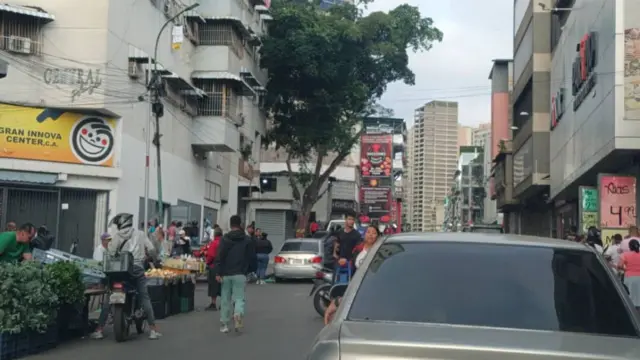
    Streets in Caracas stay calm after Trump's strike on the country

    "A lot of people still feel confused after President Trump's speech," Tomás (not his real name), a Caracas resident, tells me.

    He's concerned about how "vague Trump and his team were about the plans of running Venezuela".

    Tomás is impressed by the operation to oust Maduro and thinks the regime has brought it upon itself, but warns that his country now enters "the most dangerous stage".

    He fears a peaceful transition might be tricky after "three decades of a fierce totalitarian regime".

    And if there isn't a peaceful transition, it's "well known" what can happen, he says.

  3. Caracas vendors working hard to open and not overcharging, local tells BBCpublished at 16:09 GMT 4 January

    Kristina Volk
    BBC World Service

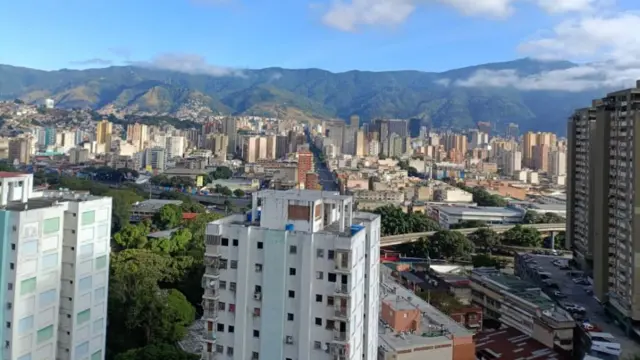
    High rise buildings in Caracas with mountains in the background

    I’ve spoken to Alirio from Caracas, following Maduro’s capture by US forces.

    On Saturday, he was woken by loud explosions. This morning, he went for a drive through his neighbourhood.

    “Things are quiet right now,” he says.

    He went to the market to stock up on some food. With the uncertainty and two children to look after, he says he doesn’t know what will happen next.

    Alirio describes the market as calm and doesn’t think that “Venezuelans will turn against each other”.

    He also says vendors are working hard to stay open for people and not overcharging, and that “things are slowly moving”.

    For the future of his country, he hopes it will “bloom and flourish”.

    “Being isolated from the world is one of the most harmful things that happened to this country. I hope the world will come to Venezuela.”

  4. 'It's a moment of wait and see'published at 15:57 GMT 4 January

    Vanessa Silva
    Reporting from Caracas, Venezuela

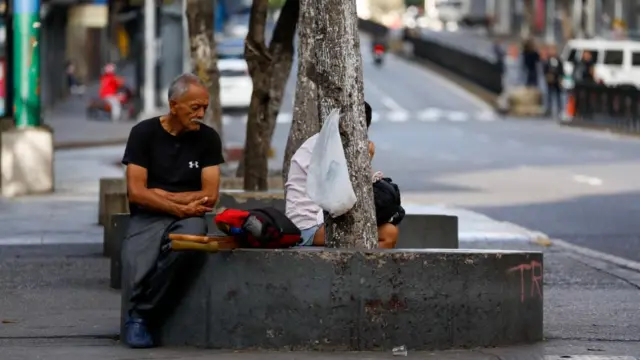
    People sit near a street after the U.S. launched a strike on VenezuelaImage source, Reuters

    It is quiet on the streets of Caracas.

    People in the Venezuelan capital are going on as normal, but there is a mood of expectation, uncertainty and caution.

    The only official information will be through the state TV channel, but they are broadcasting pre-recorded programmes with no news.

    It's a moment of wait and see.

    Delcy Rodríguez and the Venezuelan military are in power, but we are not sure about the conversations they are having with the US.

    The US warns second strikes will happen if they do not co-operate, so we're unsure how this will be for us in the coming days.

  5. What did Rubio say in the US media morning roundpublished at 15:40 GMT 4 January

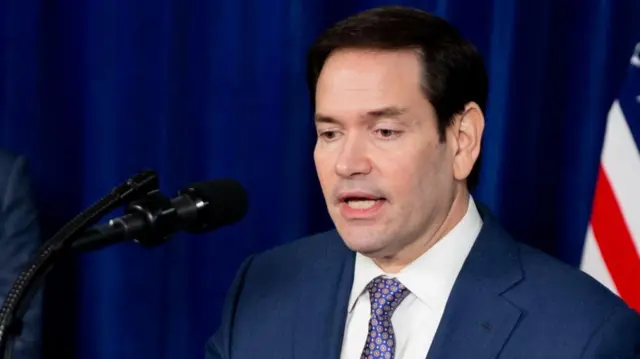
    US Secretary of State Marco RubioImage source, EPA

    As promised, here are the key points from US Secretary of State Marco Rubio, who has spoken to US media outlets this morning.

    • This is "not a war against Venezuela", he says - this follows strikes on the country on Saturday and the extraction of its president, Nicolás Maduro
    • The US will judge Venezuela by "what they do" next, Rubio says, adding that Washington will keep "multiple levers of leverage" to protect its interests
    • Speaking to ABC, Rubio says congressional authorisation wasn't needed before the operation "because this wasn't an invasion"
    • He says that he hopes Maduro's removal will lead to "a better Venezuela", but adds that the "number one objective is America"
    • Asked whether he thinks Interim President Delcy Rodríguez is now the legitimate president of Venezuela, he says the US does not believe the regime is legitimate
  6. Why US did not arrest more members of Maduro's regimepublished at 15:10 GMT 4 January

    In an interview with CBS, Rubio is asked why the US didn't arrest other members of Maduro's regime.

    The US government has offered a reward of up to $25m (£18.6m) for information leading to the arrest or conviction of Interior Minister Diosdado Cabello, and $15m for Defence Minister Vladimir Padrino.

    "It's very simple," Rubio replies. "You're not going to go in and wrap up."

    He says people can only "imagine the howls" the US would have faced if they had stayed in the country longer to capture more people.

    "We got the top priority," he says.

    Here are all the lines we've brought you from Marco Rubio, who spoke to US media earlier. We'll bring you a recap of the key points soon - stay with us.

  7. Rubio says US retains 'levers of leverage' if Venezuela does not make 'right decisions'published at 15:07 GMT 4 January

    Rubio has also been speaking to CBS, where he says the US will judge Venezuela "by what they do".

    According to a transcript of the interview, the secretary of state says: "If they don't make the right decisions, the United States will retain multiple levers of leverage to ensure that our interests are protected."

    That includes the "oil quarantine" in place, he says.

    "We're going to judge everything by what they do, and we're going to see what they do," he adds.

  8. Rubio says US will give Venezuela chance to 'address problems'published at 14:55 GMT 4 January

    Rubio tells NBC he expects to "see more compliance and co-operation from Venezuela".

    He says that, with Nicolás Maduro, the US "could not make a deal or arrangement" despite giving him "very generous offers", adding that Maduro "could have left Venezuela as recently as a week and a half ago".

    "There were opportunities for him to avoid all this," he says.

    The secretary of state says the US is going to give Venezuela "an opportunity to address the problems" raised by Trump's administration.

    Until then, says Rubio, Venezuela will continue to face the oil quarantine, pressure from the US, and have "drug boats" targeted and seized when necessary.

  9. 'Most immediate' changes in Venezuela will be those in US national interest - Rubiopublished at 14:52 GMT 4 January

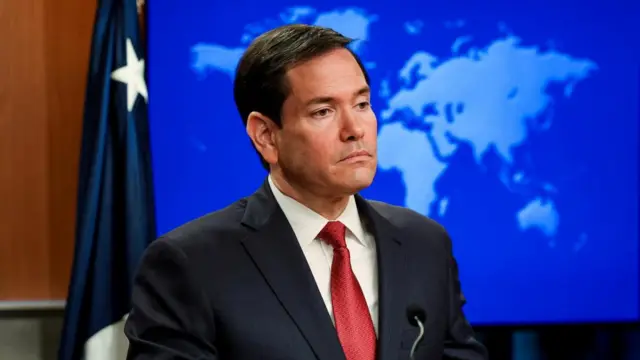
    Marco RubioImage source, Reuters

    Now back to Rubio's appearance on NBC.

    He's asked who's in charge of Venezuela and if he's running the country.

    The secretary says the US "expect to see changes in Venezuela", with the "most immediate" being those "in national interest in US".

    He describes a country where "people in charge of military and police are openly co-operating with drug trafficking organisations".

    Rubio says these are threats to the US that his government intends "to use every element of leverage" to address.

  10. Rubio says informing Congress not necessary as it is 'not an invasion'published at 14:47 GMT 4 January

    In the interview with ABC a few minutes ago, Marco Rubio was asked why congressional authorisation wasn't sought before the US operation in Venezuela.

    Rubio says it "wasn't necessary because this wasn't an invasion".

    He describes it as a "law enforcement operation", and says Maduro was "arrested on the ground by FBI agents".

    You can't notify Congress of an operation like this because "it will leak", he adds.

    He also says "all kinds of conditions" have to line up, such as weather and individuals' movements.

  11. 'That's not a war against Venezuela,' Rubio sayspublished at 14:32 GMT 4 January

    US Secretary of State Marco Rubio is speaking to several US media outlets.

    He has been on NBC, where he was asked if the US is at war with Venezuela.

    "That's not a war," he says.

    "I mean we are at war against drug trafficking organisations. That's not a war against Venezuela."

    He says the seizing of boats "bringing drugs toward the United States" will continue.

  12. US to 'retain all options' if Venezuela does not address migration and drug concernspublished at 14:30 GMT 4 January

    Rubio is asked what happens if American concerns about migration and drug trafficking aren't addressed by Venezuela.

    He says the US will "retain all options we had before the arrest [of Maduro] was made".

    This means sanctioned tankers heading to Venezuela will be seized as permitted by US court orders.

    "I cannot overstate how crippling this is for their future," says Rubio. He stresses that the alternative is "an oil industry that actually benefits the people" and not just a few.

  13. US will judge Venezuela by actions not statements - Rubiopublished at 14:27 GMT 4 January

    Asked about the statement made by Venezuela's interim president Delcy Rodríguez, Secretary of State Marco Rubio says the US is not going to judge by what is said in statements, but rather by what actions are taken.

    He says the US will react based on what Venezuela does, asking if "drugs" will stop coming and if "migration patterns" will change.

    He says those are among the issues America wants addressed, and they will be how the US judges the situation.

  14. Does Rubio think Delcy Rodriguez is the legitimate president?published at 14:27 GMT 4 January

    Rubio is asked if he thinks Interim President Delcy Rodríguez is now the legitimate president of Venezuela.

    He says "this is not about the legitimate president" as the US does not believe the regime in place is legitimate.

    Rubio says he understands there are people in Venezuela today "who are the ones who can actually make changes".

    But he says this is different from recognising the legitimacy of Venezuela's government, which will come from a period of transition and an election.

  15. 'Our number one objective is America,' Rubio sayspublished at 14:23 GMT 4 January

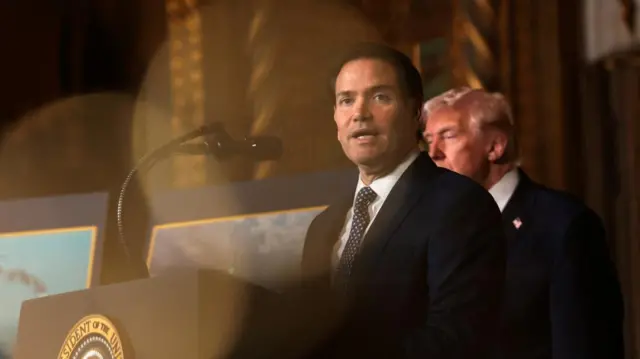
    U.S. Secretary of State Marco RubioImage source, Reuters

    Rubio goes on, saying Maduro is "not the legitimate president of the country", and describes him as "someone we could not work with".

    He says he's "hopeful" there are people in place now who will make changes that lead to "a better Venezuela".

    "But our number one objective is America," he adds, saying he wants "no more drugs" and gangs.

  16. Rubio says 'court orders' is legal authority to take action in Venezuelapublished at 14:21 GMT 4 January

    US Secretary of State Marco Rubio says the US has quarantined Venezuela's oil, which gives them leverage they "intend to use".

    Venezuela is at a "crossroads for many of our adversaries" and that they want to make it "no longer a drug trafficking paradise".

    "Obviously we want a better future for the people of Venezuela," he says, adding that the US wants them to have an oil industry where the wealth goes "to the people".

    He's asked under what legal authority the US has to achieve this.

    "We have court orders... is a court not a legal authority?" he says.

    Asked if the US is running Venezuela, he says the US is "running the direction" that makes things move forward.

    Rubio adds that Venezuela is "running out of storage capacity" and will have to start pumping oil in a few weeks "unless they make changes".

  17. Rubio speaks to the mediapublished at 14:10 GMT 4 January
    Breaking

    US Secretary of State Marco Rubio is speaking to US media outlets.

    Stay with us - we'll bring you the key points.

  18. Analysis

    US says it will run Venezuela, but things there could change quicklypublished at 14:05 GMT 4 January

    Will Grant
    Central America and Cuba correspondent

    The uncertainty continues in Venezuela, particularly in Caracas.

    Venezuelans were ripped from their sleep and they saw these explosions around the city. That is still completely shocking to those who lived through it.

    On top of that, they got the news very shortly after that Nicolas Maduro was taken from power, along with his wife. So people have just been digesting that.

    But things in Venezuela have the capacity to move very fast.

    Donald Trump was saying that the Americans, in essence, were going to run Venezuela - there is no current evidence of that.

    What Venezuelans are seeing is that the former vice president Delcy Rodríguez has now been sworn in as interim president.

    And her declarations to the Venezuelan people were that the legitimate president of Venezuela remains Nicolás Maduro, very much echoing the line you would expect out of the "Chavista" movement.

    Until there is a little more clarity on what the next few months will look like, it remains a period of deep uncertainty, nervousness and concern for all Venezuelans.

  19. Timeline of key moments up to Maduro's capturepublished at 13:45 GMT 4 January

    We've pulled together some of the key moments from Nicolás Maduro becoming Venezuelan president to his capture by the US on Saturday:

    2013: Maduro, a former bus driver and union leader, succeeds left-wing President Hugo Chávez to become president

    2020: The US charges Maduro and 14 members of his inner circle with narco-terrorism, drug trafficking, money laundering and corruption. It also offers a $15m (£12.5m) reward for information leading to Maduro's arrest.

    2024: Maduro is declared winner of the presidential election, even though voting tallies collected by the opposition suggest its candidate, Edmundo González, won by a landslide

    2025: In January, the US increases its reward for information leading to Maduro's arrest to $25m (£20.40m). This reward is then doubled in August to $50m (£37.2m)

    February 2025: Donald Trump says in a post on Truth Social that Venezuela has agreed to take back migrants who had come to the United States irregularly

    September 2025: The US launches strikes on what it says are drug-smuggling boats, targeting vessels in the Pacific and the Caribbean. Between September and December, more than 100 people were killed in the strikes.

    October 2025: Trump authorises the CIA to conduct covert operations inside Venezuela. Maduro addresses the "people of the United States" in a television address, saying "no war, yes peace"

    January 2026: The US strikes Venezuela and captures Maduro and his wife Cilia Flores. The couple are flown to a detention centre in New York where they are charged with weapon and drug offences. Maduro has previously denied being the leader of a drug cartel

  20. Pope Leo says welfare of Venezuelans must prevailpublished at 13:22 GMT 4 January

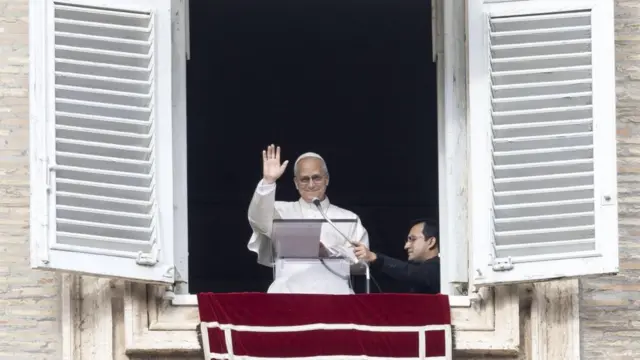
    Pope Leo waves through an open window as he stands behind a micImage source, MASSIMO PERCOSSI/EPA/Shutterstock

    The day after President Nicolás Maduro was captured by US forces, Pope Leo has urged that needs of Venezuelans must come before all else.

    Addressing crowds at the Vatican following Sunday prayer, the Pope - who spent around two decades as a missionary in Peru - said: "The good of the beloved Venezuelan people must prevail over any other consideration."

    Pope Leo - the first American pope - stressed the importance of "guaranteeing the sovereignty" of Venezuela.

    He added there was a need for nations to be "respecting the human and civil rights of each and every person, and working together to build a peaceful future of collaboration".

    He said he was following developments with a "soul full of concern".

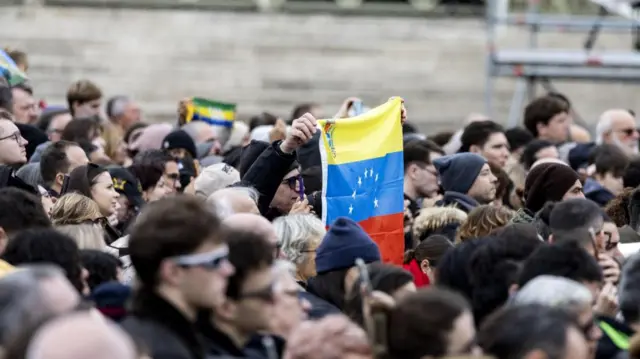
    Among the crows in Vatican City, one person waves a Venezuelan flag during Pope Leo's Angelus prayerImage source, MASSIMO PERCOSSI/EPA/Shutterstock
    Image caption,

    Among the crows in Vatican City, one person waved a Venezuelan flag during Pope Leo's Angelus prayer