BBC Weather - Help and FAQs
- Published
This page is divided into the following key areas:-
About BBC Weather
Questions about the weather forecast
Technical questions about the BBC Weather website and apps
Questions about BBC Weather on TV or radio
1. About BBC Weather
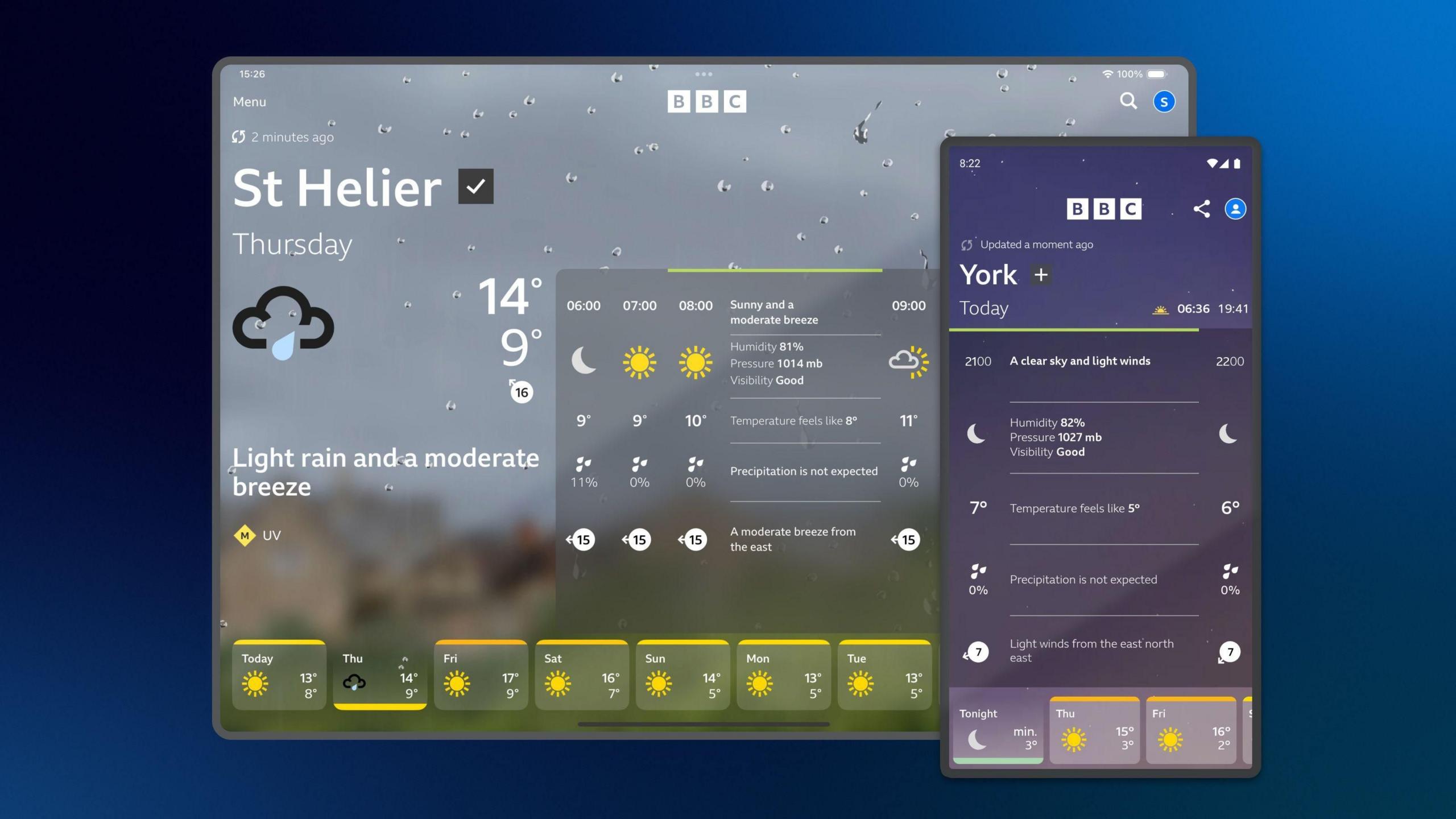
BBC Weather is one of the BBC's six key "services" along with Sport, iPlayer, News, Bitesize and Sounds. It's used by millions of people every week across broadcast, app, web, online and social. BBC Weather staff are based around the UK in our regional centres and at the Met Office HQ in Exeter.
Where does the data used in the BBC Weather forecast come from?
The forecast data and guidance for weather presenters on the BBC is supplied by the Met Office. You can read more about the BBC/Met Office partnership here.
Where can I learn more about weather forecasts?
You can find out more about the science of weather and the complicated processes which create the forecast on the Met Office website here, external.
Working with the Met Office, the BBC weather team produces hundreds of UK wide, local and global forecasts every week on TV and radio. The BBC Weather app and website has hourly updates for tens of thousands of locations around the UK and the world.
How do I send in my photos of the weather?
Your pictures of weather around the UK are a vital part of our weather coverage and we love to see them. Please upload your weather photos to BBC Weather Watchers.
How do I get in touch with BBC Weather?
We are keen to hear feedback from our audiences. We try to respond where appropriate as quickly as possible. The best way to get in touch is through the BBC's Audience services team here.
I am a teacher. Where can I find resources?
The BBC offers a selection of Weather and Climate resources via BBC Bitesize.
You can also check out the Met Office resources here here, external.
In addition, the Royal Meteorological Society website has links with resources for schools: Metlink: Weather and Climate for Schools and Teachers, external, external.
Can I go on a tour of the BBC Weather Centre?
We are sorry but there are no public tours of the BBC Weather Centre. We do attend some public events around the UK from time to time and details of those would be available locally.
Can I apply for work experience at BBC Weather?
All BBC work experience is organised centrally. You can find out more via bbc.co.uk/careers/work-experience.
2. Questions about the weather forecast
What do the symbols in the BBC forecast mean?
The weather symbols used by the BBC are more than 50 years old. You can read more about them here: The story behind the iconic BBC Weather symbols - BBC Weather
I've noticed the BBC and Met Office forecast is not identical – why is that?
BBC Weather is driven by data and guidance provided by the Met Office so our forecasts should be consistent. However, each organisation has its own weather symbols and there may occasionally be times when the forecast doesn't appear to match up. There may also be discrepancies because of the way data is processed but we're confident the core forecast will be the same. We monitor forecasts closely to ensure any variations are not misleading.
A short spell of rain or showers has been forecast. Why hasn't it rained where I am?
Showers can be hard to forecast. Their time or location doesn't have to be far out for the forecast not to be 100% correct. If you are making plans and spot a showers symbol on our website or app, you may find it helpful to review the latest video forecast for more in-depth information.
This video explains more about showers: Why are showers so hard to forecast?
What does % chance of precipitation (rain, snow, hail, etc) mean?
This information provides a probability of precipitation. A 20% chance of rain means that out of 100 situations with similar weather, it should rain on 20 of those. Remember that also means it won't rain on 80 times when those conditions occur!
The probabilities are given for the location selected only. The forecasts update regularly throughout the day using real-time information from radar, satellite, and nearby weather station observations, so you may notice the probabilities changing in the short-term.
How does % chance of precipitation relate to the weather symbol?
The weather symbol is generated by taking a series of measurements and then working out the most likely weather type based on them. For "wet weather" symbols these measurements include the hourly rainfall amount as well as the % chance of rain (probability of precipitation).
To generate a wet weather symbol, there needs to be both a measurable amount (over 0.1mm per hour, say) and a reasonable chance of rainfall expected.
This means that when very light, patchy rain or drizzle is expected, there may be occasions where the chance of seeing at least a few spots of rain is high (so a high % chance of rain), but the actual amount expected is very low (less than 0.1mm of rain in one hour).
This would be the type of weather where you feel a few spots of rain on the breeze, but it's not enough to dampen the roads and pavements. In this case, the weather symbol would remain as a "dry" weather symbol (e.g. a cloud) despite the chance of very light rain.
On the other hand, in some shower situations the chance of rain for an individual hour might be low. This is because it is very difficult to predict with high confidence the exact time that an isolated shower will hit a particular place. When it does occur, it might be a short, strong, short downpour and therefore the predicted amount of precipitation is high enough to generate a "wet" weather symbol despite a relatively low precipitation probability.
What does "feels like" temperature mean?
The temperatures in our forecasts represent the "air temperature" forecast - that is, the temperature that a properly shielded thermometer would record.
However, there are factors which can lead to a day feeling hotter or colder than this value alone might suggest. The two main ones are wind speed and humidity.
Our perception of temperature comes down to how quickly (or not) our skin is cooled. In light winds and high humidity, especially with higher temperatures, any moisture on our skin will be slow to evaporate, and so the cooling will be lower and it may 'feel' warmer.
A windy and dry day, especially when cold, may lead to the air "feeling" cooler than the temperature suggests.
The perception of temperature is subjective, so these values should only be taken as a broad guideline.
Why does the forecast detail keep changing?
The amount of information which goes in to creating the weather forecast has never been greater and continues to grow as the volume of data and computer processing power increases. The Met Office supercomputer can perform 60 quadrillion calculations every second which helps refine the forecast for thousands of locations on our app and website.
Why does the forecast only go out to 10 days ahead?
Four-day forecasts from the Met Office and BBC are now as accurate as the forecast for the next day was only 30 years ago thanks to massive advancements in Met Office science and technology. Even with modern computer power the forecast further out can be tricky because even very small changes in atmospheric conditions can mean big changes for the conditions we may experience. The Met Office has done some innovative new research on that medium range forecast, to create make what we believe is the best forecast, every hour for the next 10 days. Remember, if you've got something important happening to keep checking back because the weather can and will change!
How do the daily and hourly symbols work?
The daily weather symbol:
It is hard to give a single weather symbol to cover a whole day as the weather can change a fair bit. The daily symbol updates throughout the day and aims to show the most predominant weather type for the whole 24-hour period, at that location.
The symbol is also chosen to reflect the weather that is most likely to cause impacts giving more weighting to wet conditions. As the day moves on, this rule applies to the most impactful weather for the remainder of the day.
This means that if there is severe weather in the morning which then clears that the day symbol will match the remaining hourly symbols.
The hourly weather symbol:
The symbol that appears for each hourly time step indicates the weather expected at or near the relevant location, during the hour-long period that follows. For example, if a shower symbol appears for Wolverhampton at 1500, we are saying there is a chance of a shower in the Wolverhampton area between 1500 and 1600.
Why is there a discrepancy between maximum and minimum temps in the hourly and daily forecast?
This is because "ensemble forecasting" means each individual ensemble member could forecast the maximum/minimum to be the same level but at a different time step. So, we may be confident that a temperature will be reached but less certain of exactly when during the day it will occur. Multiple ensemble members showing the same maximum/minimum temperature gives increased confidence that at some point the temperature will be reached. Alternatively, the maximum/minimum temperature may occur at some point between, say, 14:00 and 15:00 – so would not be reflected in the "on the hour" temperature forecast shown.
Why does the wind symbol sometimes jump to over 40mph and turn black? Why are there no wind speeds in the 30s?
When the forecast predicts gusts of wind over 40mph, the white wind icon - which usually shows the sustained wind speed - will change to a black icon showing the expected wind gust speed. Once sustained winds are above 30mph, it is more likely that the wind gusts will be above 40mph. You may find, therefore, that sustained wind speeds between 30mph and 40mph rarely appear.
What is UTC (Coordinated Universal Time)?
The Coast & Sea section, apart from Tide Tables, uses the UTC time standard. UTC is, for practical purposes, the same as Greenwich Mean Time (GMT). During the months when the UK is observing GMT, the times shown on the website are equivalent to GMT.
During British Summer Time (BST), UTC is one hour behind the time observed in the UK. For Coast & Sea sections other than Tide Tables, you should therefore add one hour to the times shown during BST.
Our Tide Tables pages use UTC/GMT for dates when the UK is observing GMT, and BST for dates when the UK is observing BST.
Weather Warnings and storm naming
National Severe Weather Warnings are issued by the Met Office. You can find out more about weather warnings here.
You can sign up for notifications about weather warnings direct to your BBC Weather app. Find more details about how to do that here.
The naming of storms is a collaboration between the Met Office (UK), Met Éireann (Republic of Ireland) and KNMI (Netherlands). Read about why Storms are named here.
3. Technical questions about the BBC Weather website and online services
Can I save a list of favourite locations?
To find out more about the BBC's "My Locations" feature, please see "My Locations" FAQs.
Why is there missing data in the observations section and "--" displayed instead?
The main reason you may be seeing this symbol is that the local weather station does not collect this data. If all of the data is missing, then it is more likely that there is a fault with the weather station or the data feed to the website. This is likely to have been reported but can sometimes take a while to fix.
Why do I see adverts when I visit the BBC Weather website?
To make sure we're offering the best value for licence fee payers, users outside of the UK have access to the international version of the BBC Weather website which carries advertising.
Only people outside the UK should see advertising but due to the way certain Internet Service Providers (ISPs) connect you to the web, your location may be detected incorrectly.
You may also see if you're using a VPN (Virtual Private Network) connection to a server outside of the UK.
If you're viewing the BBC Weather website from within the UK and you can see advertising, please use this form to let us know.
How can I request my town/city is added/correct an error with it?
Go to the "Contact the BBC" section on the website and follow the appropriate instructions to leave comments about a town to be added or an error to be corrected.
How can I download the BBC Weather app?
The BBC Weather app is available on Android, Amazon and iOS devices.
You can download the Android version from Google Play, external, external, the iOS version from the App Store, external, external and Amazon version from the amazon.co.uk website, external, external.
The BBC Weather app is only available to download in the UK.
If you have a specific question about the BBC Weather app which isn't covered on this page, please refer to our Apps FAQs.
Why is something broken on the website?
Many of the issues that our users face can be resolved by updating to the latest version of the browser and checking that you have the correct settings enabled.
The site uses cookies and JavaScript to help us provide the best possible user experience. If either of these is disabled, the website might not work as expected.
Some antivirus/security software or administrator policies on a work computer can also interfere with expected behaviour, e.g. preventing you from changing your preferences on the site.
If you find something is broken with the website, we advise you to:
ensure your browser is up to date
check cookies and JavaScript are enabled
check settings in your antivirus/security software
For more information about how we use cookies, please refer to the BBC's Privacy & Cookies Policy.
How do I report a technical problem with the website or app?
If you have identified an issue that is not covered by our FAQs above, please let us know.
4. Questions about BBC Weather on TV or radio
What is the colour scale used on weather maps?
The colour scheme we use on our maps to show air temperature is shown below and was introduced in 2017 when our graphics system was upgraded.

This colour scale is used across our whole output on TV, the website and app. You can read more about this here.
Why isn't my town/city on the TV weather map?
The towns and cities on the map are there to help you find your location. Adding more town names could obscure weather information, and that's why the locations we choose are often around the coast.
We appreciate that people like to see their location on the map so aim to mix the place names up from time to time.
You can find a forecast for thousands of locations on the BBC website and app (UK only).
I've noticed that the forecast for my region is different on TV to the forecast on the website and/or app. Why is this?
While we use the same data source across TV, radio, online and the app, the forecasts can differ slightly due to the frequency at which this data is updated, as well as the granularity of the location information.
For example, a TV or radio broadcast you see at 1pm will be prepared using the latest data we have up to that point. If you check the forecast at 2pm on the website or app, we may have since received an updated set of data, from the one you saw earlier on TV.
Why do you never mention my region on the TV forecasts?
Our forecasts are often short and cover a large geographical area over a timeframe of more than 24 hours, it's not possible for us to mention everywhere.
We will often focus a little more on the areas where there are more impacts from the weather and refer to areas rather than specific places. You can always find a detailed forecast for your area on the BBC Weather website or BBC Weather app.
This article was updated on 26 November 2026 to reflect changes which came into effect as a result of the BBC and Met Office partnership.
Related Copyright Notices
Leaflet is a widely used open source JavaScript library used to build the forecast and observations map on the BBC Weather website.
Leaflet License
Copyright (c) 2010-2015, Vladimir Agafonkin. Copyright (c) 2010-2011, CloudMade. All rights reserved.
THIS SOFTWARE IS PROVIDED BY THE COPYRIGHT HOLDERS AND CONTRIBUTORS "AS IS" AND ANY EXPRESS OR IMPLIED WARRANTIES, INCLUDING, BUT NOT LIMITED TO, THE IMPLIED WARRANTIES OF MERCHANTABILITY AND FITNESS FOR A PARTICULAR PURPOSE ARE DISCLAIMED. IN NO EVENT SHALL THE COPYRIGHT HOLDER OR CONTRIBUTORS BE LIABLE FOR ANY DIRECT, INDIRECT, INCIDENTAL, SPECIAL, EXEMPLARY, OR CONSEQUENTIAL DAMAGES (INCLUDING, BUT NOT LIMITED TO, PROCUREMENT OF SUBSTITUTE GOODS OR SERVICES; LOSS OF USE, DATA, OR PROFITS; OR BUSINESS INTERRUPTION) HOWEVER CAUSED AND ON ANY THEORY OF LIABILITY, WHETHER IN CONTRACT, STRICT LIABILITY, OR TORT (INCLUDING NEGLIGENCE OR OTHERWISE) ARISING IN ANY WAY OUT OF THE USE OF THIS SOFTWARE, EVEN IF ADVISED OF THE POSSIBILITY OF SUCH DAMAGE.
Related links
- Published2 days ago