Aim
To mark Holocaust Memorial Day by hearing about the experiences of a Holocaust survivor. 27 January marks the anniversary of the liberation of Auschwitz-Birkenau, the largest of the Nazi concentration camps.
The video
Emma-Louise Amanshia meets Holocaust survivor John Hajdu MBE
EMMA-LOUISE:
Today I'm meeting someone who has a story to tell. It's not a happy story. In fact, I should warn you, it's quite a difficult and painful story. But it's an important one that needs to be told. Each year on the 27th of January, the world marks Holocaust Memorial Day. It's a day to remember the 6 million Jews murdered by the Nazis during World War Two.
This is alongside the millions of other people killed and persecuted by the Nazis, as well as the other more recent genocides in countries such as Rwanda, Bosnia and Cambodia. The 27th of January marks a day in 1945, when the concentration camp at Auschwitz Birkenau in Poland was liberated and the true extent of the Nazi atrocities that became apparent, atrocities that were mirrored at camps all across Europe.
I'm here to meet John Hajdu. John was born in 1937, in Budapest, in Hungary. Growing up, his life was typical for a child in an ordinary, middle class Jewish family. But then in 1940, Hungary joined forces with Nazi Germany. And John's life changed forever. Let's hear his story.
EMMA-LOUISE:
Hey, John, thank you so much for the time today.
JOHN:
Well, I'm delighted to be here, and I'm glad that this is an opportunity for me to tell you about my story.
EMMA-LOUISE:So I want to ask you about when Hungary joined the war and anti-Jewish laws were passed. How did life for you and your family change?
JOHN:
The anti-Jewish laws were brought in which meant that, for example, Jews couldn't hold a bank account. Jews couldn't marry non-Jews, couldn't become teachers or doctors. We were prohibited from entering cinemas, theaters or hotels.
From that moment on, life for the Jewish population has become much more difficult.
EMMA-LOUISE:Your father was taken away to a forced labour camp. What did that mean for you and for him?
JOHN:
Life for them was so difficult. They were beaten and some of them died.
My mother and I visited my father in one of these camps to give him some food, because the food given to them was totally inadequate. That meant that my mother, from that moment onwards, had to look after me and our flat.
EMMA-LOUISE:At one point, you had to wear a yellow star. What did that mean?
JOHN:
That meant that from that moment, whenever we walked on the street, we were abused or sometimes even beaten by the Arrow cross-party, which was a Nazi party in Hungary.
We were ordered to leave our house or flat at that time and move into a so-called yellow star block of flats, and we were only allowed out for two hours a day to buy food.
EMMA-LOUISE:On the 13th of October, 1944, your mother was taken away to a concentration camp. Can you describe that day?
JOHN:
When the party officials arrived at our block of flats they ordered all the women with children down to the courtyard in order to be taken away. My aunt who stayed with us saw this and very heroically and very cleverly grabbed me and rushed me across the corridor to a non-Jewish man's flat, hoping that he would agree for us to hide in his flat. He said, hide in my cupboard and hopefully that’ll save you.
He shoved us into a cupboard. My aunt and I, and closed the door and said, please keep very quiet. Don't say anything. Anything can happen. But I’ll try to look after you. At that same time, my mother was taken away to a concentration camp in Mauthausen in Austria.
EMMA-LOUISE:
How did you cope being separated from her as a child?
JOHN:
I don't think I really fully understood what it all meant. It's very difficult for a young boy of that age to understand the complexities of life without your mother knowing that she's been taken away.
EMMA-LOUISE:
Later on, you were taken away to a ghetto where Jewish people were segregated from everyone else. What was life like during that period?
JOHN:
There were people lying dead on the street or dying from typhus and various other illnesses.
It was not advisable to look outside or even to go outside, and we had to live, as I say, in very cramped conditions with hardly any food. Water had to be brought up from the street.
EMMA-LOUISE:
Amazingly, after the war you were able to reunite with your mother. How did that happen?
JOHN:
We thought that my mother, died in the concentration camp. We had no idea what happened to her. And the next thing we knew that she turned up at the flat where we lived in Romania. Now, that was a huge surprise to all of us. A wonderful, wonderful thing to happen.
EMMA-LOUISE:
You've got a teddy bear that survived the war with you. How is that even possible?
JOHN:
Yes. The teddy bear which is sitting on my desk is very precious to me, because that is the only thing constant since my early life. It was part of my happy life with my parents and grandparents. And I must have had the foresight to put it in my pocket every time we moved from the home into the yellow block, into the ghetto. It brings back bad and good memories, and it will be handed down to my family later on.
EMMA-LOUISE:John Hajdu’s story of Holocaust Survival is a remarkable one, and it's just one of the stories of the many thousands of people whose lives were affected by the Holocaust and many of those stories had a very different outcome.
It's easy to think that John's story somehow belongs in the past, and events like the Holocaust can never happen again. But history and many more recent examples of genocide and persecution around the globe teach us otherwise. That's why it's important to mark Holocaust Memorial Day each year. One way to do that is to hear from people who lived through it.
People like John.
Video summary
Emma-Louise Amanshia meets John Hajdu MBE to hear about his experiences of surviving the Holocaust.
John was born into a typical middle-class Jewish family in Budapest, Hungary, in 1937. In 1940 Hungary entered the War allied to Nazi Germany, becoming part of the Axis powers. From the 1930s onwards Hungary’s Jewish population had been subjected to various anti-Semitic laws. In 1944 Nazi Germany occupied Hungary and installed a puppet fascist government – the Arrow Cross party referred to by John. From this time onwards Hungarian Jews were forced into ghettos and then deported from them to the Nazi death camps.
John describes his own mother being taken away – to Multhausen concentration camp in Austria – but how he himself survived deportation by the quick thinking of his aunt. John lived in hiding for some time before being forced to move to the Budapest ghetto. In early 1945 the retreating Nazis intended to destroy the ghetto and its occupants, but it was liberated by the Soviet army before the plan could be implemented.
After the War John was reunited with his mother. They lived for some years in post-war Hungary, but it remained a turbulent period, including a failed popular uprising against the communist government and occupation by the Soviet Union. They escaped to Austria in 1956 and a year later they were able to move to the UK.
Context
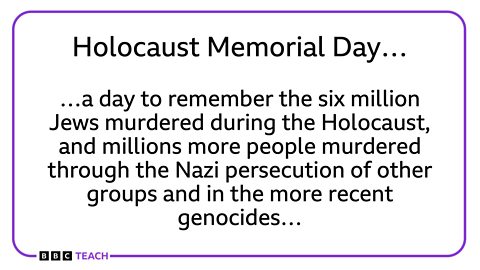
Holocaust Memorial Day (HMD) takes place every year on 27 January. The Holocaust Memorial Day Trust states that the day is ‘to remember the six million Jews murdered during the Holocaust, and millions more people murdered through the Nazi persecution of other groups and in the more recent genocides recognised by the UK government’. These include the genocides in Cambodia, Rwanda, Bosnia, and Darfur.
27 January marks the day in 1945 when soldiers of the Soviet Union liberated Auschwitz-Birkenau concentration camp in Nazi-occupied Poland. More than one million men, women and children were murdered there.
The word ‘Holocaust’ has been widely used in English speaking countries since the end of World War Two to describe the systematic murder by the Nazis of groups including Jews, Slavs, Romani people, people with disabilities, gay men and political opponents.
Holocaust Memorial Day was first held in the UK in January 2001.
Possible discussion points before the video
- What do pupils understand the word ‘holocaust’ to mean?
- What do pupils understand Holocaust Memorial Day to commemorate?
- What do pupils understand by the word ‘genocide’? (The word was coined by a Polish lawyer in 1944. It consists of the Greek prefix ‘genos’, meaning ‘race’ or ‘tribe’, and the Latin suffix ‘cide’, meaning ‘killing’. The United Nations describes genocide as ‘a crime committed with the intent to destroy a national, ethnic, racial or religious group, in whole or in part.’)
- What do pupils understand by the word 'ghetto'? (The OED defines a ghetto as 'any area occupied predominantly by a particular social or ethnic group'. Under Nazi occupation Jews were routinely forced to live in ghettos).
Possible discussion points after watching the video
- What do pupils recall of John’s testimony? What facts stick out for them?
- Why do students think it’s important to mark Holocaust Memorial Day?
- What ideas do they have for how they could participate in Holocaust Memorial Day? What could they do? (There are suggestions on the HMD Trust website).
- The UK provided a place of refuge for hundreds of Jewish children immediately before the outbreak of World War Two and John Hajdu himself arrived in the UK as a refugee in 1957. Do countries like the UK have a duty to provide places of refuge for those fleeing conflict?
Resources
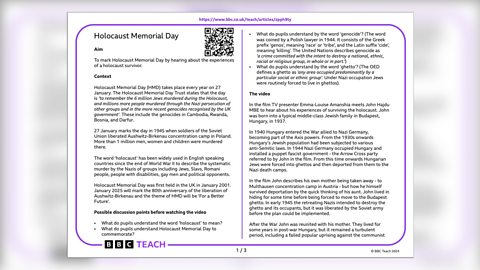
Assembly framework (PDF, 199KB) document
Download / print a suggested assembly framework
Presentation (PPT, 69KB) document
A series of slides for use during the assembly
Related links
Holocaust Memorial Day - Teaching Resources. collection
A collection of teaching resources for both primary and secondary classrooms.
Secondary History collection
A collection of resources to aid teaching of History in secondary schools.
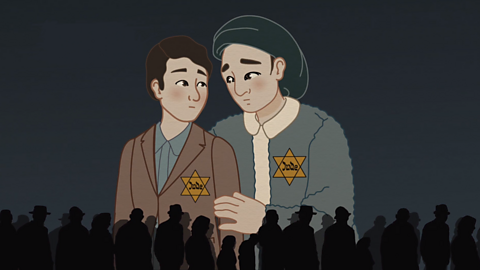
Bitesize: The Holocaust, 1939 - 1945. revision-guide
A guide for KS3 (11-14) students.
Secondary assemblies
VE Day 80th anniversary – secondary assembly. collection
An assembly framework and video to commemorate 'VE Day' on 8 May and to consider what life was like in the UK in the years immediately after World War II.
Jane Austen at 250 - secondary assembly. collection
An assembly framework to mark the 250th anniversary of the birth of Jane Austen in 2025 and to celebrate her contribution to storytelling and consider celebrity.
1971 Women's World Cup: The Lost Lionesses – secondary assembly resources. collection
An assembly framework and video to celebrate a major sporting occasion and the achievements of the England women's football team who competed in the 1971 Women's World Cup in Mexico.
Anti-Bullying Week – secondary assembly. collection
A secondary assembly framework and video to mark Anti-Bullying Week focusing on the power of words and the need to use them carefully.
Safer Internet Day - secondary assembly. collection
An assembly framework and video to mark Safer Internet Day, celebrate online safety and to consider practical steps to remaining safe online.

D-Day – secondary assembly. collection
Two videos about the D-Day landings from both a British and German perspective to provide an understanding of the actions of the human beings involved on both sides.