Virtual Reality: could it change the way we watch the Six Nations?

Robin Moore
Head of Innovation and Connected Studio, BBC Wales
Tagged with:
Virtual reality puts the viewer at the centre of the action allowing them to look around and choose what they look at. It gives a much more immersive experience than traditional television or computer games. At BBC Wales, we are experimenting with what it could mean for our coverage of events. And there aren't many bigger events in Wales than the RBS Six Nations.
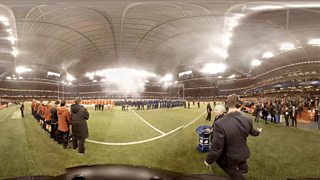
Expanded 360 view of the anthems at the start of the Wales v Scotland match 2016
Working with the WRU, Visit Wales and Cardiff based VR specialists, Atticus Digital, we filmed a selection of virtual reality video clips at the recent Wales v Scotland Six Nations match. Have a look at one of the clips on the BBC Wales Facebook page.
Together these clips give you a flavour of what it is like to be standing pitch-side at the Principality Stadium with 74,000 fans cheering as the teams come out onto the pitch and sing the anthems.
These clips are most exciting when viewed using a Virtual Reality headset, but you can still get a taste of the potential of this technology by watching the videos on your smartphone. Search for BBC Wales on your Facebook app or visit the BBC channel on the YouTube App. Move your phone and look around to get a feel for the scale of the venue and the emotional intensity of the crowd’s reaction.
This fledgling technology has its challenges. When we used it to film the Cardiff Half Marathon back in October, it was the technology that challenged us: could the camera actually film for long enough and how do we stream such large video files to the audience? Now the challenges are more creative/logistical: with such a high profile event how do we capture the quality of experience that the audience expects without getting in the way of the TV cameras, players and pyrotechnics?
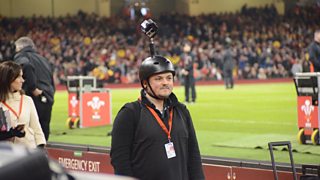
Taking VR pictures with the helmet-mounted VR camera
Wales’ Six Nations home games are filmed with 29 cameras, to achieve the very best TV coverage. You might think that adding a few more 360 cameras would be simple, but, even with fantastic cooperation from the Stadium and our TV team, it was hard to position cameras where they wouldn't obscure the view of match cameras. One novel solution is the use of a head mounted camera – easier to move than a tripod.
We hope you enjoy this first trial of capturing the excitement of international rugby, but clearly the next step is to look at how Virtual Reality could be used to capture match action. In a few years, I think we will see live coverage, and immersive experiences that take you onto the pitch during the game, putting rugby fans right at the centre of the action.