
By Laura Weldon, Principal Research Officer, Wetland Science at WWT
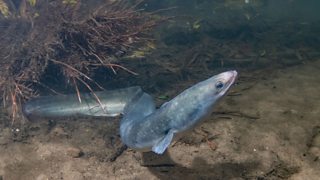
Image by Jack Perks
The slight hint of a silvery body sliding underwater is not easily spotted. It’s a creature that, if caught, is prized highly around the world. No, it’s not Nessie of legendary monster fame, but the European eel, a species now so scarce it’s listed as Critically Endangered on the global IUCN Red List.
I’m just coming to the end of my PhD; a project to design a new, more sensitive method for detecting and monitoring the European eel using eDNA. The European eel was until quite recently abundant and found in freshwaters all around the UK, but numbers of Anguilla anguilla have fallen dramatically over the last 30 – 40 years.
Disease and loss of suitable freshwater habitats are thought to be major factors in their decline. European eels migrate over vast distances to grow and mature in European freshwater habitats. Once fully grown, they leave freshwater and migrate to their spawning sites in the ocean.
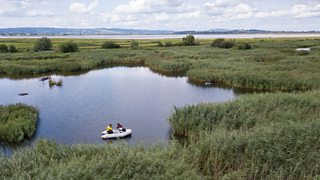
Image by WWT
We still don’t know what happens there, and so far, scientists and zookeepers haven’t been able to breed eels in captivity successfully, so it is important that the adults are healthy and able to complete this migration for spawning. Unfortunately, eels have maintained a very high monetary value and are amongst the most illegally trafficked protected fish species. This is partly because they are so scarce and cannot be bred and partly because there remains demand for this fish which is considered to be a luxury food.
What can we do about their decline?
To support the recovery of eel populations plenty of agencies are working to restore suitable freshwater habitats for eels and other migratory fish. One of the main ways we can do this is by removing weirs and other barriers that prevent these fish moving upstream. To see if these measures are working, we need to monitor eel numbers. Traditional monitoring methods such as fishing nets work well in abundant populations however when eel numbers are low they are less effective and it can be difficult to assess whether eels are present.
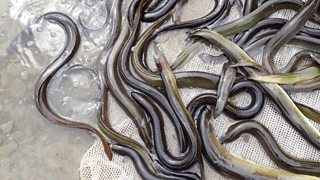
Traditional eel monitoring. Image by Laura Weldon
Eel-tracking with eDNA
All creatures leave behind traces of DNA as they move about their environments through shed skin cells, hair, gametes or urine and gut cells in faeces or for fishes and amphibians, scales and mucus. This trace DNA usually known as Environmental DNA (or eDNA) can be collected and then in the laboratory markers found that identify its origin.
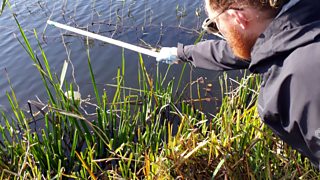
UWE researchers gather data for this hi-tech tech process using a lo-tech bottle. Image by Laura Weldon
This is a rapidly evolving research area and I used methods that other people had developed to collect eDNA but made a laboratory method specifically to identify European eels which until recently hadn’t been done. To test these methods, I used water that I collected from eel aquariums at Bristol Zoo and once I was confident the method was working came and collected water from some of the ponds around WWT Slimbridge. The first evidence I had that these methods were working on wild eel populations came from some water samples collected from the Rushy lake. I spent the next year validating the method, working with the eel monitoring team at Inland Fisheries, Ireland. This was an important step to demonstrate firstly that the method worked and to compare eDNA methods with traditional monitoring.
I was happy to find that these new eDNA methods were more sensitive and still able to detect eels in lakes when fishing nets were no longer capturing eels.
Finding other secretive species
These eDNA methods are readily adapted to finding other species too. They are great for seeking out rare or secretive species and have been really useful for detecting the first signs of invasive species. To collect eDNA water samples can be filtered on site in the field and the filters transferred to the laboratory. It’s a useful way of monitoring because it removes the need to capture or handle the organism being surveyed. We are hoping to develop monitoring with citizen scientists to survey eels and other key wetland species using eDNA methods.
Laura carried out this work as part of her PhD with University of the West of England. To find out more about the Wildfowl and Wetlands Trust’s work with migratory fish, visit our website: www.wwt.org.uk/migratory-fish