
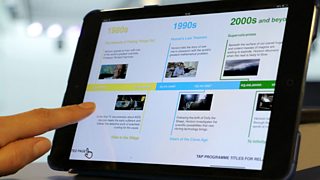
BBC Science has launched its first interactive e-book to help celebrate the 50th anniversary of Horizon, its flagship science programme. Georgia Moseley, Series Producer across the BBC e-books project, takes a behind the scenes look at the Horizon e-book’s production, and reveals how and why the e-books collections came into being.
Fifty years ago the BBC launched Horizon, which was to become its flagship science programme. Over the years the series has been constantly reinvented, so it’s fitting that this anniversary is marked with another innovation; an interactive e-book. Designed for tablet computers and packed full of archive clips, stills, interviews with current presenters and written text, the 50 Years of Horizon e-book is a fully interactive way of browsing specially curated moments from landmark episodes in the vast Horizon back catalogue.
The Horizon e-book was made by TV producer Alicky Sussman who, with no prior experience or exposure to interactive e-books before she began, was faced with the task of distilling 50 years of science programming into a manageable, meaningful publication fitting for a 50th birthday present. This involved a crash-course in e-book production: getting to grips with the software, selecting the archive, writing the text, filming interviews, and building the book page by page. The result is a worthy tribute to a much-loved series, and crammed full of clips from some of the biggest science stories of the post-war world.
One of the most poignant inclusions is the 1983 episode Killer in the Village, the first documentary to investigate AIDS which thirty years ago was the name given to describe the collection of "bizarre killer infections" that seemed to be disproportionately affecting gay men. As one of the contributors in the programme said, "its definitely transmissible, just how I don't know".
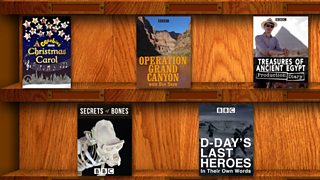
50 Years of Horizon now sits alongside five other e-books commissioned as part of a BBC pilot to explore this new form of digital storytelling. The e-books have been produced by teams across the BBC – from the Natural History Unit to CBeebies – and are all free to download. The beauty of this hybrid form is that it allows you to explore the content your way. Want to be taken on a leisurely journey just like a magazine? Fine – explore it page by page. Prefer to scroll through and jump to the bits that grab your attention? That’s fine too – browse away. There's really nothing to it.
The project first came to life through serendipity. My background is factual TV production but by nabbing a desk next to the department's Innovation Consultant, Pasquale Tropea, I got to earwig on a whole new world. Part of Pasquale’s role is to tap into the mountain of digital innovation – from cameras and kit to software and production techniques – and bring back the best new stuff to help enhance the programmes we make. After showing me some new simple software he'd come across that was designed to produce interactive e-books (mainly for use in education) we played around with the idea of how it could also be used to create low-cost interactive publications to support our programmes – making greater use of the material we were already producing, showcasing gems from the archives, and allowing the audience to interact with our content in new ways. The format allowed us to include video, audio, text and images in any order which, once published could be viewed offline.
For me, having spent a decade producing traditional 30 minute or 60 minute TV programmes, the storytelling possibilities of this new form seemed endless. The Factual Innovation Exec, Jonathan Renouf, encouraged us to experiment and after a bit of trial and error and a few late nights we produced a handful of prototypes which eventually led to the pilot being commissioned and the publication of the first BBC e-book – D-Day: The Last Heroes. Producer Anya Saunders designed the D-Day e-book around an interactive timeline of the events of June 5th and 6th 1944, enabling the audience to scroll through the minute-by-minute testimony as told by veterans in their own words. It was produced to sit alongside the BBC One series of the same name to house content that wasn't able to be included in the original programme, and is being updated (with the inclusion of some extraordinary BBC archive from D-Day itself) ready to be relaunched on June 1st in time for the 70th anniversary.
Now we are able to publish to Android and Kindle as well as iOS tablets our latest e-books should have a broad reach and appeal. With six titles under our belt and a couple more in the pipeline we are hopeful that we’ll be given the go-ahead to produce more ambitious e-books in the coming months – pushing the boundaries of this new form, while building on the brilliant storytelling skills within the BBC.
Download the interactive e-books by following the links below:
- 50 Years of Horizon - iOS
- 50 Years of Horizon - Android
- 50 Years of Horizon - Kindle Fire
- BBC D-Day’s Last Heroes – iOS
- BBC Operation Grand Canyon – iOS
- Treasures of Ancient Egypt – Production Diary - iOS
- A CBeebies Christmas Carol - iOS
- BBC Secrets of Bones – iOS
- BBC Secrets of Bones – Android
-
BBC Secrets of Bones – Kindle
Georgia Moseley is Series Producer, BBC e-books project
- Horizon's £10million Challenge on Thursday 22 May 2014 will invite viewers to cast their vote for the winner of the Longtitude 2014 prize - a chance to tackle the greatest challenges facing science today.
- BBC History are marking 50 years of Horizon with a special series of interviews with former producers and production staff.
- If there are e-books you would like to see published please leave a comment below or email [email protected].