Nepal Earthquake: When no home is safe where can you go?

Kirsty Cockburn
Director of Communications and Fundraising, BBC Media Action
Tagged with:
Yesterday, news came from Kathmandu that the family home of my BBC Media Action Nepal colleague, Bidhya Chapagain, had fallen down. No one was hurt, but Bidhya was badly shaken. The building had managed to stay standing after the first earthquake, but Tuesday’s second 7.3 shock caused an already weakened structure to collapse.
Bidhya is the presenter of BBC Media Action’s Sajha Sawal (Common Questions), Nepal’s most popular current affairs television and radio show - reaching 5.6 million people (just under one-in-three Nepalis). This programme and other ‘Lifeline’ radio shows have played a vital role in providing information to people affected by the earthquake about where to receive aid and how to stay safe and healthy. I had been filming with Bidhya in her home village just days before the first earthquake in April struck. On hearing this latest news I looked back at the photos I had taken.
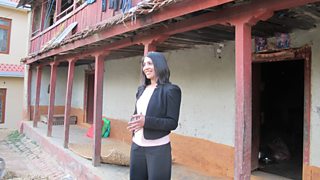
Bidhya outside her childhood home, just days before it collapsed in the second earthquake
There was that building still intact, in a farming district on the outskirts of Kathmandu, pictured behind a large group of smiling faces: Bidhya’s extended family. We’d sat inside on the earth floor with Bidhya and family and shared a generous and delicious Dal Baht. That room, that home, is no more. How quickly things change, how fragile our assumptions and supposed securities can be.
Access to information can help or it can hinder: it depends on its timeliness, its reliability and is always subject to change. Our work in Nepal is using media to help people deal with the changing challenges of chaotic and frightening times. Reports are saying that Tuesday’s huge aftershock has taken efforts back to day one: it’s about survival and rescue again. And my colleagues are once again providing updates through their network of radio stations. It’s utterly vital to cut through the confusion with clear information.
Elsewhere in the world, but still with a focus on Nepal, the media is playing its part for good and ill. A bizarre story has emerged of Facebook users, far from Nepal, clogging a new service designed to track and check on the safety of those in Nepal. People who are thousands of miles from Nepal have thought it funny to confirm they are ‘safe’ too. They are being ‘de-friended’ at pace but it is curious and striking how fragile that concept of ‘safety’ really is.
When I was in Nepal and we visited Bidhya’s home, it was a very happy and celebratory day as we talked with her family about her rapid rise as the new presenter of Sajha Sawal. Bidhya’s family home was simply too small to fit all her neighbours and friends in, so after dinner we crowded into a neighbour’s house to watch that evening’s show.
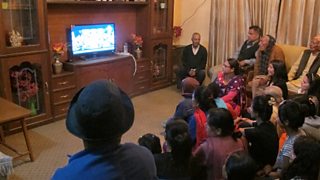
Bidhya, her family and friends, in a neighbour's house, watching the programme she presents
When the programme finished her parents spoke with pride of how Bidhya now provided not only a role model for the country’s girls, but that as a poor farmer’s daughter, “It was a lesson for all farmers to aim high”. Bidhya’s father had beamed this last sentence, his eyes shining with tears.
Now, with the monsoon approaching and with so many farmers unable to cultivate their land (rice seed stocks destroyed, the working day thrown into the uneasy rhythm of aftershocks and coping with damage and loss) there are fears about food security and for livelihoods. Even while people are trying to cope with the immediate crisis of the earthquakes and aftershocks there are other, longer-term concerns. Nepal, after so much gained and with so much potential, is a country again struggling with the most basic and urgent priorities of life: shelter, water, food, health, sanitation.
We can all help: from near and far. In the days following the first earthquake hundreds of people started flying into the country: journalists to take the story to the world, aid and health workers to provide support, and many expatriate Nepalese, returning to help the country rebuild.
I was touched to hear that my former colleague Dipika Shrestha has flown back from a ‘new life’ in the US to resume our work in Nepal. Nepal, in this time of great insecurity, needs our support more than ever. I don’t yet know of the welfare of all of those I interviewed, and I’m especially concerned about those I met in vulnerable Himalayan towns close to Tuesday’s earthquake epicentre. Their stories, back then, were of poor and marginalised people standing up for their rights through our radio shows. How those rights and priorities have had to change – buildings, lives, hopes, assumptions – need to be rebuilt.
In these uncertain times we are working with the BBC World Service’s BBC Nepali and a network of radio partners in Nepal to broadcast our radio programmes – helping people keep safe, find missing loved ones, and access food, water and shelter. In the wake of the second major earthquake, our work helping people access information is more important than ever, so if you can support us please do.
Kirsty Cockburn is Director of Communications and Fundraising for BBC Media Action.
- BBC Media Action is an independent charity and not funded by the licence fee.
- If you’d like to support BBC Media Action’s work in Nepal, you can donate online or text “INFO15 £5” to 70070 to donate £5.