
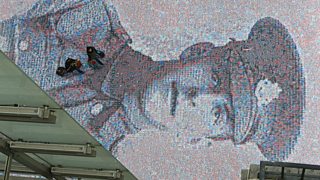
On Friday, ahead of Remembrance weekend, the BBC revealed a giant mosaic outside Broadcasting House featuring the "Face of WW1". There for all to see is an image of Private James Ernest Beaney, a soldier from London who died in the Somme, in 1916.
With every BBC Local Radio station and regional news programme creating outstanding programming around WW1, this mosaic is our way remembering those who gave their lives as a product of that work.
Commissioning artist Helen Marshall told me she wanted to take on this ambitious project as a way of commemorating the First World War in the digital age. The mosaic does just that in the most powerful way having been brought to life by English Regions, BBC Learning and our partners the Imperial War Museum.
The thousands of audience faces were taken for ID cards in our ‘recruiting office’ during the BBC WW1 At Home events which have touched audiences throughout the summer. These have been combined with original First World War imagery sourced from the Imperial War Museum’s archive and additional original images submitted by people from around the country with the end result featuring over 30,000 images.
The ID cards we created were based on one that was used at the time to help people gain entry to security sites across the UK, like those used in the First World War.
The unveiling of the mosaic has certainly had impact. Over 1.2 million people saw it on Friday morning when it was revealed on Facebook. Since then we have seen people adding their own memories and thoughts to the page in their hundreds which shows how it resonates with people around the country.
At last week’s Local Radio Gillard Awards in Hull, the Director-General Tony Hall spoke about the passion and dedication involved in the production of local programming, and the WW1 project has certainly been an example of that.
The aim to put audiences at the very heart of what the BBC does is clear, while the mosaic represents the spirit of WW1 At Home, our landmark UK wide project that tells powerful, fascinating and moving stories about the impact of WW1 right on our doorsteps.
Private Beaney, who died serving with 6th Battalion The Queen’s (Royal West Surrey) Regiment was born 16th April 1893 in Battersea, St Mary, Wandsworth to Ernest and Maria Beany.
He attested on 15 August 1914, in Kingston on Thames and was killed in action on 8 August 1916. His war grave can be found at Bouzincourt Communal Cemetery, Picardie, France and the image of Private Beany The Face of WW1 has also been turned into a short film. Explore the story of how the UK came together to create this piece of commemorative art in the special iWonder guide.
The BBC’s First World War Centenary is the biggest and most ambitious pan-BBC season ever undertaken. Featuring four years of programming and events spanning 2014-2018 – echoing the timeframe of the war – the World War One Centenary on the BBC will be unique in scale and breadth on BBC TV, Radio and Online and across international, national and local services. Alongside our collection of WW1 programmes from across the BBC the mosaic offers an opportunity to reflect all of those who gave their lives in this conflict, and others.
David Holdsworth is Controller, BBC English Regions
- Discover more about World War One at Home
- Find out more about the BBC's First World War Centenary
- Read Building understanding about the conflict which gave birth to modern remembrance
- Also Revealing the World War One at Home project
- See further World War One blogs on About the BBC