Tour de France 2014 to set off from Leeds
Matt Slater
Tour de France correspondent, BBC Yorkshire
Tagged with:
When I was a student in Leeds 20 years ago the most famous thing about the place was arguably the M1, a road to somewhere else. And the city’s best connection with France was Eric Cantona, who thrilled Leeds United fans for a season only to move to their rivals Manchester United and become a legend.
If somebody had said Leeds would one day host the start of the Tour de France I would have assumed they had drunk too much of the college bar’s top tipple, a 95p-a-pint ale called Castle Eden. It tasted more like castle than Eden.
Leeds was…well, in Yorkshire, and I do not recall ever seeing anybody on a bike, which is a shame, given the fact that Britain’s best cycling country was just beyond the ring road.
But Yorkshire is a bit like that, a secret hidden in broad daylight. Sure, we know the “God’s Own County” bluster, but do we know how gorgeous and vibrant it is?
I am not sure we do but I have a feeling the secret is about to get out. Just as the 2002 Commonwealths confirmed Manchester’s renaissance, and the Olympics sparked east London’s regeneration, the Tour provides a shop window Yorkshire has never had before.
The quid pro quo is that Yorkshire will give the Tour the best start, or Grand Depart, it has had in its 111-year history.
The owners of the race cannot talk highly enough of how Yorkshire first wooed them – beating Barcelona, Berlin, Edinburgh and Florence in the process – and then raised the bar for every host that follows.
The sense that this is Yorkshire’s Olympics can be seen in innovations like the cultural festival that has been running since late March, the 12,000 volunteer “Tour Makers” who will steward the race, and the grandest (and most expensive) opening ceremony the Tour has ever seen on Thursday, 3 July.
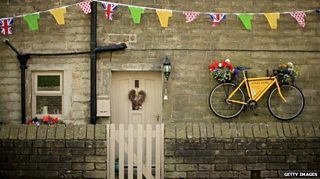
That is just formal stuff. Perhaps the best stories have come from what is happening informally in the villages, towns and cities. There are no abandoned bikes in Yorkshire anymore: they have been painted yellow and stuck on buildings. And if you are running an event that needs bunting in the next year or so, there will be stockpiles of the stuff up here.
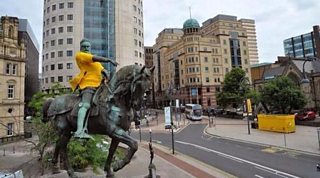
The Black Prince in City Square Leeds, sporting a yellow jersey for the Tour de France.
The routes for the two Yorkshire stages – the furthest north Le Tour has been – are special, too. From the steps of Leeds Town Hall, past the gathered royals at the Queen’s cousin’s house at Harewood, into the Dales, over Buttertubs Pass and back to Harrogate. The first stage on Saturday, 5 July, is the most ambitious advertising stunt the region has attempted.
After the Beauty, comes the Beast. Stage two is a leg-shredding schlep from York to Sheffield, via Bronte Country and the Peak District, and it will prove that what Yorkshire lacks in mountains it makes up for in steep gradients.
All of this will be captured on hundreds of cameras, many in helicopters, and by thousands of reporters. Their work will appear in 190 countries, with most of Europe, North America and Australasia taking hours of live coverage.
But more importantly in terms of what this event means for Yorkshire is that the event will be watched from the roadside by perhaps as many as a million fans a day. An academic from a leading sports research centre recently told me that if the sun shines we could be looking at the largest civilian mobilisation since WWII – he was only half-joking.
Covering the build-up to all this for BBC Yorkshire has been the most enjoyable six months of my career.
With £27m of public money invested in the Grand Depart, I have tried to hold the organisers to account, not to chase easy headlines, but to keep them honest and make sure the legacy promises are more than just marketing spin.
I have also attempted to explain just how big this thing is, but also how much of an opportunity it is – this could be worth up to £100m to the local economy.
There have been serious reports on the dangers cyclists face in Yorkshire’s cities, how much money it would cost to fix the region’s potholes and detailed looks at the event’s budget and road-closure plans.
There has been fun stuff, too, like teams of cyclists dragging a grand piano up England’s longest hill, my attempt to eat 8,000 calories “Yorkshire style”, and bunting, lots of bunting. I have also reported live from Belfast where the Giro d’Italia started, interviewed the last two winners of the race Sir Bradley Wiggins and Chris Froome, and learned how to build a dry-stone wall.
The experience has also completed a personal cycle, having started my life as an independent adult here (although I was not always very adult at the time) it has been good to come back and see how much has changed for the better.
It has also felt right that it should be the Tour that has done it. I first got into the sport during those student days when the race visited the south coast in 1994. The race had been once before, in 1974, but it had not been a success and the 20-year gap told its own story.
This time was different, though. We turned out in huge numbers to cheer on our smattering of home-grown heroes, and we finally seemed to get what all the fuss was about.
Thirteen years later, the race was back, this time in London and Kent for Britain’s first Grand Depart, and I was now reporting on it for the first time. Again, we embraced it, and the 2007 start is often talked about as the very best.
But the Tour did not change London, just as London did not change the Tour. London is too big, too self-confident, to let a few days of bike racing make much of an impact. It also had the Olympics to look forward to.
Yorkshire and the Tour, however, are perfect partners, and both should come away from this joint venture enriched.
Matt Slater is Tour de France Correspondent, BBC Yorkshire.
- Read Matt's Tour de France Grand Depart diary on the BBC News England website.
- Follw @BBCTdF on Twitter.