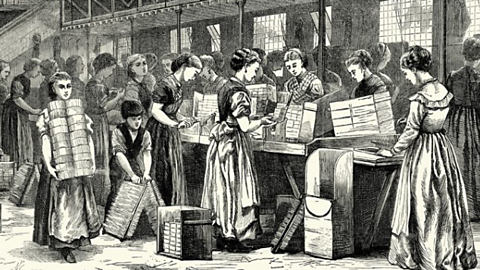
Belfast's Industrial Past
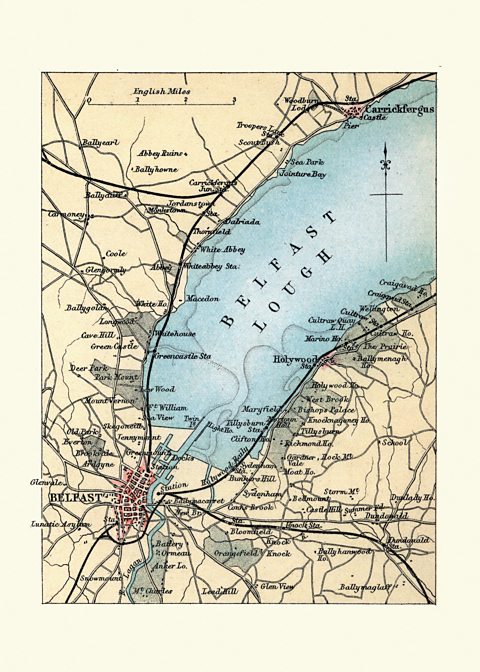
Today Belfast is a modern vibrant city. It is known for its welcoming atmosphere and people are employed in the modern jobs provided by technology, finance and the creative industries.
It is a lot different to the Belfast of the 1970s and 1980s - which was scarred by the violent period called the Troubles.
However if we go further back, to the 19th Century, Belfast was the beating heart of industrial Ireland and was at the forefront of the technology that existed at the time.
At one stage Belfast provided the single biggest shipyard, ropemakers, dry dock and linen factory not just in Ireland or Britain but the entire world.
Watch: The impact of the Industrial Revolution on Belfast
DIRECTOR: Standby on the floor.
DIRECTOR: Coming to you camera 2.
DIRECTOR: Cue on 2.
DIRECTOR: Mix-through.
DIRECTOR: Clear the floor.
MAX: I’m Max Heartrate and this is Knowledge Express. Information faster than a hare on a jet ski. And today’s topic is…
MAX: The Industrial Revolution!
MAX: Right, way, way, way, way back before 1720, most work was done either by people or animals.
MAX: Then we discovered machines!
MAX: Now we could produce stuff faster and cheaper. Example. Linen. Lovely cloth made for centuries in the North of Ireland thanks to our soggy climate.
MAX: It’s 1701 and there are loads of families in the countryside growing and spinning flax and weaving linen. They produce 200,000 yards of linen between them. Good work guys? NO!
MAX: By 1773 Belfast is exporting 17 million yards of the stuff. All thanks to machines. Classic industrial revolution – big buildings, big machines, big workforce, big profits and it’s boomtime for Belfast!
MAX: Soon everyone’s on the industrial gravy train – rope makers, ship builders, distillers, and Belfast is suddenly a big deal. Whoop woo! Party on! Not so fast! Every silver lining has a cloud. People have to move from the country to the city to get jobs. So, dangerous working practices, squalid living conditions, child labour, discrimination against women and environmental harm.
MAX: But hey, that’s capitalism in the 18th Century for you. The rich get richer and the poor get tuberculosis. Did industrialisation come without a cost? As my Belfast Granda used to say, “Catch yourself on!”
The Pre-Industrial City
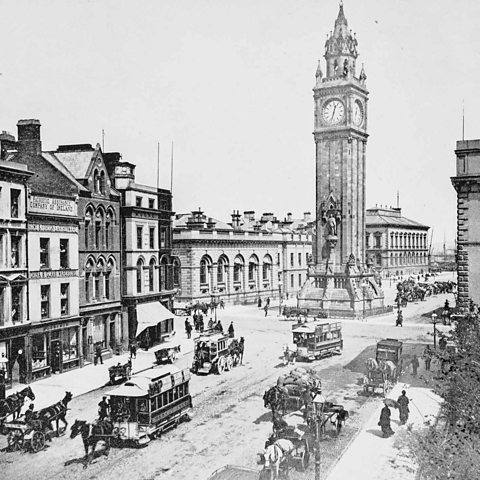
At the beginning of the 19th Century, Belfast had fewer than 20,000 people living in it. It was a port with small wooden docks where High Street met the river Lagan.
The living areas close to the docks were not streets as we would know them but small lanes and entries.
These were slum areas, overcrowded and housing the poor. Though the dwellings are long gone the original lanes and entries between High St, Ann St and Waring St are still visible today.
The City Centre also had a second river, the Farset, from which Belfast gets its name.
Some of the streets bore the names of the products produced there. Mustard was produced in Mustard St, sugar was refined in Sugar House Entry, ships' captains (skippers) stayed in Skipper St and cattle were driven to the docks through Cow Lane, now Victoria St.
Linenopolis
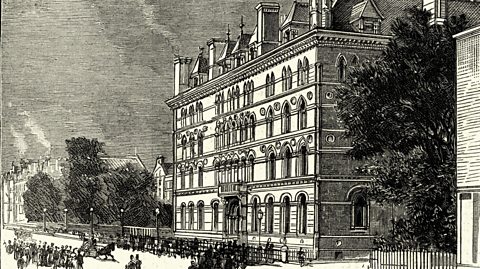
The manufacture of linen was vital to the growth of Belfast.
The fabric had been produced for many years in the Lagan Valley area and was an important product but it was the move to industrial techniques that led to the complete transformation of the city.
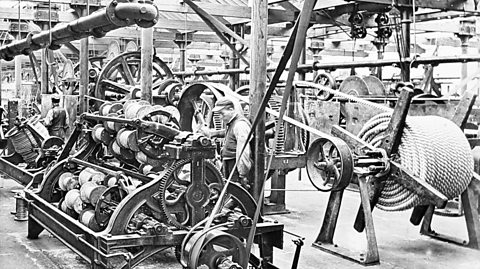
After industrialisation, one person operating a number of spindles could produce 300 times the amount that a single individual could.
Mills filled with these new machines sprung up all over Belfast.
By 1861 there were 32 mills in the city. York Street Mill, with its 1000 power looms was the largest in the world and by the beginning of the 20th century Belfast mills would have more power looms than the entire continent of Europe.
Little wonder it gained the nickname Linenopolis.
New Industry
What other industries made Belfast one of the fastest growing cities in Europe at this time?
- In 1847 the Belfast Harbour Commission, which managed the port, started a major project to create a deeper harbour and build new docks. This meant that ships could sail right into Belfast to deliver and collect goods which increased trade.
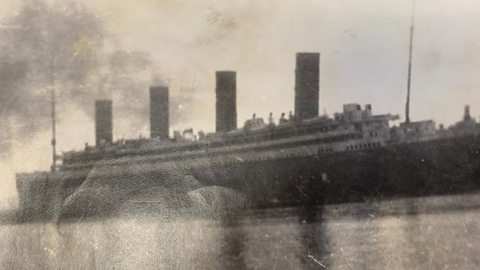
- The dredged earth that was removed was built up to create Queen’s Island and from 1856 it was site of the Harland and Wolff shipyard. This would become one of busiest shipyards in the world and would build the famous Titanic.
- Wherever there is shipping, there also tends to be ropemakers and the Belfast Ropeworks, formed in 1876, produced over 1000 tonnes of material per week.
- The Sirocco Works engineering firm, owned by the inventor Sir Samuel Davidson, pioneered a new system of ventilation that could be used in factories and hospitals.
- Gallaher's Tobacco Factory, which moved to Belfast in 1863, was located at York Street and was one of the biggest cigarette manufacturers in Europe…
Belfast Past and Present
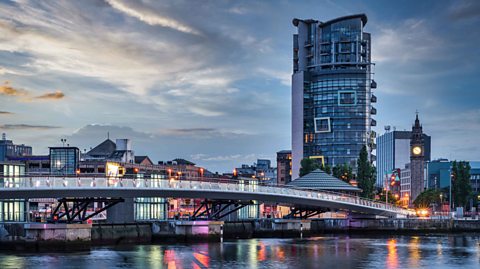
Much of the industry that originally made Belfast grow may be long gone, along with the noise, sights and smells of the bustling Victorian city.
However, the history of the people and communities that had made the city thrive is still very much alive.
The modern, vibrant Belfast of today owes much to its inhabitants from over one hundred years ago
More on The Industrial Revolution
Find out more by working through a topic
- count2 of 4
- count3 of 4
- count4 of 4