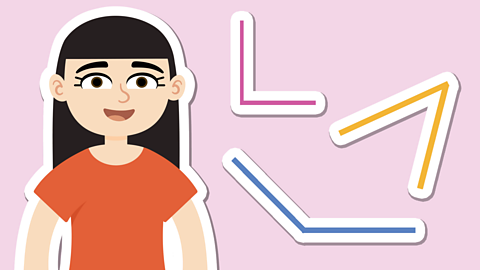
What is an angle?
An angle is the space between two lines that start at the same point. This point is called the vertex.
Angles measure the size of a turn in degrees. You can show degrees using the symbol ° after the number of degrees.
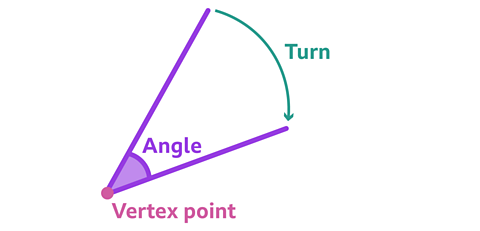
Imagine two lines acting like the hands of a clock. When the hands move apart, the space between them gets bigger or smaller - that space is the angle.
Angles can be seen everywhere - in shapes, opening doors, and even when you stretch your arms. Knowing about angles can help you understand how things fit and move together.
Quiz: Comparing angles
Test out your knowledge of comparing and ordering angles with this quiz, then read on to complete the page.
Types of angles
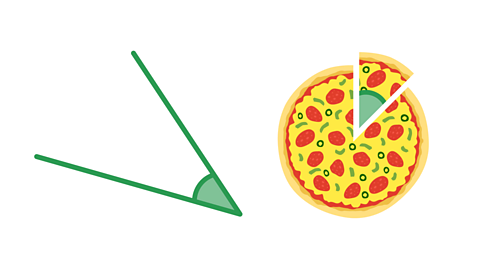
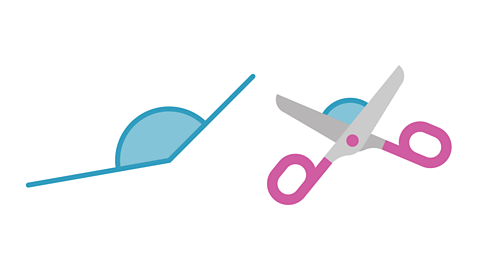
There are many different types of angles. An angle’s type can depend on the size of the turn and how wide the angle is.

Image caption, Right angle
A right angle is 90° or a quarter turn. It looks like the corner of a square or rectangle. You can spot right angles in doors, books or the edge of a piece of paper.
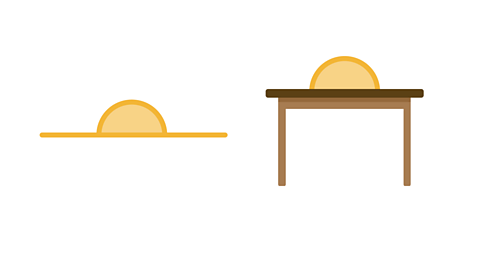
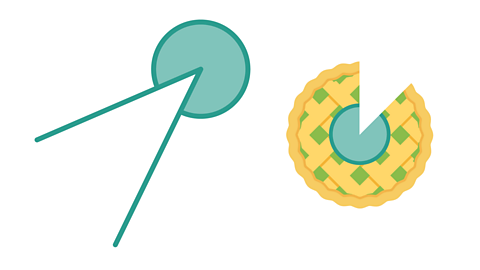
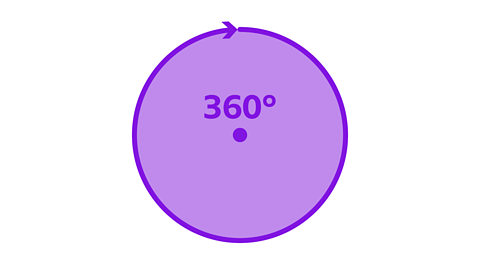
1 of 6
How to measure angles
You can use a tool called a protractor to measure angles accurately.
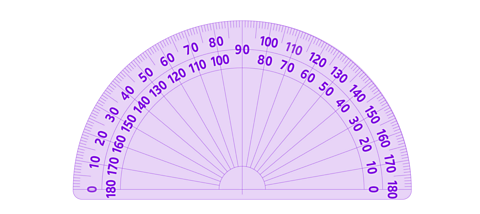
Protractors can measure angles of different sizes, such as right, acute, and obtuse angles.
Follow these steps to measure an angle using a protactor:
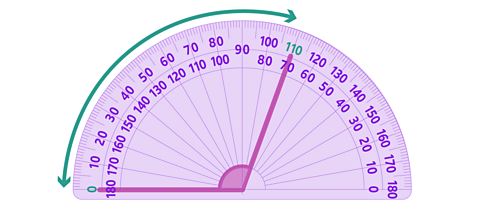
- Place the centre point of the protractor on the angle’s vertex - the point where two lines meet.
- Line up one side of the angle with the zero line on the protractor.
- Read the degree mark where the other side crosses the protractor.
The protractor in the image below has been used to measure an angle of 110°.
Example 1
An acute angle is less than 90°, a right angle is exactly 90°, and an obtuse angle is between 90° and 180°.
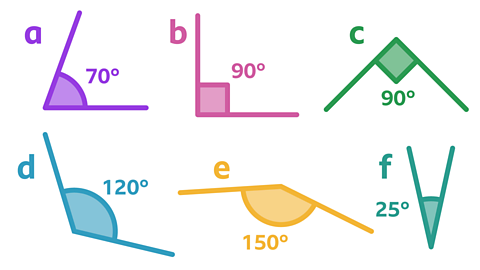
Which of the angles shown are acute and which are obtuse?
✓ Angle a and angle f are acute angles because they are smaller than 90°.
Angle d and angle e are obtuse angles because they are larger than 90° but smaller than 180°.
When you compare angles, remember to focus on the size of the angle itself, not on the direction it is pointing to.
Angles b and c might look different to each other but they are both right angles, and they measure exactly 90°.
Example 2
Remember that:
- an acute angle looks small and sharp
- an obtuse angle appears wide and open
- a reflex angle is larger than a straight line
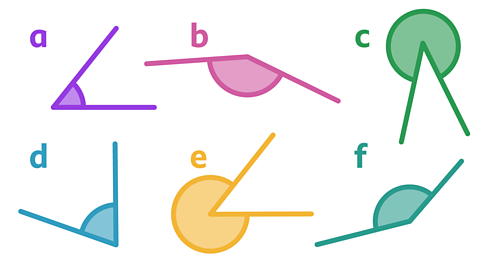
Which of the angles shown are acute, which are obtuse and which are reflex?
See if you can answer without using a protractor.
✓ Angle a and angle d are acute angles. They are smaller than a right angle.
Angle b and angle f are obtuse angles. Their turns are larger than a right angle, but are not as large as a straight line.
Angle c and angle e are reflex angles. Their turns are larger than those of a straight line, but they don't make a full turn.
Example 3
The greater than and less than signs can be used to describe comparisons between angles.

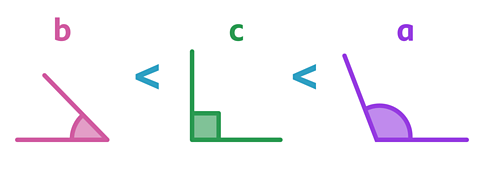
Put these three angles in the correct order from smallest to largest.
Use the less than sign in your answer.
✓ The answer is b < c < a
- Angle b is the smallest angle and is less than a right angle. It is an acute angle.
- Angle c is larger than angle b but smaller than angle a. It is a right angle.
- Angle a is the largest angle. It is more than a right angle. It is an obtuse angle.
NEW! Play Guardians: Defenders of Mathematica - the winter update. game
It's Mathematica as you’ve never seen it before, with all-new festive backgrounds and costumes. Available for a limited time only. Use your maths skills to save the day before it's too late!

More on Lines and angles
Find out more by working through a topic
- count4 of 4
- count1 of 4
- count2 of 4