Angles around a point
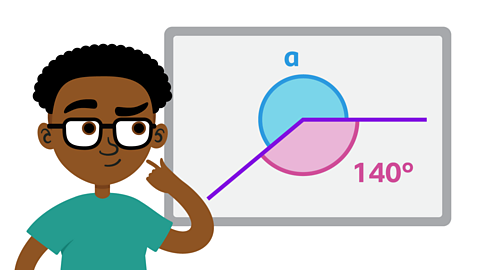
A full turn around a point equals 360º.
If a full turn equals 360º, then the sum of the angles around a point must also be 360º.
When you calculate angles around a point, you can use this fact to find the missing angles.
If you know one of the angles, you will be able to work out other angles around the point. You don’t always need a protractor.
Quiz
Why not see how much you know about this topic already? Then complete the guide and see if you can beat your score.
Types of angles
There are different types of angles based on their measurement.
Let's look at the different types.
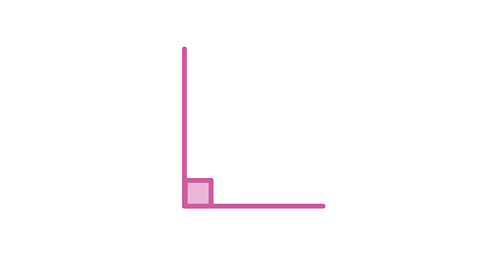
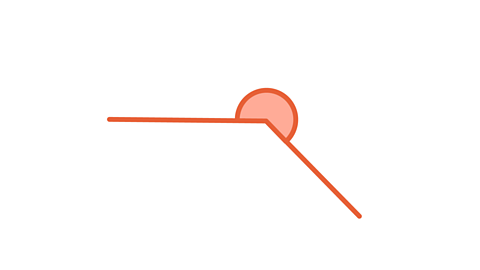
Image caption, Right angle
A right angle looks like the corner of a square or the edge of a book. It is a perfect 90°, which is often shown by a small square drawn in between the two lines


1 of 5
Calculating one missing angle around a point
We know that the sum of the angles around a point add up to 360 º.
Let’s calculate missing angle a.
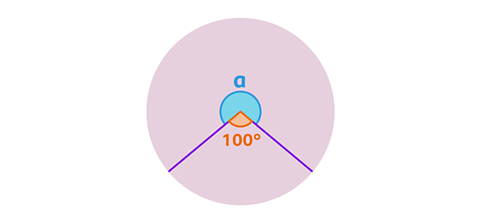
You can see from the diagram that one of the angles is 100º.
You can also see that the missing angle is greater than 100º.
It is a reflex angle. A reflex angle is greater than 180º and less than 360º.
To find the missing angle you need to subtract 100º from 360º. You can do that mentally.
360º - 100º = 260º
Then you can always check your answer by using the inverse.
260º + 100º = 360º
Therefore the missing angle is:
a = 260º
Calculating missing angles using other known fact
Sometimes you will use other known facts about angles to calculate angles around a point.
For this question, you can use your knowledge of right angles to help you.
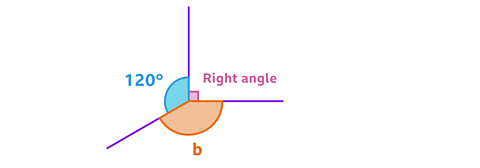
To calculate the missing angle b, you need to know the value of the other two angles.
One angle measures 120º and is obtuse. The other angle is a right angle.
You know it is a right angle because there is a small square. A right angle always measures 90º.
To find the sum of the two angles, we add them together.
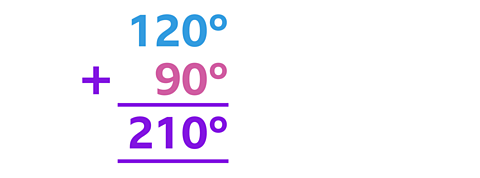
Then, you subtract this from 360º to find the missing angle.
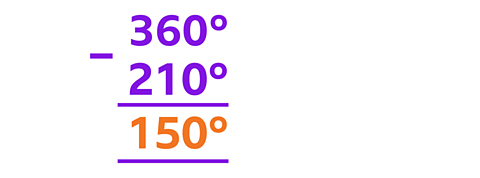
Therefore the missing angle is:
b = 150º
Calculating missing angles with the same value around a point
Sometimes the angles around a point are all the same size.
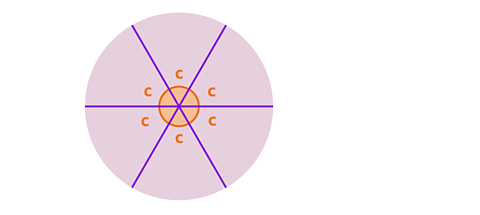
You can see that all the angles here are the same size.
To calculate angle c, you divide 360º by the number of equal angles.
There are six equal acute angles, so you divide 360º by 6.
You can use your division tables to help you.
If you know that:
36 ÷ 6 = 6
And 360 is ten times bigger than 36, then:
360 ÷ 6 = 60
You can check your answer using the inverse and our times table knowledge.
6 x 6 = 36
So:
60 x 6 = 360
Therefore, the missing angles must all measure:
c = 60 º
Example 1
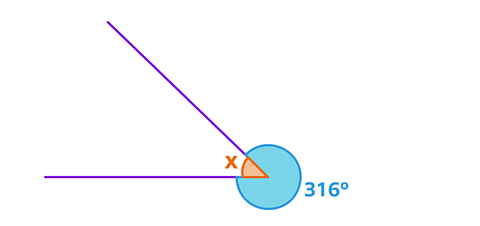
Calculate the missing angle.
✓ You can see from the diagram that one of the angles is 316º.
You can also see that the missing angle is less than 316º. It is acute.
To find the missing angle you need to subtract 316º from 360º.
360º - 316º = 44º
You can check your answer by using the inverse.
316º + 44º = 360º
The missing angle is:
a = 44º
Example 2
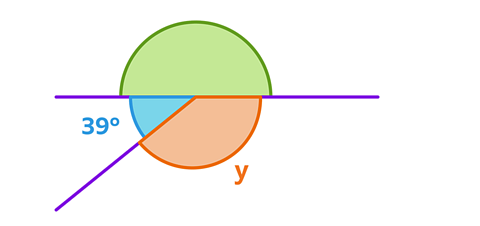
Calculate angle y.
You will need to use your knowledge of straight lines.
✓ You can see one of the angle measures 39º. Another angle is a straight line.
A straight line angle equals 180º.
To find the sum of the two angles, add them together. Then, we subtract this from 360º.
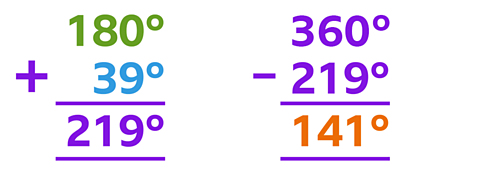
You can check using the inverse.
219º + 141º = 360º
Therefore the missing angle is:
y = 141º
Example 3
Let’s try one more.
This circle is divided into 3 equal parts, with 3 equal angles.
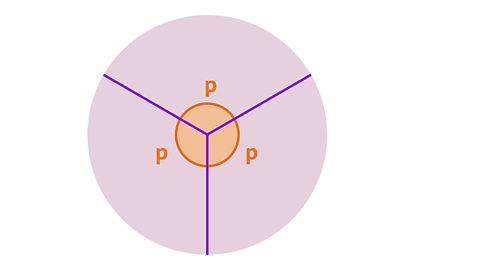
Calculate the size of the angle labelled p.
✓ To calculate angle p, you divide 360º by the number of equal angles.
You know the angles are the same because they're all labelled p.
There are three equal angles, so you divide 360º by 3.
You know that:
36 ÷ 3 = 12
So:
360 ÷ 3 = 120
Therefore:
c = 120º
NEW! Play Guardians: Defenders of Mathematica - the winter update. game
It's Mathematica as you’ve never seen it before, with all-new festive backgrounds and costumes. Available for a limited time only. Use your maths skills to save the day before it's too late!

More on Lines and angles
Find out more by working through a topic
- count1 of 4

- count2 of 4

- count3 of 4