Asteroids, comets, supernovas and stars
As a space scientist, you can spend your life studying some remarkable things.
For example, comets that streak across the sky like giant dirty snowballs. Asteroids with the power to destroy life – and perhaps create it. Not to mention mysterious planets and moons, with temperatures that could fry or freeze you to death in seconds.
Wherever you go, space is a strange and hostile place!
Yet here’s the thing about all the objects you’ll encounter in the Universe – they’re made from the same chemicals and elements you’ll find here on Earth.
What are asteroids?

An asteroid is a rocky object that orbits the Sun, just like planets do. But unlike planets, asteroids are much smaller. They are sometimes called ‘space rocks’ and come in all shapes and sizes.
Do asteroids hold the secrets of life?
Here on Earth, asteroids can get a bad press. Films often cast them as villains, and many scientists blame an asteroid for killing off the dinosaurs. But did they actually have a positive effect on our planet?
Some scientists believe that asteroids and comets were important for kick-starting life on Earth. That’s because they carry large amounts of water. Without water, life on Earth wouldn't be possible.
When the Earth was relatively young, it was struck by a giant wave of asteroids and comets. This might have provided much of the water that fills our oceans. Other scientists suggest that some asteroids might transport basic life-forms.
All this leads us on to one of science’s biggest and most controversial questions. Why is Earth the only planet – as far as we know – with life on?
If we’re ever going to solve this mystery, asteroids may hold some vital clues.

There are lots of asteroids in our Solar System. Most of them are found in the asteroid belt, a space between Mars and Jupiter.
Asteroids are made from rock, metal and ice and are left over from the formation of our Solar System. This means that they are around 4.6 billion years old.
Asteroids are all different shapes and sizes. Some are round like planets and other are jagged, irregular shapes. Some asteroids are as small as pebbles; others are hundreds of miles in diameter.
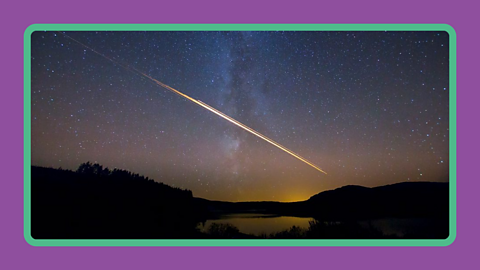
Many small asteroids enter Earth’s atmosphere each day. Almost all burn up before they hit the ground. As they burn they create a streak of light called a meteor. An asteroid that survives the fall through the atmosphere and reaches Earth’s surface is called a meteorite.
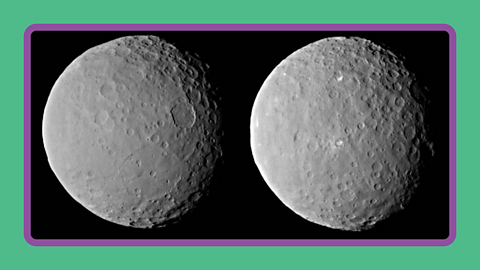
Ceres, was once thought to be the largest asteroid in our Solar System, but it has been reclassified as a dwarf planet.
What is a comet?
A comet is a big ball of ice, dust, and rocks that orbits the Sun. They are best known for their long tails. Sometimes, comets are called ‘dirty snowballs’ because they are made of frozen gases mixed with dirt and rocks left over from the formation of the Solar System.
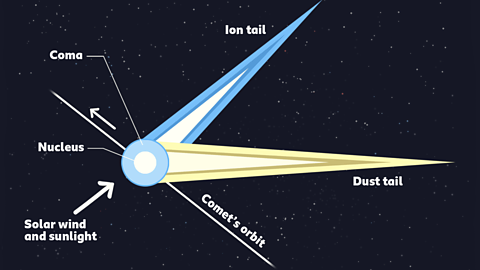
The solid centre of a comet is called the nucleus. It’s like the ‘head’ of the comet and is usually very small compared to its tail. It is made of frozen water, gases, dust and rock.
When a comet passes close to the Sun, the heat causes its ice to melt. This makes a bright, glowing tail of gas and dust, which can stretch millions of miles!
Unlike planets that orbit the Sun in a circle, comets travel around the Sun in big, long loops. Some take hundreds of years to make just one trip around the Sun.
Watch this video to see how you can make your very own comet at home:
Fran Scott uses everyday items to make a comet.
Comets are leftover bits of material from when our solar system formed 4.5 billion years ago.
They really are quite simple things, But it's the super freezing cold of space that allows them to exist.
But using a few simple ingredients we can make our own version of a comet, right here on Earth. Let's give it a go.
Firstly, comets, they do have water in them, so I've got some water here and it goes into our mixing bowl.
But comets not only contain frozen water, they also contain other frozen chemicals or compounds. Like this ammonia.
So these are smelling salts and they are used to wake people when they faint. And they really stink. Eugh, they really, really stink!
I'm just going to put a few of those into our mixing bowl there.
And the next thing they contain, comets have a rocky core. So I've got some sand and I'll put in a little like that. There we go.
And comets also contain the element, carbon. So I've got here some charcoal and this is made of carbon.
But in addition to that comets also have organic molecules. So these are molecules which contain carbon as well as other things.
…And this soy sauce is really rich in organic molecules. So I can do a good glug of that.
But another organic molecule is alcohol. Nail varnish remover has a little bit of alcohol in it. So I can just pour some of that in.
Now organic molecules are really important for living things, but another material that is also important is proteins.
So here we've got some amino acids and these go in to make our comet as well. Now at the moment it just looks like a dirty puddle.
But that's not a bad thing as comets are actually known as dirty snowballs.
So all we need to do to our dirty puddle is to freeze it. And to do that we are going to use one very special ingredient.
I'm sure you all know that here on Earth, water can be different things. When it's frozen, it's a solid, ice.
If we warm it up it soon becomes a liquid. And finally, when it gets hot it evaporates to become a gas, steam.
But in the super cold of space everything freezes, including gases like carbon dioxide which is the gas we breathe out. Even that freezes and here it is in its solid form.
Now it's really cold here, it's at minus 79 degrees Celsius, which is much colder than your freezer at home.
So cold in fact, I've got to wear these gloves and these goggles to protect me. And what I'm going to do is add this frozen carbon dioxide, or dry ice, to our dirty puddle.
In it goes, and I need to crush in all the items together.
Ah, it's hitting the water that is in the atmosphere and it's actually water vapour that you can see there, which is just like a cloud.
Okay, let's see what we have got. We've got a bit of a mess going on here.
Oh, and this is our comet.
If I blow on this, then you should be able to see the jets of gas as the dirty snowball is heating up and escaping.
And this is what makes the tail of a comet that you can see as they go past the Earth.
Ah, it's beautiful, I love my comet!

Fascinating facts about comets
One of the most famous comets throughout history is Halley’s Comet. It can be seen from Earth about every 76 years.
In the Medieval era, comets signified a bad omen. Halley's Comet appears on the Bayeux Tapestry which depicts the invasion of England by William the Conqueror in 1066.
The Perseid meteor shower happens every year in August as the Earth passes through the trail left by Comet Swift-Tuttle.
In July, 1994 Comet Shoemaker–Levy 9 collided with the planet Jupiter leaving dark red spots on the planet's surface that were visible from Earth.
On 4th July, 2005 a space probe named Deep Impact collided with Comet Tempel 1 to study the make up of comets. It found they were dustier than first thought.
What is a star?

A star is a giant ball of glowing gas, mostly made of hydrogen and helium, that shines brightly in the sky. Our Sun is actually a star. It gives us light and heat, which helps plants grow and keeps us warm.
Are you made from star-stuff?
The chemical elements are the basic building blocks for everything in the Universe. You’ll find them here on Earth, and right out across the stars.
Stars are like giant, cosmic factories, making elements. When stars like our Sun reach the end of their lives, they begin to run out of fuel and collapse. This creates the extreme pressures and temperatures needed to cook up elements, such as oxygen you breathe and the carbon that makes up your body.
When stars, larger than our Sun, collapse, they form even heavier elements, like aluminium and iron. However, when the largest stars (nine times bigger than our Sun) come to the end of their life, they are blown apart in a giant explosion called a supernova.
So next time you look in the mirror, remember what you’re made of – an incredible set of elements created by the giant explosion of a dying star!
Fascinating facts about stars
Stars twinkle because their light passes through Earth's atmosphere, which makes them look like they're shimmering.
Stars come in different colours depending on their temperature. Blue stars are the hottest, and red stars are cooler.
Stars form patterns in the sky called constellations. Some of the most well-known ones are the Big Dipper or Orion.
Stars are born from huge clouds of gas and dust in space, and they live for millions or even billions of years. When they grow old, some stars explode into supernovas.
When the centre of a massive star collapses in on itself, it can form a black hole.
Slideshow: Asteroids, comets and meteorites
- Image source, NASA/MSFC/MEO/Aaron Kingery

Image caption, Comets are balls of ice and dust in orbit around the Sun. As a comet approaches the inner Solar System, the heat from the Sun causes the materials within to vaporise and stream out forming a tail.
1 of 5
Did you know?
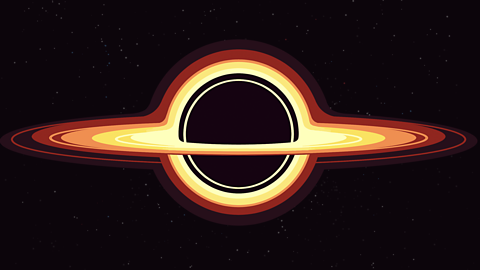
Black holes are inescapable. Their gravitational pull is so strong that they can swallow entire stars. Even light can't avoid being trapped by them.
There is a supermassive black hole located at the centre of our galaxy, the Milky Way. It was revealed to scientists by the Event Horizon Telescope (EHT) Collaboration in May 2022.
What is a supernova?

A supernova is a giant explosion that happens when a star dies. It’s one of the most powerful and brightest events in space!
A supernova is the most powerful force in the Universe, with temperatures reaching more than 100 billion degrees. Within seconds, the heaviest and rarest elements like gold and silver are created.
What causes a supernova?
Supernovas are like giant fireworks in space. They show us that even stars have life cycles, and when they explode, they make room for new stars and planets. They help scientists learn more about how stars and galaxies change over time.
Big stars like the Sun use hydrogen and other gases as fuel to shine brightly. Without fuel, the star can't hold itself up anymore, so it collapses. This collapse causes a massive explosion, called a supernova.
Fascinating facts about supernovas
When stars explode, they release a lot of energy and this makes the star shine much brighter for a short time.
For a few weeks or months, a supernova can be brighter than an entire galaxy! It lights up space and can even be seen from Earth.
After a supernova, what's left of the star can turn into a neutron star or even a black hole.
Supernovas spread gas and dust into space, which helps create new stars and planets.
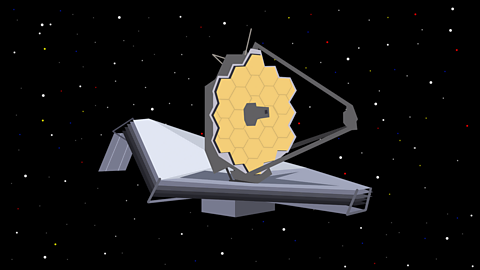
The James Webb Space Telescope orbits around the Sun and allows us to take images of supernovas and stars across the Universe.
What is a moon?
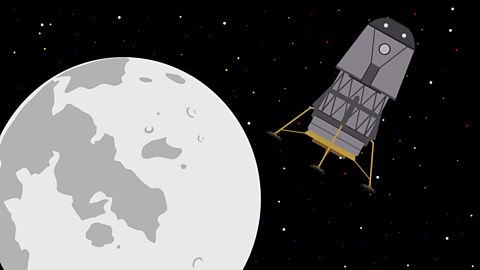
A moon is a large, round object that orbits (or goes around) a planet.
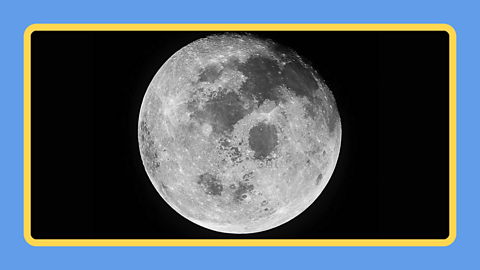
Many planets have moons, and Earth’s Moon is the one that we see in our night sky.
Our Moon is always circling around us, and it plays a big role in things like ocean tides and our calendars.
Fascinating facts about moons
The largest moon in the Solar System is Ganymede, which orbits Jupiter. Ganymede has its own magnetic field and is larger than the planet Mercury.
Mercury and Venus are the only two planets in the Solar System which do not have any moons.
Our Moon is the fifth-largest moon in the Solar System, and it's the closest object to Earth in space.
The Moon looks different each night because of its phases. Sometimes it's full and round, and other times, we can only see part of it, such as a crescent.
The Moon doesn’t have air or water like Earth so nothing can live there.
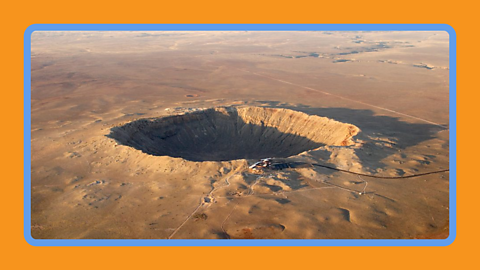
The Moon's surface is covered with craters, which are holes caused by asteroids, meteoroids or comets crashing into it.
Humans first landed on the Moon in 1969 during the Apollo 11 mission. Astronauts Neil Armstrong and Buzz Aldrin walked on the Moon and collected rocks.
Important words

Asteroids – Celestial bodies made of rock and metal that orbit the Sun. Asteroids can often collide with other celestial bodies like the Moon.
Black hole – Black holes appear when a star collapses in on itself. They create such a strong gravitational field that not even light can escape.
Chemicals – Any substance in the Universe with a defined composition. Chemicals are made up of elements.
Comets – A big ball of ice, dust, and rocks that orbits the Sun.
Dwarf planet – A small celestial body that orbits a star, often at the far reaches of our Solar System. Pluto is a dwarf planet.
Elements – A substance made of atoms that cannot be broken down into any other substance.
Meteor – Rocks that enter the Earth's atmosphere, heating and lighting up brightly as they fall to the surface.
Meteorite – The piece of rock or metal left behind from a meteor after burning through the atmosphere.
Moons – A moon is a huge ball of rock that orbits a planet.
Nucleus – The middle of a comet, usually a combination of ice, rock and dust.
Neutron star – The result of a supernova explosion. It is the collapsed core of a star.
Planets – A celestial body that orbits a star. They can be made up of rock, gas or a mix of both. The Earth is a planet.
Supernova – A giant explosion that happens when a star dies. A supernova is one of the most powerful and brightest events in space.
Activities
Activity 1 – Take the quiz
Activity 2 – Match the pictures
New game! Horrible Science: Stinky Space. game
Join Pipette on her epic mission and learn some revolting facts about space along the way.
More on Earth and space
Find out more by working through a topic
- count13 of 14
- count14 of 14
- count1 of 14
- count2 of 14