What is a wave?

When we think of a wave, we might think of someone moving their hand from side to side to say 'hello' or 'goodbye'.
We might think of the crashing waves in the Earth's oceans.
In science, a wave is the transfer of energy from one place to another. You may have heard of light waves or sound waves before.
What waves are there in every day life?

There are lots of waves all around us in everyday life.
There are waves in our seas and oceans. You can drop a rock into a pond and see waves form in the water.
Sound is a type of wave that moves through matter and then vibrates our eardrums so that we can hear.
Light is a special kind of wave that is made up of photons.
We even use waves (microwaves) to cook our food really fast.
Waves in space
In space, we can find lots of different types of waves.
These waves carry information about space objects, like how far away they are, how fast they're moving and what they're made of.
By studying these waves, scientists and astronomers are uncovering mysteries about the Universe.
So, what kind of waves do we find in space?
Light waves
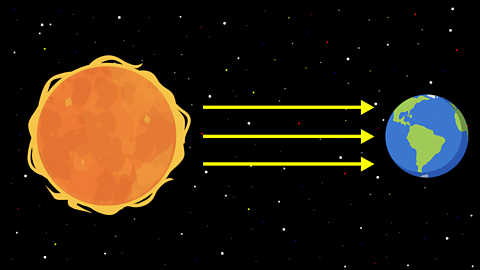
Everything we know about the Universe comes from light.
Light from stars and galaxies travel through space in waves.
Scientists use special telescopes to capture these light waves and learn about things that are far away.
A star's light contains information about the star's age, its surface temperature and the direction it's heading.
Radio waves
Radio waves are like messages from faraway objects in space.
Astronomers use large radio telescopes to 'listen' to space.
These waves can tell us about things such as black holes, pulsars and even signals from other galaxies.
Gravitational waves
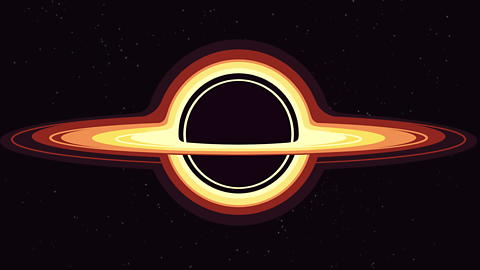
Gravitational waves are ripples in space itself. They happen when something really massive moves, such as when two black holes crash into each other.
These waves help scientists understand super big events in space that we can't see with light.
Sound waves need a medium to travel through. This is because they vibrate the particles to pass on the energy.
In space, there are virtually no particles to vibrate so sound waves can't travel in space.
However, scientists can turn the waves we receive from space into sounds that we can hear such as star's heartbeat or the rumble of a black hole.
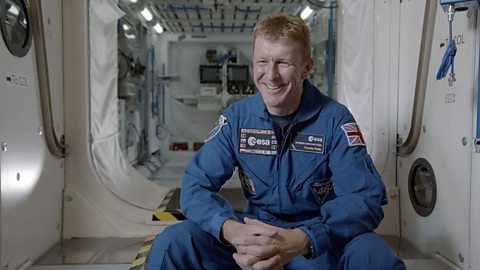
Watch: Tim Peake on sound in space
Tim Peake and Fran Scott explain why you can't hear anything in space. Archive: ESA, NASA
MALE NARRATOR: The International Space Station is a noisy environment. There are fans and machines running round the clock that maintain the environment that we need to stay alive. That includes generating oxygen, removing waste gases and maintaining a constant temperature.
But once in a while, when a repair is needed or an experiment needs to be set up, astronauts get to step outside their home and go on a spacewalk. And that’s when we leave the noise behind, because in space, everything is silent.
I’m told it’s a very strange and eerie experience. Even if you took a noisy alarm clock out into space, you wouldn’t hear a sound.
ALARM BEEPS
FEMALE NARRATOR: So why doesn’t sound travel in space? Well, sounds are just vibrations. So when you bang a drum, it cause the air to vibrate, that vibration travels as a wave and when it reaches your ear, you hear a particular sound.
But in space, it’s a completely different story. So what we are going to do is try and recreate the conditions that stop sound travelling in space. And to try and silence Tim’s rather annoying alarm clock.
So we’ve put the alarm clock under this bell jar and we are just going to put it on the plate there.
ALARM BEEPS QUIETER
FEMALE NARRATOR: Now we can still hear it ringing because it’s vibrating the air inside the bell jar, that’s vibrating the plastic, and when that vibration reaches our ear, we hear the sound. But listen carefully as we remove the air from inside this jar using this pump here, and see what happens to the sound…
MACHINE BUZZES
FEMALE NARRATOR: Now at the moment, that sound you can hear , that’s just the vacuum pump, pumping the air out, sucking the air out of the bell jar. I’m going to listen closely…MACHINE BUZZES
FEMALE NARRATOR: We need to remove a little bit more air…
MACHINE BUZZES
FEMALE NARRATOR: Okay we may be ready now. We’re just going to seal the bell jar. Turn the pump off…
SILENCE
FEMALE NARRATOR: And silence…
Now you can no longer hear the alarm even though it’s still going off, you can still see it’s flashing. And that’s because there’s no air inside of the jar for the sound to vibrate through. But just to prove that it’s still going, I’m going to let the air back in and have a listen…
AIR WOOSHES
FEMALE NARRATOR: That’s the sound of the air coming back in, but wait for it…
ALARM BEEPS
FEMALE NARRATOR: And there you go. You can still hear the alarm. So sound, is all about vibrating air.
Fascinating facts
Sound waves can travel through solids, liquids and gases.
The speed of light in air is very close to 300,000,000 m/s, which is nearly a million times faster than the speed of sound.
Light waves travel in a straight line.
Radio waves have the longest wavelengths in the electromagnetic spectrum.
Gravitational waves were first predicted in 1893 by the English scientist Oliver Heaviside. In1916 physicist Albert Einstein demonstrated the existence of gravitational waves using his general theory of relativity.
Gravitational waves are caused by violent or energetic processes in our Universe such as explosions, stars collapsing and black holes.
Black holes absorb every kind of wave including light waves. If you went near one, it would be impossible to escape.
The Hubble Space Telescope, which launched in 1990, has been used to see galaxies 13.4 billion light-years away.
The story of starlight
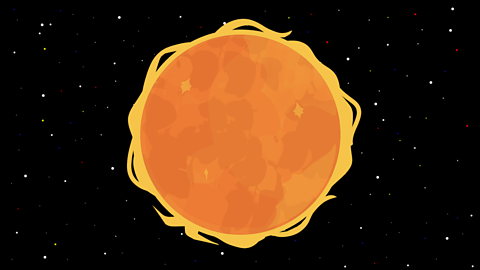
Although sound waves can’t travel in space, light waves can. That’s why everything we know about the Universe comes from light.
Light travels at an amazing 186, 282 miles per second. It can go seven-and-a-half times around the world in one second. Even at this speed, it takes light over 100,000 years to travel across our galaxy alone. The entire Universe is so big that many stars are already dead by the time their light reaches us.
Scientists have discovered that each star has its own unique light reading. Even though we could never visit them, we can use their light to study them. Written in the starlight is information about a star’s age, surface temperature and the direction it’s heading.
Astronomers have used light to reveal even more about space. They have discovered alien worlds, the age of our Universe and even the forces at play around a black hole. In short, light is helping us unlock some of space’s greatest mysteries.
Slideshow: Our Universe
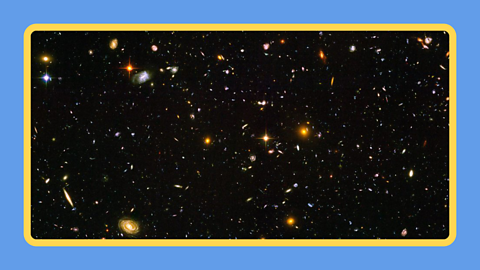
Explore the gallery below to find out about some of the most beautiful and extraordinary images of our Universe.
- Image source, NASA
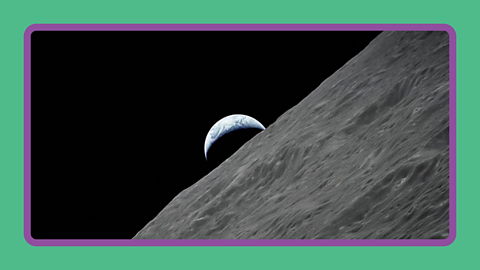
Image caption, This image shows the Earth rising above the surface of the Moon. It was taken by astronauts on-board the Apollo 17 spacecraft (the last piloted mission to the Moon) as they orbited the lunar surface in 1972.


1 of 8
Did you know?
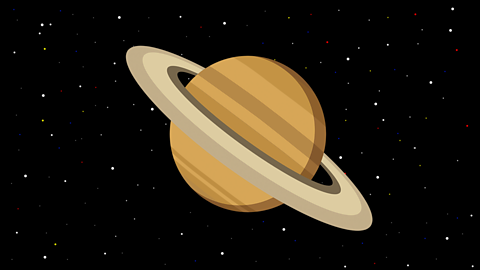
Satellites and probes offer similar benefits to telescopes.
Probes are unmanned spacecraft on a one-way ticket into space. They pick up scientific data about our Universe and beam it back to Earth.
Some probes orbit and land on different planets. Others head out into space. The probe Voyager 1 set off on its journey in 1977 and is now over 15.6 billion miles away!
Our eyes in the sky
Your eyes aren't powerful enough to see all the secrets of space. That’s why scientists use telescopes, satellites and probes to observe the Universe in greater detail. These instruments can also pick up light that is undetectable to our eyes.
Studying light on Earth has a few problems. The Earth’s atmosphere disturbs and blurs our pictures of the Universe. By putting telescopes into space, these problems can be solved instantly.
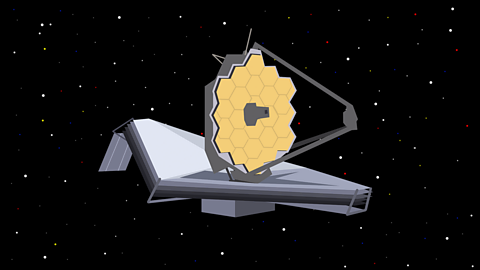
The James Webb Space Telescope launched on the 25th December, 2021 and is the largest telescope in space. Unlike the Hubble Space Telescope, it orbits the Sun (roughly 1 million miles away) not the Earth.
It can see further into the Universe than ever before, viewing supernovas, black holes and galaxies at the edge of the known Universe. It will help astronomers learn about the history of our Universe.
Important words
Astronomers – Scientists who focus on astronomy and everything outside of the Earth including space, planets, moons, asteroids, galaxies, stars and the wider Universe.
Gravitational waves – Ripples in space itself. They happen when something really massive moves, such as when two black holes crash into each other.
Light waves – Light from stars and galaxies travel through space in waves.
Particles – A tiny piece of matter.
Probes – A space probe is a robotic spacecraft that travels away from the Earth, like Voyager 1 and 2, which have now left our Solar System.
Radio waves – Radio waves are like messages form faraway objects in space. Radio telescopes can detect radio waves from black holes, pulsars and even signals from other galaxies.
Satellites – An object in space that orbits another larger object.
Sound waves – Sound waves need a medium to travel through because they use vibration to make energy. This means there's no sound in space as it's a vacuum.
Telescopes – A piece of equipment used to see faraway objects. Astronomers can use telescopes to see distant stars, planets and galaxies.
Wave – In science, this is the transfer of energy from one place to another.
Activities
Activity 1 – Take the quiz
Activity 2 – Draw the secrets of space

New game! Horrible Science: Stinky Space. game
Join Pipette on her epic mission and learn some revolting facts about space along the way.
More on Earth and space
Find out more by working through a topic
- count12 of 14
- count13 of 14
- count14 of 14
- count1 of 14