Reactions power rockets
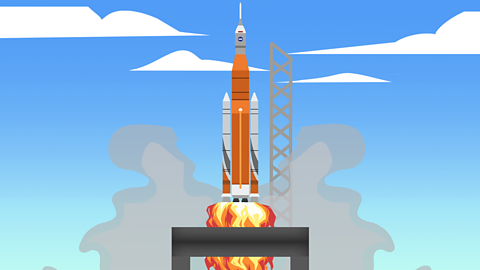
Have you ever wondered how a rocket launches into space?
How can a heavy object full of astronauts actually get off of the ground?
Well the answer is combustion!
Have you ever blown up a balloon and let it go – the air rushes out and makes the balloon fly away. This is similar to what happens when a rocket launches.
Rockets are propelled up into the sky by a chemical reaction known as combustion. This is a process where fuel reacts with oxygen, releasing heat and producing hot gases.
How do rockets blast off?
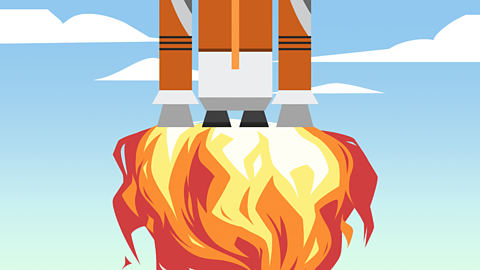
Rockets are powered by burning fuel, which makes hot gases shoot out of the base of the rocket, and this pushes the rocket upwards and away from the Earth.
Step 1
Rocket fuel is mixed with oxygen and ignited. This starts a chemical reaction.
Step 2
This chemical reaction produces a large amount of heat and hot gases.
Step 3
The hot gases are forced through a nozzle, expanding rapidly and accelerating. This expansion generates thrust. The faster and hotter the gases, the greater the thrust.
Gravity, a pulling force, is trying to keep the rocket on the ground. There has to be enough thrust from the rocket's engines to overcome gravity.
Watch: Tim Peake explains the journey to the ISS
Just before dawn on the icy plains of Central Asia, a giant hanger door opens and a train towing a 2,000 tonne Soyuz rocket rolls to the launch pad in the morning light.
On launch day, three astronauts pack into the capsule on top of the rocket and make the journey to the International Space Station (ISS). After lift-off, the rocket quickly burns through its fuel. Once the tanks are empty, they break away and fall back to Earth, while the rest of the rocket continues on to the ISS.
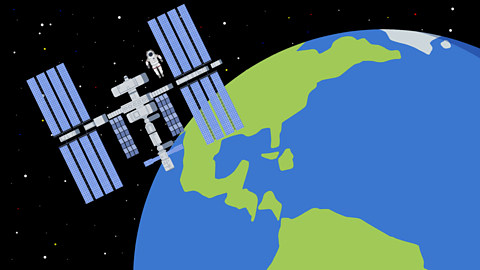
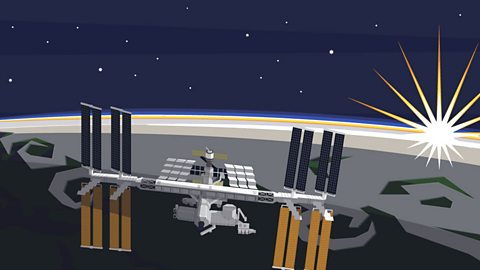
When the astronauts reach the ISS, it’ll be their home for around the next six months. The space station is a kind of orbiting science lab about 250 miles above the earth.
Tim Peake explains the journey to the International Space Station. Archive: ESA, NASA
TIM PEAKE: The International Space Station is about 400 kilometres up, which isn't that far actually, it's about London to Paris.
And it's orbiting the Earth at about 17,500 miles per hour which is extremely fast – about ten times the speed of a bullet.
Now, going that fast, it travels around the earth every 90 minutes so astronauts on board the space station get to see 16 sunrises and sunsets in a normal earth day.
We're actually freefalling around planet Earth.
So we have a centrifugal force if you like that comes from the fact that we're going so fast at 17,500 mile per hour and that is balanced by the force of gravity which is still pulling us down to planet Earth.
And those two forces balance out so we just constantly fall around planet earth and it feels like we're in zero gravity.
Fascinating facts
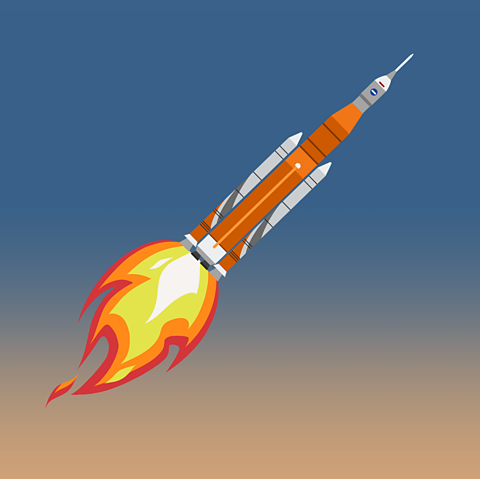
"Fire arrows' were used in battles in China in around 900 AD. They used gunpowder poured into bamboo sticks, which could be lit and fired into the sky.
In 1944 during the Second World War, the V-2 rocket was launched as a weapon by Nazi Germany. It generated thrust by burning a mixture of liquid oxygen and alcohol made from potatoes!
On 4th October, 1957 the Russian space agency launched the first artificial satellite, Sputnik I.
On 12th April 1961 a Russian cosmonaut named Yuri Gagarin became the first person to travel into space.
The Starship rocket, made by a private company SpaceX, is the largest rocket ever launched. It was almost 120 m tall, had 33 engines for thrust and could lift 150,000 kg of payload.
Astronauts can grow up to 3% taller whilst in space, although they go back to normal when back on the Earth.
On 15th April 1970, the crew of Apollo 13 (Jim Lovell, Fred Haise, and Jack Swigert) were 400,171 km from Earth whilst circling around the Moon, the furthest any humans have travelled from our planet.
NASA's Artemis rocket aims to take astronauts back to the Moon, and in the future to Mars!
How do you catch a space station?

Astronauts spend years training for the launch day. Every action is carefully controlled and prepared for, right down to the tiniest detail.
Nothing is left to chance. The astronauts are strapped in to a Soyuz rocket charged with highly explosive fuel - one minor miscalculation could be disastrous.
It can take less than nine minutes for the astronauts to get to space. As the Soyuz bursts out of the atmosphere, the sky flashes from blue to black and the capsule is left orbiting the Earth.
But the space station isn't floating in one place – it's flying around the planet at over 17,000 miles per hour!
The astronauts have to delicately guide their capsule to meet a tiny docking station on the ISS. It’s a ballet between hundreds of billions of pounds of space technology – all done while wheeling around the world at 10 times the speed of a bullet.
Fran Scott explores the explosive power of rocket fuel. Archive: NASA
It takes a team of the world's best scientists and engineers to get a rocket into space, but, actually, the science that gets a rocket off the ground is pretty simple.
It's all to do with unlocking the power of reactions.
Most rockets are powered by a combustion reaction, so they burn a fuel and that releases a lot of energy, really, really fast.
This balloon is filled with the same gas that they use as rocket fuel, so hydrogen. This burns really quickly when you mix it with the oxygen that's in the air, as you will see. BOOM!!
If we watch in slow motion we can see that as the balloon splits, the hydrogen burns very quickly and we get a large but brief fireball – a combustion reaction.
Now that was ok, but to make a combustion reaction powerful enough to make something move, you need to burn the fuel ridiculously fast – faster than we just did. And the way to do that is to not just use the oxygen that's in the air, but to use pure oxygen.
So here we've got another balloon and again it's filled with hydrogen, but there's also a little bit of oxygen in there. And this one is going to be much loader. I'm going to light it and let's see what happens. BOOM!!!
Wow! That was load and a much more violent explosion. You can see how the balloon just explodes apart.
And that is how a rocket works; all of that expanding air caused by the combustion reaction in the rocket engine is forced in one direction, down towards the ground.
We call this thrust and it fights the force of gravity – the force that pulls everything back to the ground.
And if the rocket's thrust is large enough, then it lifts off!

Did you know?
The Saturn V rocket that took NASA astronauts to the Moon in the 1960s and 1970s carried a massive 770,000 litres of kerosene fuel and 1.2 million litres of liquid oxygen.
That's how much thrust and combustion it took to escape Earth's orbit!
Important words

Astronaut – A person trained to travel in space. In Russia they are known as cosmonauts.
Chemical reaction – The process in which two or more substances react to create different substances.
Combustion – A chemical reaction that produces heat and flames.
Gravity – A force that pulls things to the ground on Earth and other planets. It also holds planets, moons and asteroids in their orbits around the Sun.
Ignite – To cause something to catch fire.
Thrust – The force that pushes a rocket upwards.
Activities
Activity 1 – Launch the rocket
To launch a rocket off the ground, its engines need to provide enough thrust to overcome gravity – the force that pulls everything back to Earth.
Move the arrow over the video to see the forces in action.
Over 300 years ago, Sir Isaac Newton first described how applying a force in one direction creates an equal but opposite force in the other direction.
In other words, if you want to make a rocket go up, something needs to push down. So as the rapidly expanding gas from the burning fuel is forced down towards the ground, it forces the rocket up into the sky.
Activity 2 – Take the quiz
Activity 3 – Quiz sheet
New game! Horrible Science: Stinky Space. game
Join Pipette on her epic mission and learn some revolting facts about space along the way.

More on Earth and space
Find out more by working through a topic
- count10 of 14
- count11 of 14
- count12 of 14
- count13 of 14