Returning to the Earth from space

Returning to the Earth from a flight into space is a challenge.
Astronauts return home from space through a carefully planned process that involves their spacecraft and accurate measurements so that they can return safely.
Astronauts and their support team need to calculate the angle and speed of their descent correctly, taking into account the forces of gravity and air resistance.
Re-entry – Step by step

Leaving the Space Station
If astronauts are on the International Space Station (ISS), they must first enter a special spacecraft called a space capsule (like NASA's Orion or the Russian Soyuz). The space capsule detaches from the ISS and with the pull of the Earth's gravity it begins its journey back to Earth.Re-entry into Earth's Atmosphere
As the space capsule travels closer to Earth, it starts to fall back towards the planet and speed up. It enters Earth's atmosphere and heats up because of the friction between the capsule and the air. The capsule has a heat shield to protect the astronauts from the extreme heat involved in re-entry.
Slowing down with parachutes
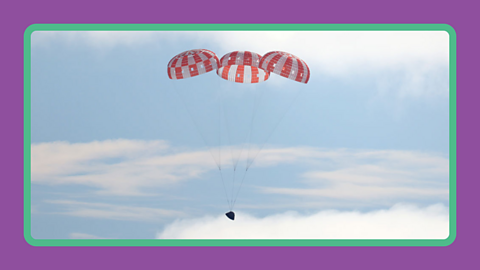
After it passes through the atmosphere, the space capsule needs to slow down. Large parachutes open up and create a much larger surface area than just the capsule alone. This increased surface area creates more air resistance which helps the capsule float gently towards the ground.Splashdown or landing
Depending on the mission, the capsule either lands in the ocean (called a ‘splashdown’) or on land with the help of parachutes. Rescue teams will be waiting to pick up the astronauts once they land.Home sweet home!
After landing, astronauts are safely brought back to their home base. They are checked by doctors and then can return to normal life on Earth.
Watch: How astronauts return home
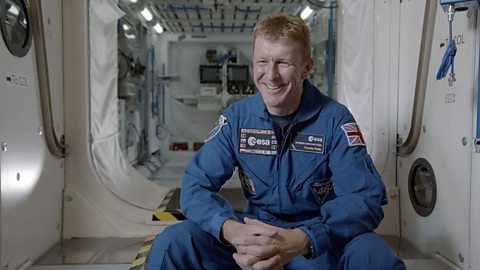
Tim Peake and Fran Scott explain the science behind getting the astronauts back home. Archive: NASA
MALE NARRATOR: After six months of living and working on board the International Space Station, astronauts have to make their way back down to Earth. Three of them cram into the Soyuz capsule with not much more room than the back seat of a car, and drop the 400 km out of orbit and back down to Earth.
After the capsule detaches from the Space Station a quick blast on the thrusters slows it down and gravity does the rest, pulling it back to Earth. The capsule slows from about 28,000 km an hour in orbit and drops into the Earths atmosphere, streaking across the sky at 800 km an hour.
And this is a pretty bumpy ride and one of the most dangerous parts of the mission. We have to get the re-entry angle just right. Too shallow and the capsule will bounce off the Earths atmosphere like a skimming stone and off out into space. Too steep and the capsule will burn up on re-entry.
Even getting the angle just right means the capsule glow white hot, which is why it has a special protective heat shield and this is because the of the friction with the Earths atmosphere.
FEMALE NARRATOR: It’s just the force of gravity that brings the astronauts back to Earth, as Issac Newton may have once said; “What goes up, must come down”. But slowing the astronauts down, well that’s a completely different matter.
How on Earth do you stop something that’s travelling at 17,000 miles an hour? Well to be honest with you it’s the Earth’s atmosphere that does most of the work. As the craft enters the Earths atmosphere, the air rushing past the craft creates friction. And that force, which is also known as ‘air resistance’ or ‘drag’, that slows the aircraft down.
But if something rubs past another object fast enough, like air whooshing past an aircraft at high speed, then things are going to get extremely hot - because friction creates heat. Just like, you know when you get your hands and you rub them together really, really hard, ah…
Then they get hot as well.
Now people in the olden days used this idea of friction creating heat to rub sticks together to make fire. But that used to take a long time so instead, I’m going to use this drill. And I’m going to do it on this little bit of wood and see if we can create some heat…
DRILL BUZZES
So what we can see with our heat sensitive camera is that as the drill whizzes round it rubs against the plank so much that it creates enough friction and heat to create the smoke.
There you go can you see the smoke that’s coming off? Just there? Now that, is because the heat is being created by the friction. The friction is the drill rubbing on the wood. Oh and I can smell the smoke as well from here.
So there you go, friction cough creates heat.
So if like the astronauts capsule, you’re travelling through the Earths atmosphere, things do get extremely hot. Over 1600 degrees Celsius. That, is hot enough to melt steel.
And for the final few miles the astronauts have another trick to help them. The capsule unfolds huge parachutes. The largest is 10,000 square meters – about as large as four tennis courts. A massive surface area that catches the air, acting like a natural break. This slows the craft down to a safe speed.
Bringing the astronauts safely back to Earth.
Fascinating facts

Spacecraft re-entering the Earth's atmosphere travel at between 17,500 mph and 25,000 mph which is faster than the speed of sound.
Russian cosmonaut Valeri Polyakov spent 437 consecutive days in space on the space station Mir, the longest stretch in history.
The Russian space capsule Soyuz 23 landed on Lake Tengiz in Kazakhstan in October 1976, which was frozen over. The capsule sank in temperatures as low as −22 °C and it took nine hours to recover the capsule from the frozen water. Both cosmonauts survived.
The angle of a spacecraft's re-entry is crucial for managing heat exposure. If the angle is too deep or too shallow the craft will burn up, killing everyone on board.
The International Space Station (ISS) completes 16 orbits of Earth every day (24 hours).
Spacesuits keep astronauts safe from the vacuum of space, as well as from dangerous radiation and extreme temperatures.
Astronauts can grow up to 3% taller whilst in space, although they return to their normal size when back on Earth.
On 12th April 1961, a Russian cosmonaut named Yuri Gagarin became the first human to travel into space.
Apollo 11 and Neil Armstrong
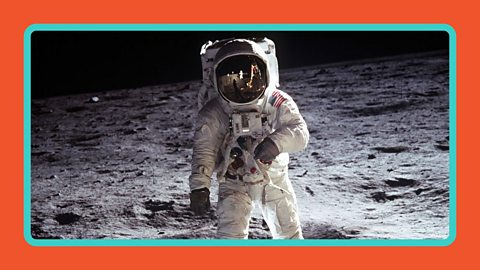
The Apollo 11 mission was launched from the Kennedy Space Center in Florida on 16 July. On 20 July 1969, the American astronaut Neil Armstrong became the first person to walk on the moon, closely followed by his fellow pilot Buzz Aldrin.
After returning safely to their spacecraft, the Eagle lander, Armstrong and Aldrin launched from the Moon's surface to dock with the command module Columbia, piloted by Michael Collins which was in orbit around the Moon.
It took four days for Columbia and the three astronauts to travel the 200,000 miles back to Earth from the Moon.
On re-entry, the module turned around to point its heat shield toward the atmosphere where it reached speeds of more than 24,700 miles per hour, with temperatures reaching as high 2750°C.
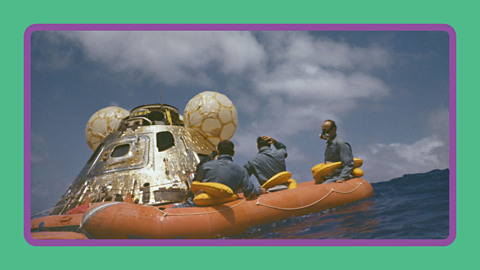
Once through the atmosphere, at an altitude of about 24,000 feet the parachutes were jettisoned to slow the spacecraft down and allow for a safe landing in the Pacific Ocean.
After a flight of 195 hours, 18 minutes and 35 seconds Apollo 11 splashed down in the Pacific Ocean.
The astronauts were picked up by two US Navy helicopters and returned to an aircraft carrier, before going home.
The module Columbia is on display at the The National Air and Space Museum in Washington, DC. The Eagle lander was jettisoned and if it has not crashed to the surface by now, may still be in orbit around the Moon!
Important words
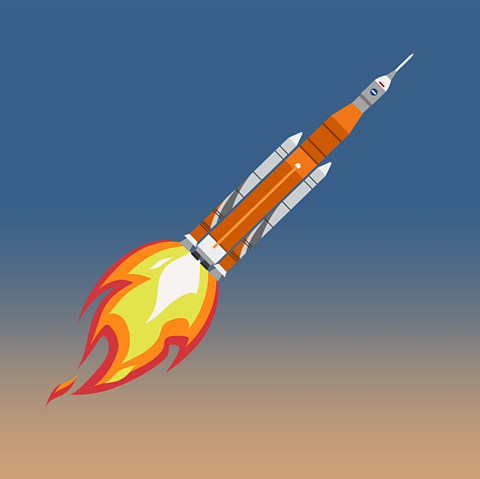
Air resistance – A type of friction that occurs when an object travels through the air.
Astronauts – A person trained to travel in space. In Russia, they are called ‘cosmonauts’.
Atmosphere – A mixture of gases that surrounds a planet.
Friction – The resistance experienced when an object travels over or through a surface.
Gravity – A force that pulls things to the ground on Earth and other planets. It also holds planets, moons and asteroids in their orbits around the Sun.
Space capsule – A spacecraft designed to take astronauts and other things in and out of space.
Activities
Activity 1 – Returning home safely quiz
Activity 2 – Interact: The International Space Station (ISS)
Click below to learn more about the ISS, its astronauts, and the Earth they are orbiting.
Activity 3 – Design your own spacecraft

New game! Horrible Science: Stinky Space. game
Join Pipette on her epic mission and learn some revolting facts about space along the way.
More on Earth and space
Find out more by working through a topic
- count14 of 14
- count1 of 14
- count2 of 14
- count3 of 14