The Earth

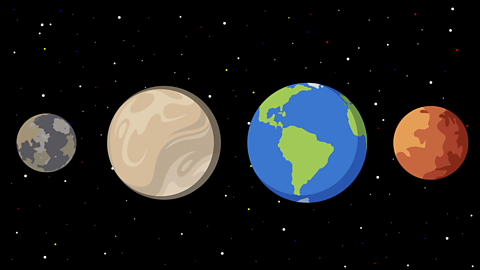
The Earth is one of the planets that form part of our Solar System. It is mostly made of rock rather than gas like some other planets.
It looks like a giant sphere in space.
It is the only planet that is known to be able to support life because it is just the right distance from the Sun so that it is not too hot and not too cold. This means that the water on Earth mostly stays as a liquid, rather than frozen as ice or evaporating as a gas.
The water on the Earth is important to allow living things to survive.
Watch: What is the Earth?
Discover more about Planet Earth.
Narrator: Four and a half billion years ago, clouds of cosmic dust and gas which were orbiting the Sun collided into one another, creating the Earth,
our planet, the home of mankind.
It spins at 1000 miles an hour, taking 24 hours to complete a full rotation.
Relentlessly travelling through space, it undertakes a full orbit of the Sun every year, giving the planet its seasons.
In fact, the definition of a planet is a celestial body which orbits around a star.
The Moon, is only a quarter the size of the Earth.
Gravity holds it in an ongoing embrace, its orbit taking nearly 27 and a half days to complete.
What's this…?
Stella: The Earth is spinning around, its rotation causes night and day…
It’s daytime when it faces the Sun,
Night-time when it faces away.
The Earth is spinning around,
Its rotation causes night and day…
Now the moon doesn’t spin,
While it orbits the Earth
Gravity stops it drifting awwwwaaaaaay…
Fascinating facts

Water covers about 70% of the Earth's surface and almost all of this is salt water in the oceans.
Planet Earth is about 4.5 billion years old.
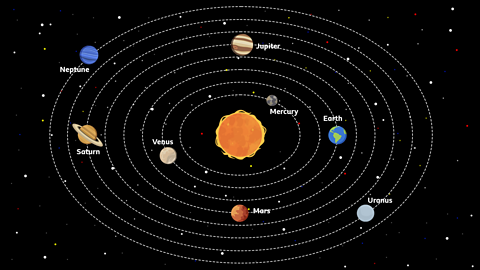
The Earth is the third closest planet to the Sun.
It takes Earth just one year (365 days) to orbit the Sun.
As well as orbiting the Sun, the Earth rotates on its axis at 1000 miles an hour, completing one full rotation in 24 hours.
The Earth isn't actually perfectly round. Its rotation causes it to flatten slightly at the poles and bulge at the equator, not to mention the various mountains and volcanoes on the surface!
Earth is the fifth largest planet in the Solar System.
Earth is the only planet in the Solar System that has just one moon.
The Earth and the Sun
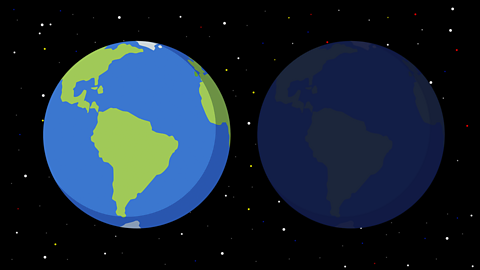
The Earth is constantly spinning. We can't fee it spinning but it is actually moving at 1000 miles an hour.
It takes 24 hours for the Earth to do one full rotation on its axis and get back to the point that it started from. This is what makes a day.
When the Earth rotates, one side will be facing the Sun and it will be daytime in these countries.
On the opposite side of the Earth, the countries that are facing away from the Sun will be dark and it will be night-time.
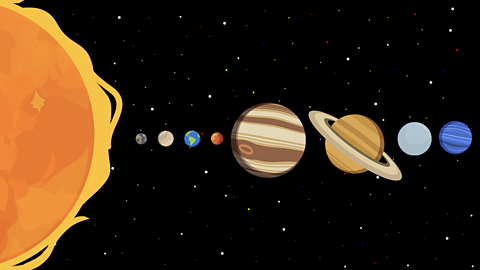
The Earth, along with the rest of the other planets in our Solar System, orbit the Sun. Each planet takes a different amount of time to travel around the Sun once, depending on how close they are to it.
The Earth takes about 365.25 days to orbit the Sun which is one year.
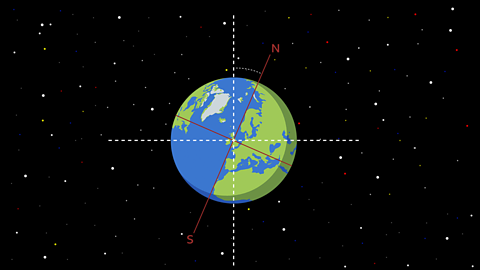
When you look at a model of the Earth or a globe, they are usually mounted straight with the north pole right at the top of the globe and the south pole right at the bottom with the axis straight through the middle.
However, in real life the Earth is actually tipped over at an angle of 23.5 degrees from upright.
The tilt of the Earth means that as it orbits the Sun, the northern and southern hemisphere get different amounts of sunshine at different times of the year.
This creates the different seasons.
Slideshow: The four seasons
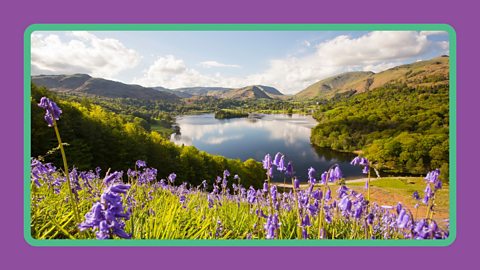
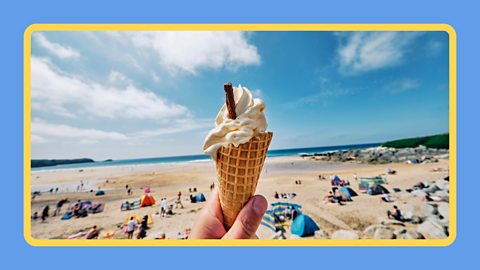
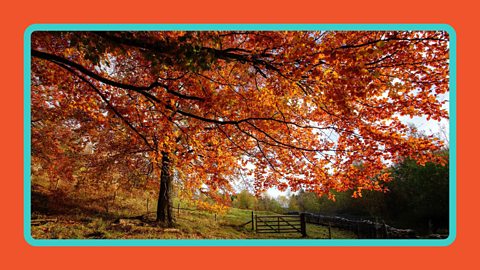
Image caption, Spring
When it is spring, day and night are about the same length. The days are starting to become longer as we move towards the summer.

1 of 4
Did you know?
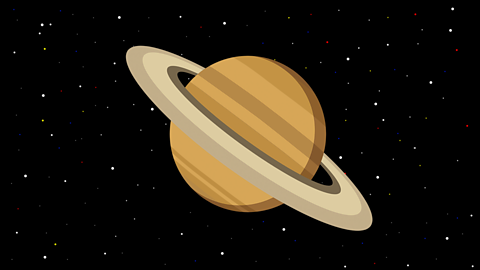
The name 'Earth', was taken from Old English and Germanic. It simply means "the ground." It is the only planet name in our Solar System that does not come from Greco-Roman mythology.
The names of other planets, such as Jupiter and Saturn, come from Greco-Roman mythology.
Slideshow: What is the Earth?
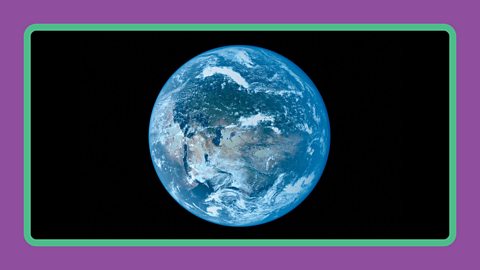
Image caption, The Earth
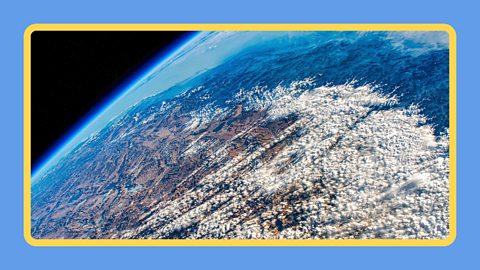
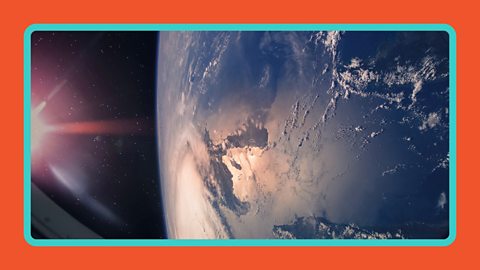
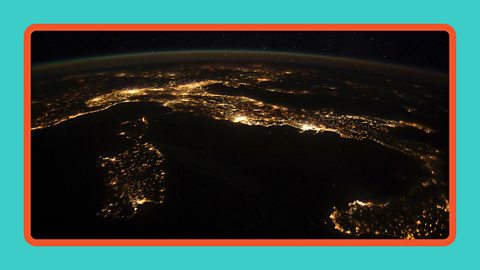
Planet Earth is about 4.5 billion years old and is the third planet from the Sun. It is the only planet in our Solar System that supports life.
1 of 4
Did you know?
A year on Earth is usually 365 days long, but because the Earth takes 365 and a quarter days to orbit the Sun, we add the four quarters of a day together to create a whole extra day once every four years.
We add this on to February so we have February 29th once every four years. We call this a leap year!
The Earth and the Moon
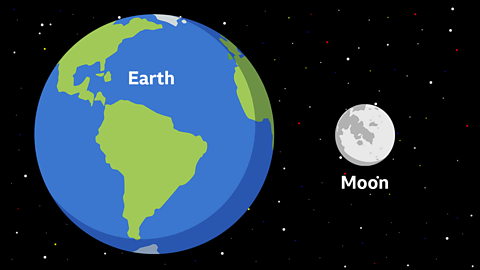
The Earth is the only one of the rocky planets to have its own natural satellite.
It is called the Moon.
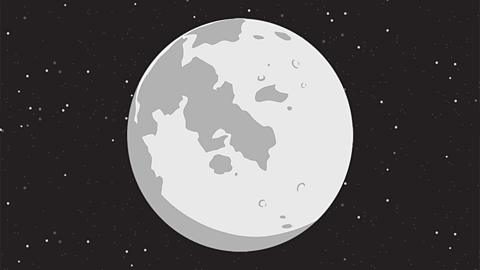
The Moon is a large sphere shaped lump of rock which is about a quarter the size of the Earth. It is covered in craters; lots of dents and holes caused by other objects in space crashing into it.
The Moon orbits the Earth, taking 27 and a half days to travel all the way around.
It is held the right distance away from the Earth by the Earth's gravity.
The Moon cannot make its own light so even though the Moon looks like it is shining into the night sky, it is actually just reflecting the light from the Sun.
Day and night
When the Earth rotates on its axis, half the Earth is facing the Sun which means it is daytime.
The other half facing away from the Sun is in darkness so it is night-time.
Watch: Day and night
Learn more about the Earth's orbit of the Sun.
If you imagine a line running between the North and South Poles, the Earth rotates about this line, called an axis.
In winter, the North Pole is tilted away from the Sun, so the Sun's rays can't reach places in the far north, the Arctic Circle.
In these places, it stays dark all day in the middle of winter.
But the Earth travels around the Sun, taking a year to do so.
As the Earth moves around the Sun, in the north, you can see the amount of daylight gradually increasing, so the days there get longer, as in springtime.
By June, the Earth has moved around the Sun, so the North Pole is now tilted towards the Sun and places in the far north get really long days.
At the North Pole, it doesn't get dark.
The Earth takes a whole year to orbit the Sun.
But it's the tilt which gives us the seasons.
Here, the North Pole is back in midwinter darkness again.

Did you know?
Modern humans have only been on the Earth for around 200,000 years. Before that, our ancestors would have been around for nearly 6 million years which is a short time considering the Earth is almost 4.5 billion years old.
Important words
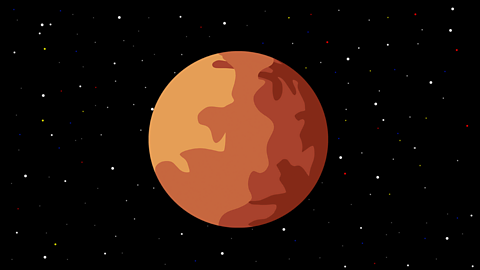
Axis – The imaginary line running through the Earth, from the North to the South Pole.
The Earth – The planet that we live on. The Earth is the third closest planet to the Sun and is tilted an angle of 23.5 degrees. It's made from rock and gas.
Hemisphere – Half of a sphere. The Earth is split into two hemispheres, the northern and southern which are separated by the equator.
Orbit – To move in a circle around a planet or star.
Planet – A celestial body that orbits a star. Planets can be made up of rock, gas or a mix of both. The Earth is a planet.
Satellite – An object in space that orbits another larger object.
Solar System – The eight planets and their moons as well as other smaller bodies, such as asteroids and comets, which orbit the Sun.
Sphere – A circular shape, like a ball.
Activities
Activity 1 – Tap and find
Activity 2 – The Earth quiz
Activity 3 – Create your own Sun, Earth and Moon model
New game! Horrible Science: Stinky Space. game
Join Pipette on her epic mission and learn some revolting facts about space along the way.
More on Earth and space
Find out more by working through a topic
- count2 of 14
- count3 of 14
- count4 of 14
- count5 of 14