What causes day and night?

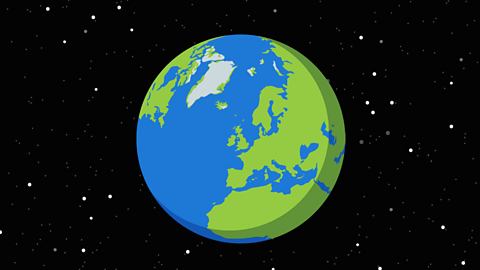
The Earth is always spinning on an imaginary line called an axis. This line goes through the North and South poles.
We call this spinning, rotation, and it takes about 24 hours for the Earth to make one full turn.
As the Earth rotates on its axis, it is also orbiting the Sun. As it rotates on its axis, different parts of the Earth face the Sun, which does not move.
When a part of the Earth is facing the Sun, it's daytime and you can see the Sun in the sky. As the Earth keeps spinning, that same part of the Earth starts to turn away from the Sun and it begins to get dark. This is called night-time.
You may have noticed that during the summer, the day is longer than the night and during the winter, the day is shorter than the night. This is because the Earth's axis is actually tilted.
This is what causes the Earth to have seasons.
Watch: Day and night
Find out how it goes from day to night.
Here, on Earth, how do we go from day to night?
It's night-time in parts of the world, but daytime in other parts.
When Britain faces the Sun, it's daytime in Britain.
But the other side of the world is in darkness, so, in Australia, it's the middle of the night.
However, the Earth rotates, and as it rotates, parts of the Earth that were facing the Sun turn away into darkness.
The Earth rotates one complete turn every 24 hours, so day is followed by night is followed by day.
Fascinating facts

The Earth's rotation is what also gives us time zones. In one part of the world it will be night-time while at the same point in time in another part of the world it will be daytime!
During certain months of the year at the North and South Poles, there can be 24 hours of daylight or 24 hours of darkness. This is due to the tilt of the Earth's axis.
At any moment, half of the world is in daylight, with the other half in darkness.
In the UK, during the summer there is around 16 and a half hours whereas during the winter there is only around 7 hours and 45 minutes.
The Earth's rotation makes it seem like the Sun rises in the East and sets in the West.
The shortest day of the year is called the winter solstice in the UK, and the longest is called the summer solstice.
We can only see the Moon because it is lit up by the Sun; the moon does not make its own light.
A day on Earth is 24 hours long because that is how long it takes for the Earth to rotate once on its axis. Other planets in our Solar System have longer or shorter days because they take more or less time to rotate once.
Slideshow - Day and night
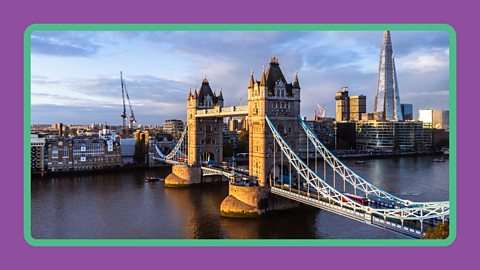
Image caption, Daytime
When half of the Earth faces the Sun, the sky is bright and lit up by the Sun, meaning it's daytime.
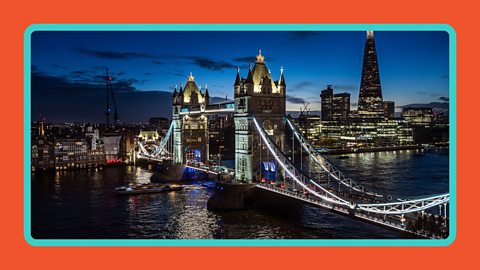
1 of 2

Did you know?
The clocks go forward to British Summer Time (BST) on the last Sunday in March every year, meaning we all lose an hour of our day.
They go backward on the last Sunday of October every year, which is when we gain an hour!
Does the Sun move?
Do you ever look up at the sky and see that the Sun has moved? You may even have heard the phrase:
the sun rises in the east and sets in the west.
This is not true!
The Sun doesn't actually move across the sky. The sun stays exactly where it is: in the centre of our Solar System.
The sun appears to move because the Earth is rotating.
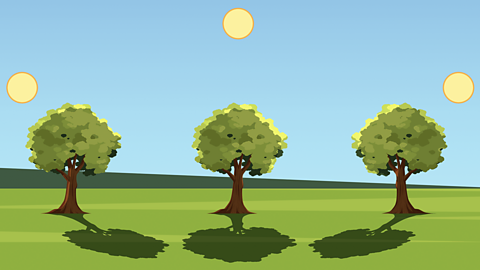
In the morning, it looks like that the Sun is rising in the east. As the day goes on, the Earth continues to spin. The Sun appears to move higher in the sky.
Later, as the Earth starts to turn away from the Sun, it looks like that the Sun is setting in the west.
It is the spinning of Earth on its axis that causes day and night.
It is this spinning that also makes the Sun look likes it's moving across the sky when actually it is the Earth that is moving.
Watch: Explaining day and night
Understanding why we have day and night.
SEYMOUR: Hello, Seymour Science here! As we all know, sometimes it’s day… and sometimes it’s night… but why do we have day and night? My guest today is here to tell us! Ladies and gentlemen… Rosie!
ROSIE: Thanks Seymour! Many of us live in villages, towns or cities… but these are all part of one big place that we call… Planet Earth! Earth is lit up by the Sun —
SEYMOUR: Which is a star!
ROSIE: That’s right. There are billions of other stars similar to the Sun, most are even bigger… they're just much further away, so look really small. Our planet spins on an invisible line — called ‘an axis’. Half of the Earth is always facing the Sun, meaning it is lit up. The other half is in darkness until the planet turns around. That’s why we have day and night!
SEYMOUR: The Sun keeps us warm too, right?
ROSIE: That’s right! The Sun is a HUGE ball of gas, MUCH bigger than Earth, and the gas is exploding all the time, so it gets very hot and very bright.
SEYMOUR: But what about the Moon?
ROSIE: The Moon can look bright too— but that’s because sunlight bounces off it, helping us see at night!
SEYMOUR: Now for the really clever stuff!
ROSIE: The Earth takes one day to completely spin around…and it takes about a month for the Moon to go all the way around the Earth in a circle…
SEYMOUR: We call this an orbit!
ROSIE: …And then it takes a whole year for both of them to go all the way around the Sun. So this is how we measure days, and months and years.
SEYMOUR: Like I said… clever!
MUM: I hope you two aren’t making a mess up there!
SEYMOUR: Ooh, got to go!
Did you know?
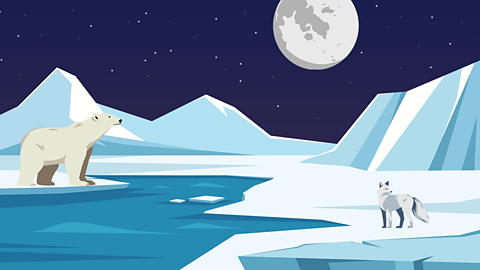
Longyearbyen in Svalbard, Norway is the world's most northerly civilian settlement.
Every year from around November 14th to January 29th Svalbard experiences a Polar Night of complete darkness without any sunlight.
In summertime Svalbard experiences a Midnight Sun between the months of April to August, when the Sun never sets!
Important words
Axis – The imaginary line running through the Earth, from the North to the South Poles. Earth spins around its axis.
Daytime – The hours of the day when the Sun provides enough light to see.
Earth – Our planet, the third from the Sun in our Solar System.
Night time – The hours of the day when it's dark outside and the Sun isn't providing light.
Seasons – The four periods of the year we base our calendar around; spring, summer, autumn and winter.
Solar System – The Solar System is the name given to the part of space that surrounds the Sun and everything in it, from planets to moons, comets and asteroids.
Activities
Activity 1 – Day and night quiz
Activity 2 – Make a model
Let's make a model of the Earth and the Sun.
Place a ball on a stick or hang it from some string and use a lamp to model the Sun.
Place yourself on one point on the ball (Earth). Observe what happens when the ball spins on its axis in front of the Sun.
What does this tell us about day and night?
Activity 3 - Downloadable
New game! Horrible Science: Stinky Space. game
Join Pipette on her epic mission and learn some revolting facts about space along the way.
More on Earth and space
Find out more by working through a topic
- count9 of 14
- count10 of 14
- count11 of 14
- count12 of 14