Who is Tim Peake?

Tim Peake is a British astronaut who became the first British European Space Agency (ESA) astronaut to visit the International Space Station (ISS).
Tim Peake was born on 7th April 1972 in Chichester, England.
Before becoming an astronaut, he was a helicopter pilot and a major in the British Army.
Tim Peake is a real-life space hero and his mission has inspired many people, especially young students, to learn more about space and science!
How did Tim Peake become an astronaut?

Tim joined the European Space Agency (ESA) in 2009 after being selected from over 8,000 applicants.
During his astronaut training, Tim had to learn how to speak Russian, as he used the Soyuz rocket to travel to space, and learn how to perform minor surgical procedures and dentistry.
Underwater training allowed him to perform simulated spacewalks and parabolic flights gave him the first taste of weightlessness. To prepare for the forces of launch and re-entry, a machine called a centrifuge prepared Tim for the large amount of force he would experience on his body.
Tim blasted into space in December 2015 as part of the Expedition 46/27 crew. He spent six months on the ISS conducting scientific experiments, spacewalks and educational activities.
On 15th January 2016, Tim became the first British ESA astronaut to complete a spacewalk (EVA). He spent 4 hours and 43 minutes outside the ISS helping with repairs and upgrades.
During his mission, Tim was involved in many educational programs inspiring children to become interested in science, technology and space exploration.
Tim returned to Earth in June 2016. Since then, he's been an advocate for space exploration, science and education, often giving talks and writing books about his experiences.
Watch: Tim Peake on how astronauts return home
Tim Peake and Fran Scott explain the science behind getting the astronauts back home. Archive: NASA
MALE NARRATOR: After six months of living and working on board the International Space Station, astronauts have to make their way back down to Earth. Three of them cram into the Soyuz capsule with not much more room than the back seat of a car, and drop the 400 km out of orbit and back down to Earth.
After the capsule detaches from the Space Station a quick blast on the thrusters slows it down and gravity does the rest, pulling it back to Earth. The capsule slows from about 28,000 km an hour in orbit and drops into the Earths atmosphere, streaking across the sky at 800 km an hour.
And this is a pretty bumpy ride and one of the most dangerous parts of the mission. We have to get the re-entry angle just right. Too shallow and the capsule will bounce off the Earths atmosphere like a skimming stone and off out into space. Too steep and the capsule will burn up on re-entry.
Even getting the angle just right means the capsule glow white hot, which is why it has a special protective heat shield and this is because the of the friction with the Earths atmosphere.
FEMALE NARRATOR: It’s just the force of gravity that brings the astronauts back to Earth, as Issac Newton may have once said; “What goes up, must come down”. But slowing the astronauts down, well that’s a completely different matter.
How on Earth do you stop something that’s travelling at 17,000 miles an hour? Well to be honest with you it’s the Earth’s atmosphere that does most of the work. As the craft enters the Earths atmosphere, the air rushing past the craft creates friction. And that force, which is also known as ‘air resistance’ or ‘drag’, that slows the aircraft down.
But if something rubs past another object fast enough, like air whooshing past an aircraft at high speed, then things are going to get extremely hot - because friction creates heat. Just like, you know when you get your hands and you rub them together really, really hard, ah…
Then they get hot as well.
Now people in the olden days used this idea of friction creating heat to rub sticks together to make fire. But that used to take a long time so instead, I’m going to use this drill. And I’m going to do it on this little bit of wood and see if we can create some heat…
DRILL BUZZES
So what we can see with our heat sensitive camera is that as the drill whizzes round it rubs against the plank so much that it creates enough friction and heat to create the smoke.
There you go can you see the smoke that’s coming off? Just there? Now that, is because the heat is being created by the friction. The friction is the drill rubbing on the wood. Oh and I can smell the smoke as well from here.
So there you go, friction cough creates heat.
So if like the astronauts capsule, you’re travelling through the Earths atmosphere, things do get extremely hot. Over 1600 degrees Celsius. That, is hot enough to melt steel.
And for the final few miles the astronauts have another trick to help them. The capsule unfolds huge parachutes. The largest is 10,000 square meters – about as large as four tennis courts. A massive surface area that catches the air, acting like a natural break. This slows the craft down to a safe speed.
Bringing the astronauts safely back to Earth.
Fascinating facts

Fascinating facts about Tim Peake!
On December 15th, 2015, Tim became the first British astronaut to travel into space on a Russian space capsule (Soyuz) to stay on the ISS as part of the European Space Agency (ESA).
On January 15th, 2016, Tim completed his first spacewalk at the ISS and became the first British astronaut to spacewalk.
Before becoming an astronaut, Tim was a Major in the RAF and flew Apache helicopters.
Tim spent a total of 185 days, 22 hours and 11 minutes in space.
All astronauts, like Tim, need to learn to speak and read Russian as it is used on the ISS and in the Soyuz space capsule.
Astronauts can grow up to 3% taller whilst in space, although they go back to normal when back on the Earth.
The International Space Station (ISS) does 16 orbits of Earth every day (24 hours).
Slideshow: Tim Peake

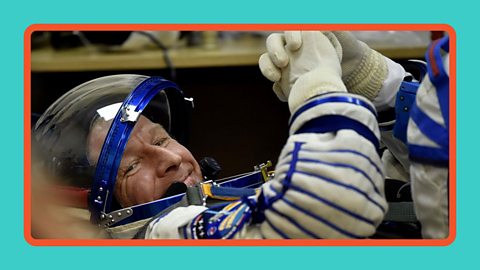
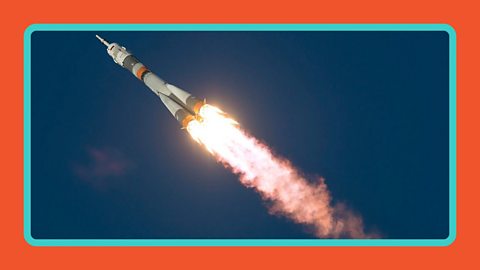
Image caption, Tim Peake is a retired British European Space Agency (ESA) astronaut, who flew into space, staying on the International Space Station as part of Expeditions 46 and 47.

1 of 4

Did you know?
Tim Peake was accepted into the European Space Agency (ESA) on 18th, May 2009, becoming the first officially British ESA astronaut.
Important words
Astronaut – A person trained to travel in space. In Russia they are called cosmonauts.
Centrifuge – A machine that astronauts use to train for the extreme forces encountered during space flight due to acceleration. The centrifuge spins around extremely fast to simulate the effects of space travel.
European Space Agency (ESA) – A space agency made up of 23 countries in Europe, including the United Kingdom, France and Germany.
Launch – When a spacecraft or rocket takes off and leaves our atmosphere to journey into space.
Re-entry – When a spacecraft returns to Earth, precise measurements are needed so that it can return safely. Re-entry is extremely dangerous, with the spacecraft reaching high temperatures on its return.
Spacewalk (EVA) – When an astronaut puts on a space suit and leaves a spacecraft to go out into space.
Weightlessness – In space there is no gravity, Astronauts can float around and are weightless.
Activities
Activity 1 – Ask Tim Peake
On 15 December 2015, British astronaut Tim Peake left Earth to spend 185 days on the International Space Station. Click on the questions above to ask Tim some questions about his mission.
Archive: ESA, NASA, ROSCOSMOS
Activity 2 – Take the quiz
Activity 3 – Guided reading

New game! Horrible Science: Stinky Space. game
Join Pipette on her epic mission and learn some revolting facts about space along the way.
More on Earth and space
Find out more by working through a topic
- count1 of 14
- count2 of 14
- count3 of 14
- count4 of 14