The Arms Race and the Space Race
For a long time, the Union of Soviet Socialist Republics - collection of states, also known as the Soviet Union. had been aware of the A powerful and destructive bomb that gets its power from the energy released when atoms are split. possibilities. But ever since the USA had dropped the atomic bomb on Hiroshima in 1945, the USSR had been even more determined to develop its own nuclear weapons. It finally succeeded in 1949 and this began a nuclear A competition between America and the USSR to build more destructive and a higher number of nuclear weapons. with both sides racing to develop more and bigger bombs. As the Cold War developed, the theory of Situation that developed due to the nuclear arms race where both America and Russia knew if they started a war it would destroy the world. (MAD) took shape, which said that the existence of such massive nuclear weapons meant that a future World War could end life on earth.
This nuclear arms race was matched by similar competition over space and the race to the moon.
| USA | Date | USSR |
| USA drops atomic bombs on the Japanese cities of Hiroshima and Nagasaki | 1945 | |
| 1949 | The USSR’s first successful atomic bomb test ends American nuclear monopoly | |
| The UK carries out nuclear tests in Western Australia | 1950 | |
| The USA successfully tests the first Hydrogen bomb, 2500 times more powerful than the atomic bomb | 1952 | |
| 1953 | The USSR tests its own Hydrogen bomb | |
| The USA publishes its Doctrine of Massive Retaliation stating that any attack on the USA or its allies would be met with incredible destructive force | 1955 | |
| 1957 | The USSR launches Sputnik 1 - the world’s first telecommunications satellite. Sputnik 2 was launched later that year and carried a small dog named Laika – the first living animal in space | |
| Launch of the first Intercontinental Ballistic Missile (ICBM), a rocket capable of carrying an atomic warhead for thousands of miles | ||
| The USA tests its own ICBMs. | 1958 | |
| The USA deploys Polaris submarines capable of launching nuclear missiles close to the shore of the USSR | 1959 | The USSR launches Luna 1 - the first man-made object to orbit the sun |
| Following the launch of the USSR's Luna 1 the USA sent Pioneer 4 to do a fly-past of the Moon | In response, the Soviets then launched Luna 2 at the moon | |
| The USA launches Discovery XIV - the first satellite equipped with a spy camera | 1960 | |
| May - the USA responds by launching its own Apollo missions, and Alan Shepard becomes the first American in space. President John F Kennedy challenges America to put a man on the moon by the end of the decade | 1961 | April - the USSR puts the first man, Yuri Gagarin, into space |
| October - the USSR detonates the Tsar Bomba, a nuclear bomb which produced the largest ever man-made explosion | ||
| The Cuban Missile Crisis – for 13 days the world stood on the edge of nuclear war | 1962 | |
| The USA develops MIRV technology, which enabled multiple independently targeted warheads to be fired from one missile | 1968 | The USSR develops and Anti-Ballistic Missile system to shoot down in-bound US missiles |
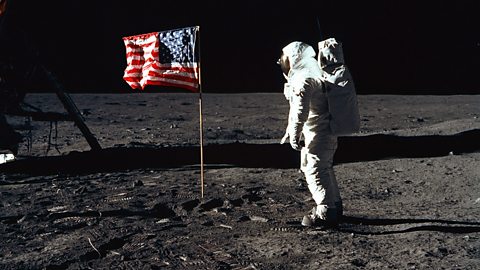
| The American astronauts, Neil Armstrong and Buzz Aldrin, become the first men to walk on the moon | 1969 |
| USA | USA drops atomic bombs on the Japanese cities of Hiroshima and Nagasaki |
|---|---|
| Date | 1945 |
| USSR |
| USA | |
|---|---|
| Date | 1949 |
| USSR | The USSR’s first successful atomic bomb test ends American nuclear monopoly |
| USA | The UK carries out nuclear tests in Western Australia |
|---|---|
| Date | 1950 |
| USSR |
| USA | The USA successfully tests the first Hydrogen bomb, 2500 times more powerful than the atomic bomb |
|---|---|
| Date | 1952 |
| USSR |
| USA | |
|---|---|
| Date | 1953 |
| USSR | The USSR tests its own Hydrogen bomb |
| USA | The USA publishes its Doctrine of Massive Retaliation stating that any attack on the USA or its allies would be met with incredible destructive force |
|---|---|
| Date | 1955 |
| USSR |
| USA | |
|---|---|
| Date | 1957 |
| USSR | The USSR launches Sputnik 1 - the world’s first telecommunications satellite. Sputnik 2 was launched later that year and carried a small dog named Laika – the first living animal in space |
| USA | |
|---|---|
| Date | |
| USSR | Launch of the first Intercontinental Ballistic Missile (ICBM), a rocket capable of carrying an atomic warhead for thousands of miles |
| USA | The USA tests its own ICBMs. |
|---|---|
| Date | 1958 |
| USSR |
| USA | The USA deploys Polaris submarines capable of launching nuclear missiles close to the shore of the USSR |
|---|---|
| Date | 1959 |
| USSR | The USSR launches Luna 1 - the first man-made object to orbit the sun |
| USA | Following the launch of the USSR's Luna 1 the USA sent Pioneer 4 to do a fly-past of the Moon |
|---|---|
| Date | |
| USSR | In response, the Soviets then launched Luna 2 at the moon |
| USA | The USA launches Discovery XIV - the first satellite equipped with a spy camera |
|---|---|
| Date | 1960 |
| USSR |
| USA | May - the USA responds by launching its own Apollo missions, and Alan Shepard becomes the first American in space. President John F Kennedy challenges America to put a man on the moon by the end of the decade |
|---|---|
| Date | 1961 |
| USSR | April - the USSR puts the first man, Yuri Gagarin, into space |
| USA | |
|---|---|
| Date | |
| USSR | October - the USSR detonates the Tsar Bomba, a nuclear bomb which produced the largest ever man-made explosion |
| USA | The Cuban Missile Crisis – for 13 days the world stood on the edge of nuclear war |
|---|---|
| Date | 1962 |
| USSR |
| USA | The USA develops MIRV technology, which enabled multiple independently targeted warheads to be fired from one missile |
|---|---|
| Date | 1968 |
| USSR | The USSR develops and Anti-Ballistic Missile system to shoot down in-bound US missiles |
| USA | The American astronauts, Neil Armstrong and Buzz Aldrin, become the first men to walk on the moon |
|---|---|
| Date | 1969 |
| USSR |
The USA and USSR were locked into an expensive battle to develop the best technology and try to produce the most advanced weapons. By stockpiling so many weapons, they ironically guaranteed their own safety under the theory of MAD (Mutually Assured Destruction). Neither side would be willing to launch their weapons because they knew the other side could retaliate and wipe them out as well.
However, this situation didn’t help to calm relations between the two sides and neither could afford to fall behind in either race. For the USSR especially, the cost of the Arms Race and the Space Race was a burden that would store up problems for later in the Cold War.