BBC Three uses VR 'to put you inside someone else's head'

Ian Ravenscroft
is an assistant producer with BBC Three
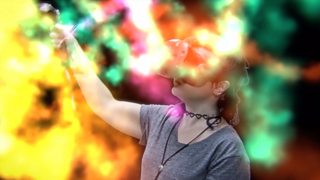
I first became aware of the power of virtual reality when I found myself at the bottom of the ocean, on the deck of a sunken ship, watching a blue whale swim across my path. I was, of course, actually standing in a small room in Bristol waving my arms around in a funny-looking headset.
It was from that point that I realised the new generation of virtual reality technology had the power to transport you to new places and see things from different perspectives. It occurred to me that VR might be the perfect way to help people understand the world in a very different way. What if I could use it to put you in someone else’s head?
That was the starting point for my new series of films for BBC Three, My Mental Health in VR.
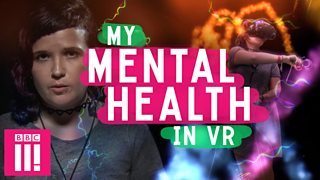
Mental health is a subject I connect with through friends, family and the stories we explore at BBC Three. I’m always struck by how people with these conditions live with a different lens on reality, which felt like a perfect fit with how virtual reality augments the world around you and blurs the boundary between what’s real and what isn’t.
Once my concept had been commissioned, a new challenge emerged. How could I translate VR into something a broad audience of young people could access and connect with?
My first task was to work with MIND and other mental health charities to find incredible stories of people who see the world differently. Katy had borderline personality disorder that gave her visual and auditory hallucinations, James had anorexia and bulimia which affected his self image and Danika had psychotic depression which manifested as somatic hallucinations - delusions that felt like real physical symptoms on her body. These stories were powerful and personal, about conditions that are often difficult to communicate.
The next challenge was technological. How could we use VR to express these conditions in a way that our audiences could not only understand, but access? The trouble with VR is that most people don't yet have the headsets or the right computers. So my aim became to use virtual reality as a filmmaking tool. This meant I could produce VR visuals in a video to be seen by many across BBC Three’s online platforms and not just by a few with the right equipment.
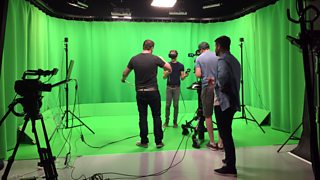
Filming in the VR studio
I chose to use ‘mixed reality’ - a new filming technique that is definitely not yet an exact science. It allowed us to put real people in a video with a virtual world around them in 360 degrees. We chose Google’s Tilt Brush as our VR painting software and used YouTube Space London’s green screen studios to set up the mixed reality shoot.
The look is achieved by aligning a virtual camera (one of the VR controllers) with a regular camera and sending both feeds to a quadrant of exported feeds which we could also monitor live. These elements were then composited together by our editor. It was not an easy process and involved a lot of learning on the job, but I feel it achieved a unique look that perfectly suited my goal of representing the inner ‘headspace’ of our contributors.
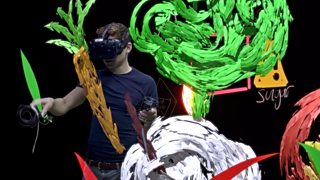
A big encouragement during this production was how the subjects in our films really took to the VR painting. Within minutes Katy, James and Danika were expressing themselves in a whole new way, using movement and colour to represent something that they had had difficulty saying with words to friends or family, or in therapy. They all said how useful they found it.
James, who talks about his eating disorders in the film, reflected on the VR experience like this: “I could make anything I wanted in that moment. Constructing my own reality about what this is like for me was really valuable. It gave the power back to me about making my own story and narrative, whereas I was always looking to professionals to say what was wrong. Art therapies have been cut quite a lot but I think this virtual reality speaks to young people."
It didn’t seem to make a difference whether the contributors had artistic ability or not: the tools proved to be intuitive and useful for this kind of content. I didn’t expect the contributors to have so much fun - but it was genuinely difficult to stop them once they got going.
I think the end result is a colourful and surprising take on mental health. It allows you to see what someone feels and turns difficult-to-grasp symptoms and conditions into easier-to-understand metaphors and images.
The collision of technology, art and personal mental health stories allowed us to provide an insight into the way many people see the world every day. The reaction so far has shown me there is a clear demand for content that explores mental health in more detail and focuses on individual conditions through personal stories and visual representations. I hope we get an opportunity to dig deeper in representing these stories in ways that connect with the community that is building around these conditions.
Borderline Personality Disorder: My Mental Health in VR episode 1
Anorexia & Bulimia: My Mental Health in VR episode 2
Psychotic Depression: My Mental Health in episode 3
My Mental Health In VR is available on BBC Three’s YouTube channel, Facebook page, and website.