Representations of people with dwarfism matter

Eugene Grant
Writer and activist in the UK dwarfism community
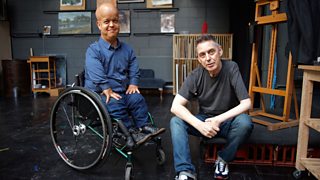
Most average height people meet few, if any, people with dwarfism in real life. Perhaps that’s because there aren’t many dwarf people, comparatively. The most common form of dwarfism, Achondroplasia, occurs in only one in around twenty thousand births. However, as Richard Butchins shows in his intelligent and persuasive new documentary, Dwarfs In Art: A New Perspective, representations of dwarf people in art and popular culture are ubiquitous - and, for the most part, not in a good way.
How many people have heard of Bashful - one of seven white, unintelligent, asexual cartoon men, each so one dimensional they are described as single emotion or state of being - but have never heard of Bes – the Ancient Egyptian God of war, fertility, and childhood, seen carrying the whole sky in his arms? How many people consumed the violence against dwarf bodies in hit films Austin Powers: The Spy Who Shagged Me and The Wolf Of Wall Street, but are unaware this spectacle can be traced back to Ancient Rome, when people with dwarfism had to fight in public arenas for ‘entertainment’. How many people could identify Tyrion Lannister, in the successful Game of Thrones series, but wouldn’t recognise Velazquez’s painting of Sebastian de Morra, sat on the floor, small fists in his lap, his eyes burning with fire.
The history of dwarfism - which Butchins sensitively traces through sculptures, paintings, photographs and films - is dark and unsettling. It is a history that includes the Stuart and Georgian periods, during which time monarchs kept people with dwarfism - like Jeffrey Hudson (featured in the programme) - as pets; it includes the Victorian Freak Shows, at which people like me were ‘exhibited’ and ridiculed - the spectacle of the dwarf body turned into a profitable commodity; it includes the Holocaust, during which time Nazis subjected Jewish people with dwarfism to horrific experiments. Set against, say, the ostentatious backdrop of the Court of Charles I, it is easy for images of royal extravagance to eclipse the bleak reality: that people with dwarfism were bought, presented, and kept in a similar way as cats, dogs, and monkeys. And while those who study it often appear to forget the gravity of this history, for his part Butchins does well to anchor these scholars to the sobriety of their subject matter.
Representations of people with dwarfism matter a great deal for they shape popular attitudes and behaviour towards people of restricted growth. Today, with actors such as Meredith Eaton, Lisa Hammond, and Peter Dinklage doing fine work, these representations are slowly improving. But they’re not enough. Game of Thrones cannot compensate for centuries of dire representation. There is a long way before we see many more banal, everyday depictions of dwarf people - your newsreaders; bake off contestants; TV detectives - not to mention more LGBT+ and dwarf People of Colour. And it’s about time. As the dancer, actor, and advocate Kiruna Stamell says in the programme: “People who are different are everywhere and they have stories as worthy of telling as everybody else”.
Eugene Grant was interviewed as part of Dwarfs In Art: A New Perspective, which was broadcast on 20 August and is available to view on the BBC iPlayer until 19 September.