My name is Dr. Maggie Aderin-Pocock, and I'm a space scientist and a science communicator, and that means I put things into space. When I first went to school, I didn't enjoy it very much because when you're young, it's all about reading and writing. I suffer from dyslexia, which means that my spelling and when I try to put words together, it didn't really work for me. But I think there was actually a turning point in my life, and it happened to me when I was eight years old. I was in the library at school, and I saw a book. And the book had an astronaut on the cover, and I thought, "Wow! That's what I want to do. I want to go into space!"
As a child, I was one of those really annoying kids that asked "why" all the time. "Why this?" and "Why that?" And that's what it is to be a scientist, to be inquisitive. If you want to be a space scientist, there are many different ways of getting in there. For instance, I went to university. I did a degree in Physics and a PhD in Mechanical Engineering, so I was at university for seven years. But you don't have to study that long. I know many people who leave school and then take up an apprenticeship. So, they come and work in the space industry straight away and start building things and putting them into space.
Sometimes, when I meet people for the first time and tell them I'm a space scientist, they look really surprised because I'm not quite what they expect a space scientist to look like. They expect someone who looks very serious and is usually white and male. And you can tell that that's just not me. But being a scientist isn't about being white and male or being serious. It's about having a passion for something, a passion for understanding.
As a space scientist, I'll specialise my work into certain areas, like optical instrumentation. That is, building machines that look at things and give us an understanding of things by taking images. Some of the projects I work on are making a real difference to us here on Earth. For instance, I was building a satellite which told us more about climate change. Climate change is probably the biggest challenge we're facing in our lives, and satellites are really helping us to understand it. So, space isn't just about "out there," it's also about looking in and understanding our own planet.
If I could travel back in time and go and see little Maggie growing up, I'd tell her to believe in herself because when you believe in yourself, you can achieve so much. And it's worked for me. So, if I can do that, what can you do?
Video summary
Space scientist Maggie Aderin-Pocock explains why being different is no barrier to success if you are passionate about something.
As a dyslexic child, Maggie found reading and writing in school difficult.
Nonetheless, it was a book that changed her life. On its cover was an astronaut.
As soon as Maggie saw that picture of a man floating without gravity in his amazing suit, she craved more information about space.
Driven by a desire to understand how the universe worked, she studied science and went on to make new discoveries about space on her own.
Maggie describes how she worked hard to overcome stereotypes by staying true to her goal. Despite not fitting the common image of a ‘serious, white male scientist’, she made it.
Her message to others is simple: "Believe in yourself, and you can achieve so much.”
Teacher Notes
This clip could be used as a discussion starter.
What are the ethical implications of sending people into space?
Can we justify the hundreds of millions often spent on satellites?
Use Maggie's answers in the clip as prompts for a debate on science funding to fit in with SMSC part of the syllabus.
The lesson could be expanded to include the Large Hadron Collider.
It can also be used in Science Week for prompts on careers in science and women in science.
This clip will be relevant for teaching Modern Studies and Physics at KS2 and KS3 in England and Wales, and 2nd level in Scotland.
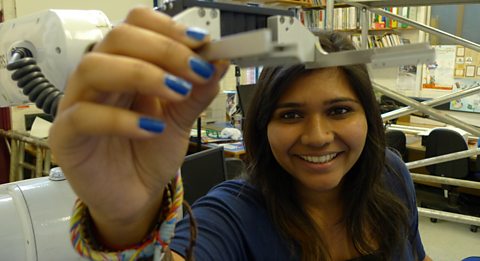
A career in robot design. video
Engineer Puja Varasani takes us inside her work as a robot designer.
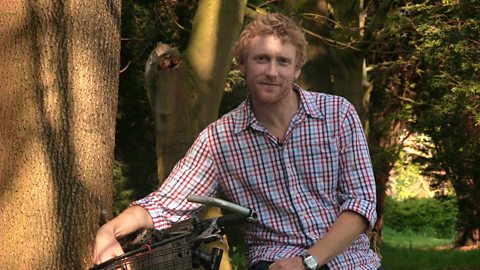
A career as an adventurer. video
Alastair Humphreys' extraordinary journey from ordinary kid to round the world cyclist.
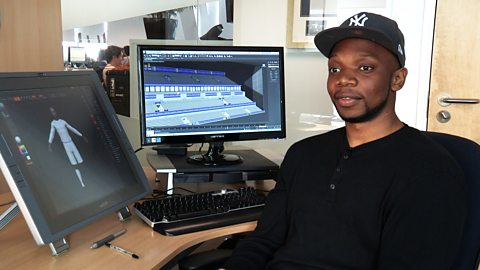
A career as a games artist. video
Ronnie Ochero turned his childhood obsession of playing video games into a career, by making them!