Sally Lindsay:
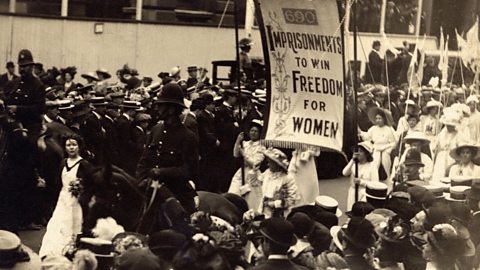
The Suffragettes were a group of women who campaigned for their right to voe in elections, when only men had the vote, and they served brutal prison sentences for their cause. Formerly known as the Women's Social and Political Union, they were led by Emmeline Pankhurst, a mother of five and a working widow from Manchester.
Sally Lindsay:
Even though Emmeline was an Edwardian campaigner, she grew up in a very Victorian world, where women were rarely seen and certainly not heard. But here in Manchester, that was all about to change.
Sally Lindsay:
I've come to the historic Chetham's Library in Manchester to see some recently unearthed archive that will reveal more.
Dr Charlotte Wildman:
So we know that a real turning point for Emmeline was her experience of going to hear Lydia Becker.
Sally Lindsay:
Lydia Earnestine Becker was a talented botanist and her specimens survive today in Manchester museum. A Votes for Women pioneer, she founded the National Society for Women's Suffrage in 1868, and wrote the first journal on the topic in 1870.
Dr Charlotte Wildman:
For lots of women like Emmeline, she was a real heroine, but for a lot fo men and certainly the press, she was heavily criticized and really kind of caricatured and they were really critical of the way she looked. This is Lydia portrayed as a donkey and she's being ridden by Jacob Bright, who was an important Manchester MP and is a great friend to the Women's Suffrage movement. And you can tell it's Lydia from the graphics.
Sally Lindsay:
Lydia Becker hit national headlines in England when in 1867 she marched a woman called Lily Maxwell to the poling booths in Manchester to vote 50 years before British women won the right.
Sally Lindsay:
I'm here at Manchester Central Library to find out more.
Dr Kate Cook:
So the crucial thing about Lily is, because she was a widow, she was the householder. She paid her rent and as a consequence of that she appears to have been taken for someone who had the right to vote. And here in this document is the actual evidence, and there she is. This is the register of voters.
Sally Lindsay:
Register of voters.
Dr Kate Cook:
For the Borough of Manchester, 1866 to 67. Here's Lily in Ludlow Street in a house, 25 Ludlow Street and this is…
Sally Lindsay:
Woman.
Dr Kate Cook:
Woman.
Sally Lindsay:
An exclamation mark.
Dr Kate Cook:
Yeah absolutely. Nobody else is a woman.
Sally Lindsay:
How did she get in there?
Dr Kate Cook:
Yeah.
Sally Lindsay:
Inspired by Lydia and her fellow campaigner Richard Pankhurst, who Emmeline would later marry, a young Emmeline joined the cause and she soon found herself in the dock defending her beliefs after giving a speech at an important Manchester park.
Dr Eloise Moss:
In 1896, Emmeline Pankhurst, as well as her daughters Christabel and Sylvia, start giving a speech about the women's right to vote and about the labour movement that's attended by 20,000 people.
Sally Lindsay:
20,000?
Dr Eloise Moss:
20,000. It's a huge audience for a woman speaker in this period. And shortly afterwards she is summonsed to trial. And she basically challenges the very premise upon which she's been brought to court. She's very indignant about it and there's actually a really interesting account of it in a newspaper at the time.
Sally Lindsay:
Oh, let's have a look.
Dr Eloise Moss:
So, it describes how this is about Emmeline in court. And she says "if the magistrate decided illegally, as she contended, to fine her, she would not pay on her own account, and she would be deeply indignant if anybody presumed to pay for her instead."
Sally Lindsay:
Wow!
Dr Eloise Moss:
I think this was quite integral to her future character as the famous Suffragette leader, because she realises in quite a strategic way that she can use the courtroom to further publicise her cause.
Sally Lindsay:
By 1903, Emmeline decided the time for simply asking for the vote was over. So she set up the WSPU in her own home. Emmeline led by example. With her willingness to face he hardships of prison for the cause, with dramatic results.
Sally Lindsay:
So this amazing front page really has really caught my eye. Could you talk me through that.
Helen Antrobus:
Absolutely. So, this is the front cover of the Daily Sketch after one of Emmeline's many arrests, and it has these really powerful words: "Mrs. Pankhurst again defeats the law". And it shows her in her prison cell. The picture really demonstrates all the horrors she would have suffered while she was in prison, and treated appallingly. It really damaged her health in the long term as well. So even though this image is quite a defiant powerful image, it still highlights how much suffering she went through and how much suffering she believed she had to go to. She would do whatever it took to win the vote.
Sally Lindsay:
Helen, tell us about this amazing banner, this exquisite piece of art hanging there.
Helen Antrobus:
It says Mrs Pankhurst on it. It was a real dedication, a token of her success in starting the Suffragette movement and the WSPU, but it also stood alongside her on platforms.
Sally Lindsay:
Oh really?
Helen Antrobus:
We have so many reports of her marching alongside this, and it shows her dedication to Manchester and the movement that she started here.
Video summary
Sally Lindsay unearths a range of primary historical sources that reveal more about the life and work of Emmeline Pankhurst, the leader of ‘votes for women’ campaign group the Women’s Social and Political Union - also known as the Suffragettes.
With descendants and expert historians, she discovers how original artefacts can be rigorously used to understand the contrasting arguments and interpretations of the women’s suffrage campaign and its leading campaigners, including Lydia Becker.
Sally takes us back into the heart of the movement to bring the period back to life with newspaper extracts from the time, medals and banners that the Suffragettes created for their marches, and even a voting register showing the first Manchester woman to ever cast a vote.
Teacher Notes
Students could begin the lesson by analysing a source about the suffragettes – what can they learn from the source? How is the source useful to them in finding out about women’s suffrage? What additional material would help them learn more about the movement?
When watching the video students could answer the following questions: Who was Lydia Becker and how was she portrayed in the media? What different types of evidence are examined throughout the clip? How does the evidence help us to understand the contrasting arguments and interpretations of the women’s suffrage campaign? Why do historians use a range of artefacts when examining the past?
Students could then be given a range of materials about the Suffragette movement which they have to use to produce their own mini-exhibition about the Suffragette movement - using only five of the sources they have been given – explaining why they would choose each item and how it would help people to understand more about the movement. Or students could be asked to write a short article which examines the different ways in which the Suffragettes have been interpreted by contemporaries of the time and today, 100 years on.
At the end of the lesson students could be asked to choose their favourite artefact/source material from the lesson and explain why they have chosen it.
Suitable for teaching History at KS3 in England, Wales and Northern Ireland and 3rd Level in Scotland.
How the Votes for Women campaign began. video
How the votes for women campaign began, and the women who led the fight for suffrage.
How Manchester shaped Emmeline Pankhurst. video
Sally Lindsay finds out how Manchester shaped the Suffragettes leader Emmeline Pankhurst.
The life and work of Emmeline Pankhurst. video
Sally Lindsay reports on the life and work of the Suffragettes leader Emmeline Pankhurst.