Climber's horror fall helps test NHS breakthrough

Lewis Bruten is now back climbing after the horrific fall which left him with dangerous chest injuries.
- Published
A rock climber who suffered a collapsed lung after a 5m fall in the Wye Valley has gone on to help doctors test a new treatment that could transform care for NHS patients.
Lewis Bruten, from Bristol, broke bones, fractured vertebrae and suffered a life-threatening chest injury when a piece of climbing gear came loose beneath him.
While being treated at Southmead Hospital, he became one of the first patients enrolled in a major UK trial of a less invasive technique for treating collapsed lungs.
"This can be a life-threatening injury," said Dr Edd Carlton, who is leading the study. Researchers hope the technique could speed recovery and reduce complications.
More from Bristol
Blaze at community centre used in Outlaws TV show
- Published3 days ago
Legal action taken against 'prolific flag erector'
- Published4 days ago
What happens next after major footbridge collapse?
- Published4 days ago
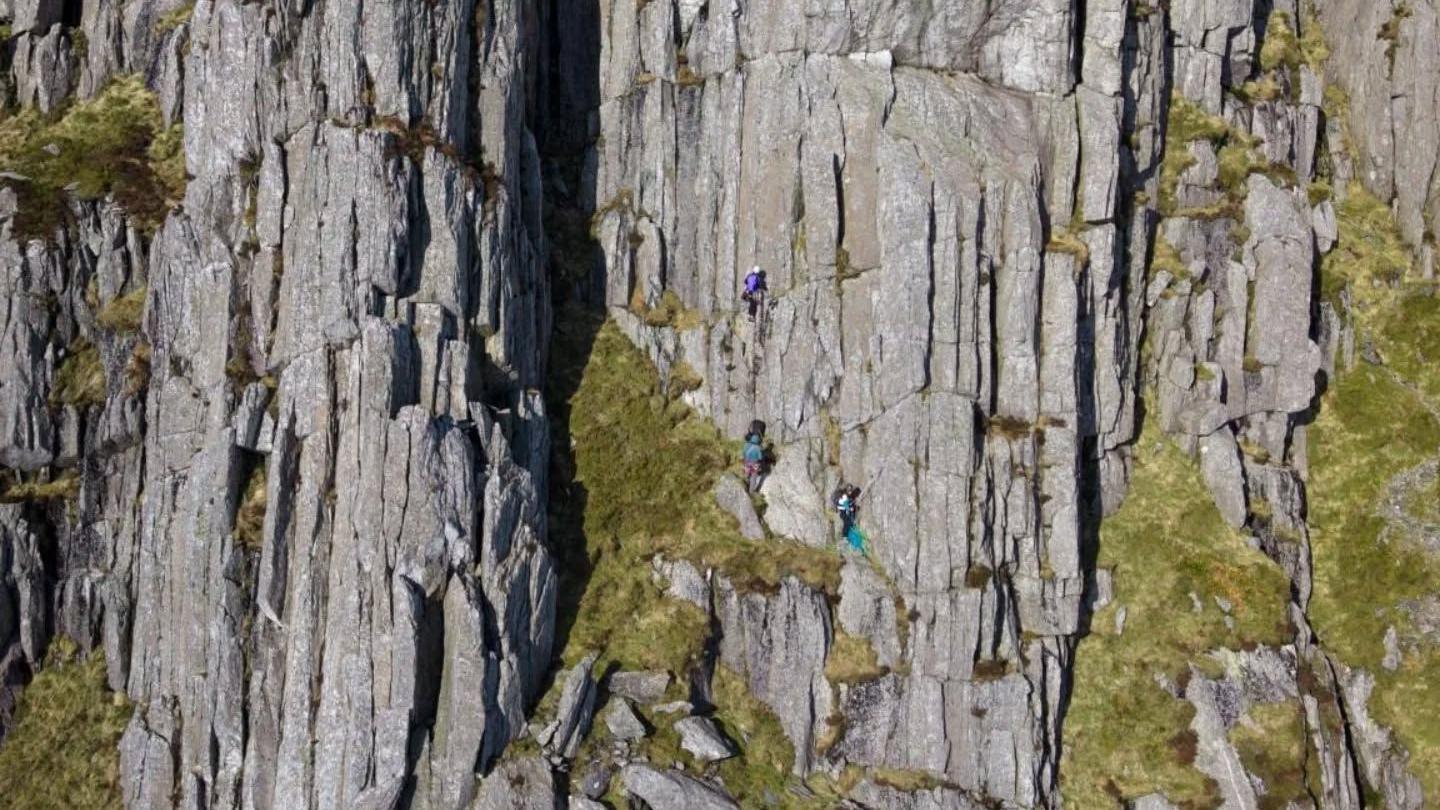
When Bruten set out on a warm August morning intending to climb Wintour's Leap in the Wye Valley he did not anticipate ending the day in a hospital bed.
"Me and my mate went to do a type of climbing where you place gear into the rock as you go up, rather than there being bolts that you clip into," he said.
"I got myself into a position where I couldn't get myself back and ended up falling.
"Unfortunately, the gear that I placed came away from the rock, and I went shoulder first into a boulder on the ground."
Bruten suffered a broken shoulder, six fractured ribs, fractures to four vertebrae and, most dangerously, a condition called haemopneumothorax or collapsed lung.
This is a serious medical condition where both blood and air collect around the lungs.
It left him struggling to breathe and needing urgent treatment.
A mammoth rescue operation involving Severn Area Rescue Association, Almondsbury Ambulance Station and Gloucestershire Fire and Rescue took five hours to bring him from the remote valley to the major trauma centre at Southmead Hospital.

Lewis was rescued from the Wye Valley after falling 5m while climbing
Carlton was contacted after Bruten arrived because his injuries made him a suitable candidate for the CoMiT-ED 2 trial, which is investigating a less invasive way of treating collapsed lungs.
"We're recruiting over 1,500 adult patients from more than 50 trauma centres and units across the UK. Lewis's injuries meant he was a good candidate for the study," he said.
"If the lung continues to collapse and the air accumulates around the lung, people can actually stop breathing or their heart stop."
The study is comparing the standard treatment with a less invasive technique developed by Carlton and colleagues, which uses a small tube inserted under local anaesthetic.
"Instead of what we've traditionally done for over 100 years, which is to make a big hole in the chest using a scalpel and putting in a large drain," added Carlton.

Dr Edd Carlton said the new technique could transform treatment for collapsed lungs
Acquiring Bruten's consent to take part presented an ethical dilemma.
Despite enthusiastically insisting he wanted to be part of the study, "My informed consent was delayed by a few days because I was on quite a lot of morphine and felt really unwell," said Bruten.
Such was the success of his treatment, after a week in hospital and two weeks at home, he was able to return to his job as a vet.
Carlton said the new technique could transform care for patients with chest injuries across the NHS.
"We know that about one in five patients who suffer serious accidents have significant chest injuries," he said.
"If these smaller drains do help and reduce complications, that will aid their pain during recovery, and help them recover from the other injuries that they've sustained."
Get in touch
Your Voice
Follow BBC Bristol on Facebook, external, X, external and Instagram, external. Send your story ideas to us on email or via WhatsApp on 0800 313 4630.
More stories like this
- Published21 October

- Published31 March
- Published19 February


