Possible Iron Age settlement discovered above town

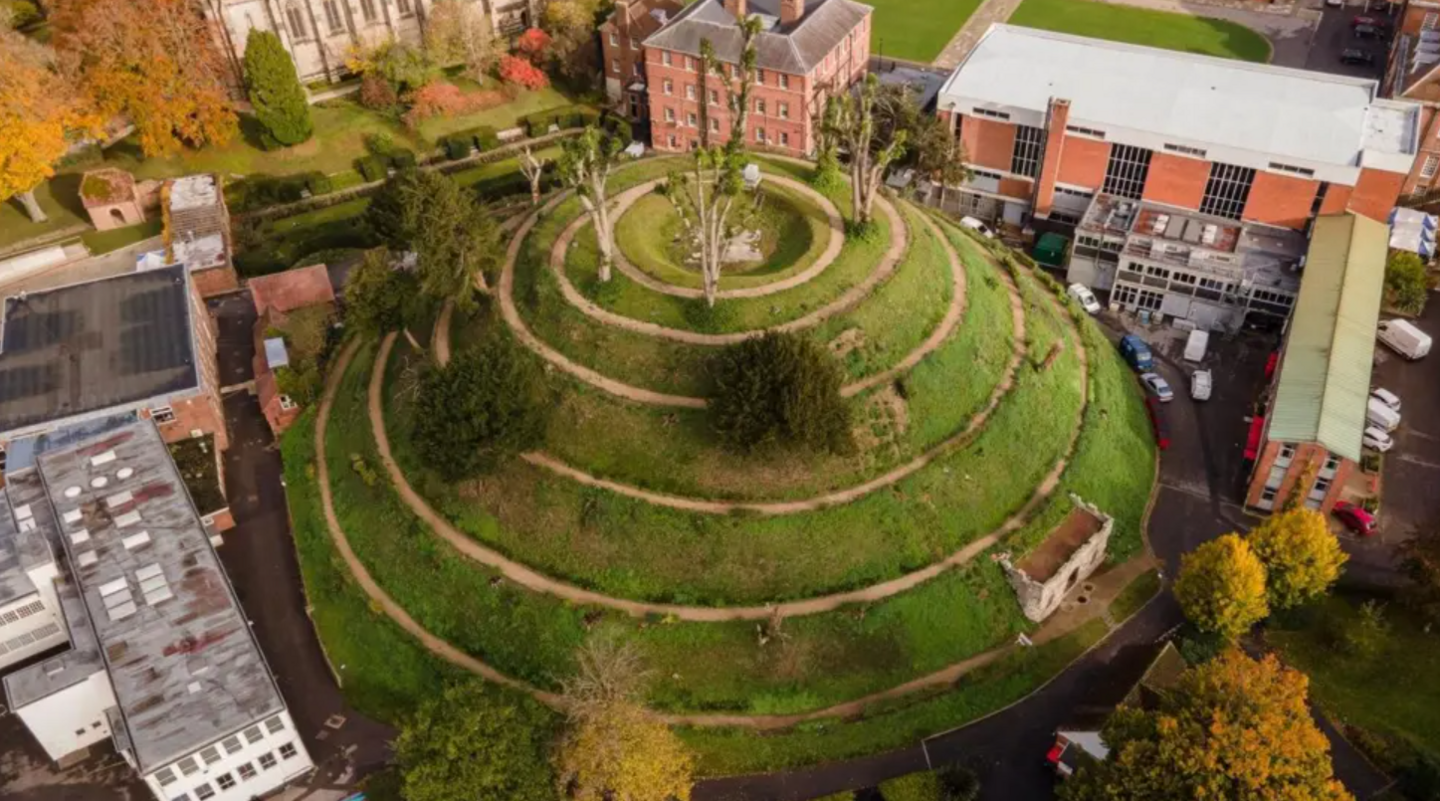
An artist's impression of what the site may have looked like thousands of years ago
- Published
A possible Iron Age farming settlement has been found above a town.
Experts have "rewritten the history" of Royal Wootton Bassett, in Wiltshire, following the discovery at Brynards Hill in Coronation Country Park.
Archaeological digs have revealed thatched huts once sat within a ditch and bank at the top of the hill.
David Carson, of the Royal Wootton Bassett Environmental Trust, said the find "points to" the area being a former Iron Age settlement, adding: "We have good evidence but we are waiting for an official report to be published, so nothing is 100% until that point. But I think that's where we are heading, I can safely say that."

Trenches were excavated as part of the mission to uncover the history of the land
People in Royal Wootton Bassett have long speculated that a plateau at the top of Brynards Hill could have been the site of an Iron Age hillfort.
The town council commissioned a geophysical survey in April 2025, which found there was a manmade circular ditch feature around the top of the hill.
"It was indicative of an an enclosure of some sorts," Carson explained. "But on the other hand, it could have been a Victorian farm feature. We didn't know for sure."
More from Wiltshire
Why antidepressant users struggle in heatwaves
- Published9 July
Care for single child costs council £1.5m a year
- Published8 July
Waste site behind town's 'whiff' shuts for repairs
- Published8 July
In May, Wiltshire Museum's archaeology field group excavated the site in a three-day dig across three trenches.
The excavation confirmed evidence of a circular bank and ditch enclosure. Pottery found in two of the trenches has been dated to the late prehistoric period, which puts the enclosure in the Iron Age 800BC to 43AD.

People from across Royal Wootton Bassett got involved in the excavation work
"It is always fascinating to read the land," Carson contiued. "We made the excavation open to the public as a community dig and had a lot of volunteers of all ages from the town and local villages.
"They were chuffed to bits to be excavating their own history."

It is thought Brynards Hill was once home to Iron Age farmers who kept livestock nearby
Since the work was undertaken, Wessex Archaeology has suggested that, rather than a hillfort as some had theorised, Brynards Hill would more likely have been an Iron Age farming settlement.
The enclosure area was a safe place at night for the families and also their livestock, it said.
"We have, I hope, rewritten the history of Royal Wootton Bassett for the future," Carson continued. "We know this is an important site and now it will be in all the official records and won't be touched in the future, which is the most important thing."
David Dawson, director of Wiltshire Museum, said: "This was project developed by our volunteers working to professional archaeological standards.
"This was a fantastic community archaeology project, working with many local people to give them a taste of archaeology and the opportunity to uncover new evidence of the story of the town."
Get in touch
Tell us which stories we should cover in Wiltshire
Follow BBC Wiltshire on Facebook, external, X, external and Instagram, external. Send your story ideas to us on email or via WhatsApp on 0800 313 4630.
Related topics
More stories
- Published18 October 2025
- Published19 November 2025