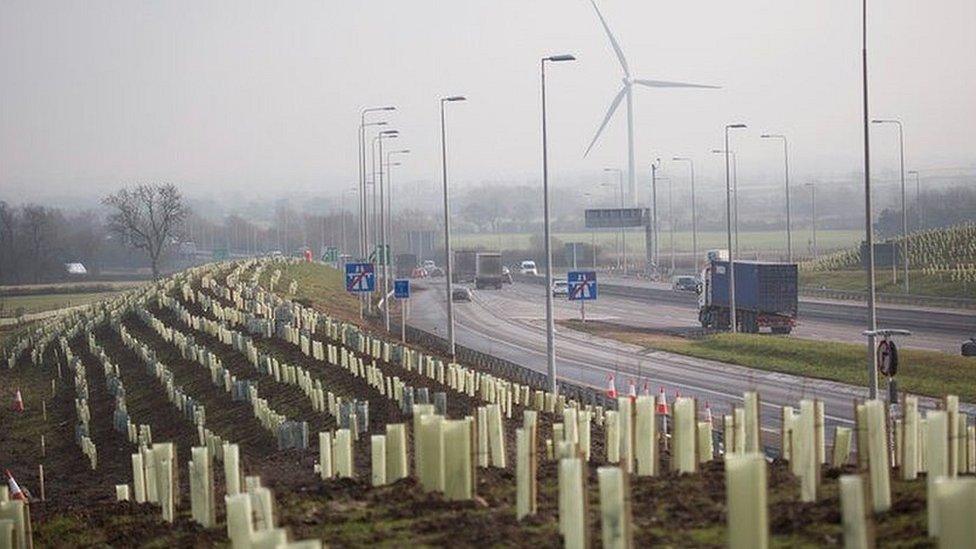
Why are trees dying beside a major road and how can it be fixed?

Questions remain about the success of the planting along the A14
- Published
National Highways is to trial a new way of planting trees alongside roads after admitting its "performance on tree planting has not been good enough".
Many thousands of trees have died since it planted 860,000 saplings between Cambridge and the A1, after completing the A14 upgrade in 2020.
A further 165,000 trees and shrubs were planted between 2022 and 2023, and people nearby even took to planting their own trees along part of the road's embankments.
So what goes wrong after trees are planted - and can it be fixed?
Why are trees planted along major roads?

The re-routed Cambridge to Huntingdon A14 opened in 2020, although the scheme was not completed until 2022 with improved Huntingdon connections
For decades, the A14 in Cambridgeshire was synonymous with slow-moving traffic, jack-knifed lorries and very long delays.
That changed with the completion of a £1.5bn road improvement scheme, a 12-mile (19km) Cambridge to Huntingdon three-lane carriageway. About 270 hectares (670 acres) of habitat, including 40 native tree and shrub species, was planted as part of the project.
In part, this was to mitigate for the removal of the many existing mature trees in the path of the re-routed road.
"Trees are the soft estate along the highways and have multiple functions, including as a visual screen to hide it from surrounding landscape," said Neil Davies, the chairman of the board of trustees at the Arboricultural Association, a charity which promotes awareness of tree care.
"It can provide environmental screening, for noise for example, and it has a habitat and landscape value, including linking up with established habitats."
What has gone wrong with the A14 planting?

More than 860,000 trees were originally planted, but a large proportion of them died
Up to 30% of the first tranche of saplings planted along the A14 died, although all were replanted.
In 2023, Martin Edwards, senior project manager at National Highways, said this was partly because their planting took place in the spring, which was not an optimal time, after the Conservative government wanted the road opened early.
Hot summers were also to blame.
But two years later, there were complaints sections of the A road "still look like a desert".
The problem is not unique to the government agency — the National Trust believes last year's drought was responsible for losing two in every five newly-planted trees in the Peak District, while hundreds of council-planted saplings died in Darlington.
Davies, whose organisation was not involved with any of these schemes, added: "I've never been involved with a scheme with a 100% success rate.
"If you plant 100 trees, you'll expect about 10% loss and up to 20% with a really horrible winter, but the contract would expect the owner and the contractor to take responsibility for 'beating up' - or making good the losses."
What are the problems that can affect growth?

Young trees need the right location, the right soil and plenty of aftercare if they are to thrive
"Often the problem is getting the right tree for the right location," said Davies.
He explained large-scale planting schemes, like the A14 one, planted "whips" - metre-high trees aged between two and four years old.
"These should have a good success rate if handled appropriately. Some species prefer very damp and wet locations, others prefer it dry and others don't like it in a very windy location," he said.
Willow or alder would suit a very wet site, designed to deal with motorway run-off while they would not be happy with a free-draining bank that drops away from the road.
Ground preparation was also key, removing any builders' rubble, not planting trees over drainage tunnels and ensuring the sub-soil has not been so tightly compacted by months of heavy machinery that the roots struggle or have nowhere to grow.
"You need to manage the conditions so it's not out-competed by brambles or bracken and to make sure the tree guards are still in place to stop deer or rabbits eating the bark, and water them if there's a drought," he added.
In fact, the association recommends that newly-planted trees should be given 50 litres (11 gallons) of water per week, external during the summer months for the first three years after planting.
"Ultimately, these whips have got quite a lot of vigour and vitality and should grow well if handled appropriately."
What is being done in the A14 trial?

Neil Davies, who has worked in the tree industry for 30 years, welcomed the National Highways trial
A National Highways spokesperson said the A14 upgrade had "delivered major economic, safety and environmental benefits, but we recognise that our performance on tree planting has not been good enough".
So, in addition to using cell-grown saplings the government-owned company would:
Use mychorrizal [fungi], external to improve moisture retention
Add fertiliser for an additional nutrient boost
Install a mulch mat to provide a protective barrier to suppress weeds and further support moisture retention
Davies said: "It's always good to trial these things and see what does work and what doesn't.
"For example, the mychorrizal will help improve the condition and biome of soil [the community of organisms living in the soil], but I've not trialled it on a 50,000-trees scale, so it'll be interesting to see how it works out."
What should be done in the future?

Resources need to be allocated so all tree-planting projects include the right site preparation and aftercare, experts said
Davies said the A14 landscape scheme was not the only one in the country which was "not getting it right" and often it came down to not factoring the all-important aftercare.
"I was talking to a colleague at the Netherlands last summer and over there, contracts are established on the basis of not only sticking the trees in the ground, but also making sure they survive for the first four or five years," he said.
In the UK, he had seen contracts where the emphasis is on keeping the contract as low as possible on price.
"As an industry, we've got to be aware that if we want trees to be established in the landscape — whether it's in a housing estate, by a railway or along a road — then we need to allocate resources to that," he said.
"The key from me is education, education, education. Let's let everyone know — it's not just sticking a tree in the ground, it's preparation and aftercare."
Do you have a story suggestion for Cambridgeshire? Contact us below.
Get in touch
Your Voice
Follow Cambridgeshire news on BBC Sounds, Facebook, external, Instagram, external and X, external.
- Published17 June 2025
- Published19 June 2025
- Published3 November 2023