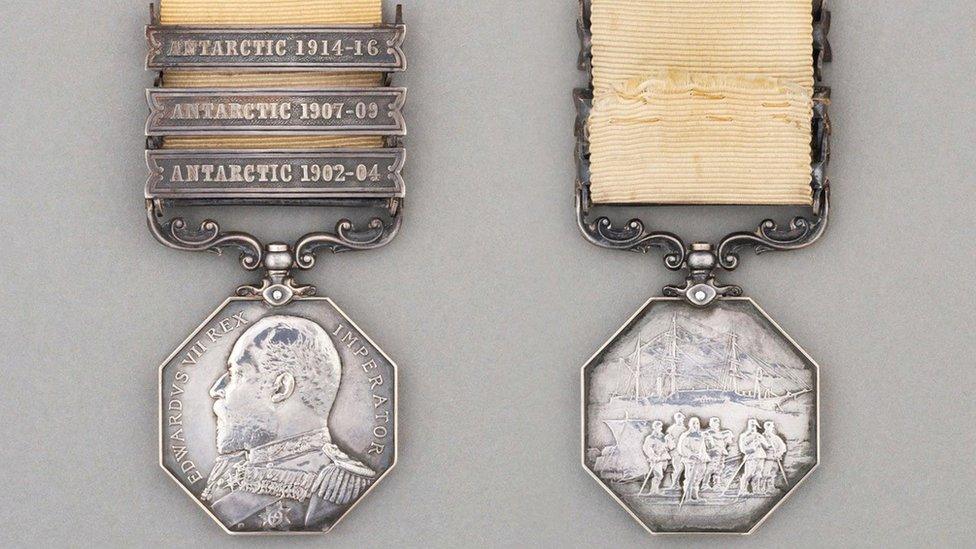
Polar Medal awarded to expert on mass extinctions

Prof John Marshall has studied reasons for extinction events in Earth's past
- Published
A scientist credited with uncovering reasons for mass species extinctions hundreds of millions of years ago has been awarded the Polar Medal.
Prof John Marshall has made 19 expeditions to Greenland and Norway over 30 years.
He has shown how separate extinction events on Earth were caused by volcanic eruptions and an ultraviolet atmospheric burst, the University of Southampton said.
The Polar Medal, announced in the New Year's Honours list, is awarded for outstanding service to the UK in the field of polar research.

Marshall said his work could be "very challenging"
Marshall said: "It has always been a great privilege to work in these remote areas.
"You can visit places nobody has ever been so there is always a great sense of adventure and discovery.
"It can be very challenging with significant manual effort and endless climbing, often in extreme conditions with blizzards and storms.
"On the way we have encountered many of the fabulous arctic animals such as narwhal, muskoxen and of course polar bears."

This image shows the professor on a night-time boat trip in East Greenland in 2009
In Greenland, Marshall discovered the earliest known seed plant and the geological ages of the earliest four-legged animals, the university said.
On Spitsbergen, an island in Svalbard, he is credited with identifying a new type of prehistoric forest as well as details of a 55-million-year-old warming event.
The Polar Medal was instituted in 1904 to reward Capt Robert Falcon Scott's first successful expedition to the Arctic.
Previous recipients have included famed explorers Sir Ernest Shackleton and Sir Edmund Hillary.
It replaced Arctic Medals, which were awarded for exploration in the 19th Century.
Get in touch
Do you have a story BBC Hampshire & Isle of Wight should cover?
You can follow BBC Hampshire & Isle of Wight on Facebook, external, X (Twitter), external, or Instagram, external.
See also
- Published2 days ago
- Published3 February 2024