Lyse Doucet: ‘Look for the light in the dark’ to make sense of hard news

Lyse Doucet
Chief international correspondent, BBC News @bbclysedoucet
Earlier this month Lyse Doucet helped judge a competition to find the most inspirational personal stories featured by the BBC World Service programme Outlook to mark its half-century on air. Far from being a soft option, she says, accounts of extraordinary human experience help audiences better understand complex international events:
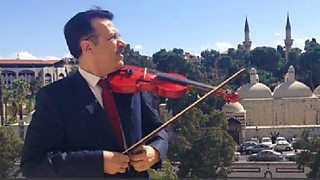
Violinist Abdul Halim Hariri continues to organise concerts in embattled Aleppo
Why do journalists always focus on negative stories? Why is it always bad news?
Journalists confront this complaint time and again. Our answer has always been that we focus on bad news because we see it as extraordinary - a deviation from what we think of as a more normal state of affairs in our world.
But no-one wants to hear bad news all the time. And life itself just isn’t like that, not even in places where there can seem to be little, if any, good news at all.
Being a judge for this month’s Outlook Inspirations awards was a profound reminder of the remarkable resilience among people from all walks of life facing all manner of dangers and distress.
Confronted by the worst of times, it brings out the best in them.

Natalia Ponce de Leon survived a savage acid attack and went on to change Columbian law
From an acid-attack survivor in Colombia (above) to a motorcycle-riding female Afghan activist and a Ugandan prisoner framed for murder, stories of everyday heroism were brought together to mark 50 years of our acclaimed BBC World Service programme.
When I return home from capitals that are now bywords for conflict and crisis, I often sit in my kitchen and listen to Outlook’s inspiring chronicles - simple, powerful human stories of strength and survival behind all those negative news headlines.
The terrible turns of our times must be reported. But even there - and perhaps especially there - it’s important to look for the light in the dark.
It’s not hard to find it. It’s part of people’s lives.
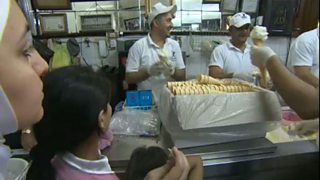
The Damascus ice cream parlour that stays open for business against the odds
In recent years we’ve reported on a much-loved ice cream parlour in the Old City of Damascus (above) where Syrians queue to savour sweet treats in a country torn by war. A family that’s been making Syrian ice cream for generations is determined to keep this tradition alive.
In Kabul we reported on how Afghans, looking to develop a new generation of sporting heroes to help unite a fractured country, developed a Premier Football League and a national cricket squad. Afghans keep turning out en masse, defying threats of violence, to cheer on their national teams whose sporting prowess keeps winning Afghanistan titles as well as national pride and joy.
People who live with hardship and heartache, day in day out, find ways to carry on. They have to. To ignore that essential humanity is to miss a significant essence in the lives of people whose stories we tell.
And when our audiences respond to our reports by saying ‘I didn’t know that’, I feel we’ve done our job.
Five years into a war in Syria which has shredded the country and its cultural mosaic, we spoke to Syrians who had not just survived but channelled their own anguish into efforts to do whatever they could to save something of Syria: the violinist of embattled Aleppo (top image) who organises concerts to lift the city’s spirit; the archeologist who remains in Syria to try to protect its rich cultural heritage.
The massive exodus of Syrians and many others from their homeland is now one of our main news stories, and understandably so. People are escaping with their lives. But there are Syrians who are able to choose to stay, and they do.
These are stories which surprise. They’re the stories people remember.
“How can you report on a dog show in a park in Baghdad?” a BBC colleague once asked me on a trip to the Iraqi capital. He insisted it would clash with what he called a reputation for doing serious journalism on big issues.
Our Cruft’s dog show Iraqi-style turned into a memorable story for listeners on a reporting assignment which included visits to the front line against the so-called Islamic State, and an interview with Iraq’s embattled prime minister.
The dog show emphasised a side of Iraqis which doesn’t always emerge in our coverage: their great sense of humour; their refined culture; and a resolve to carry on with life, whatever the risk.
This isn’t the same as telling ‘good news’ for the sake of it, or doing it to make a point. It’s not the headline. But it is a way of trying to understand societies which look and feel so different from our own but share some crucial ingredients of a shared humanity. It helps to break down some of the distance between ‘us and them’, to make increasingly complex stories easier to grasp and comprehend. Most stories, however complicated, are in essence human stories.
Our audiences now have far more choice in which reports they wish to see or hear. There are so many more media platforms. That means many more stories are being told, and told in different ways. There’s more space for the inspiring tales which tell us much more about our world.
It means that when negative headlines erupt again, you - and our audiences - will have a better understanding and empathy for what it must be like for those who have to live through such times.
Outlook’s longlist of 50 inspirational stories
Who inspires Lyse Doucet?
Lyse Doucet: ‘Most international news is no longer foreign news’
From Our Own Correspondent: A sweep of history in one human story
Student animators get creative with one-minute World Service stories