What happened when gaming met Twitter in the land of dragons

Matt Andrews
Creative technologist, BBC Digital Guerillas @mattpointblank
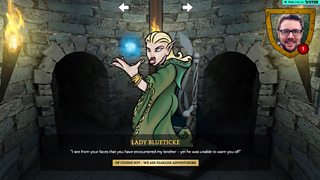
We know computer games are inherently social experiences and multiplayer games have been popular for decades. So my team, the Birmingham-based Digital Guerrillas, wondered if we could turn social data into a game in itself.
How well do you know your friends? Can your knowledge of their social activity help you escape from trolls and dragons? This was the basis of the idea for Mates vs Monsters, our Twitter-powered dungeon adventure.
We're a team of digital specialists who work as part of the BBC to produce experimental, innovative online experiences. Some of our past work includes an immersive online mystery alongside BBC Three's Thirteen drama, and a partnership with a comedy illustrator. We'd never built a game before, but we thought we'd be able to give it a go.
Our producer Joe Bell, a keen board gamer, came up with the original idea: what if we could use Twitter's API (a tool for accessing Twitter's data) to power a quiz? We built a quick prototype which pulled in your friends list from Twitter and worked out various statistics: who tweeted the most, who had the fewest followers, etc. This was the basis of the game, but we needed to build a world to play it in.
Our designer Lynsey Reynolds, also a talented illustrator, was able to quickly knock up some imagery for our dungeon-based game. The idea was that you'd be faced with a series of doors, and would navigate the dungeon, encountering different characters (some of whom you'd have to battle with), and ‘challenges’ where you'd have to answer a question about your friends.
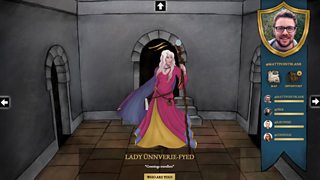
Original artwork by Lynsey Reynolds for an early version of the game
We soon had a playable version where you could click arrows to move between rooms. One challenge quickly became apparent: when you moved into a new room, the direction arrows didn't move with you. We had to rewrite the code for the dungeon to factor in your viewing direction when moving through a door. Turns out building games is a bit more complex than we'd suspected...
Eventually we had a version ready for alpha testing and we brought in some local students from Birmingham City University to run through the game. Quite quickly we saw problems: lots of them got stuck in the dungeon, unsure which doors they'd already been through or which way they were facing. We'd tried adding a map but this didn't always help, and because of the open-plan dungeon, not all of the players experienced the challenges, monsters or items we'd added to the different rooms.
Going back to the drawing board, the entire team collaborated to rethink the game. Ian Ravenscroft, our storyliner, suggested that we make the entire game a ‘gauntlet’ - a linear set of rooms where players would either succeed at a challenge and move forward, or fail and have to try again. We worked out we could keep some of our doors in the game, splitting the player's path in two, but keeping the player moving forward (rather than left, right or backwards) to avoid the problem of getting lost.
This new version required an almost total rewrite of the game's code, but it was worth it. When we user-tested the new version there was no more confusion about direction/movement (top image shows how the game looks today, with simplified movement controls). Because the room choices were limited, it meant more players got to experience the different gameplay elements we'd added.
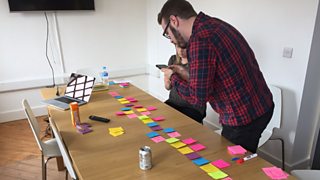
Back to the drawing board: Matt and Lynsey rethink the lay-out with a paper prototype
We still encountered issues: most players didn't notice the inventory icon we'd added, which showed them items they'd collected. We experimented with animating it when they collected an item, but further testing showed this was still too subtle. In the end, we added a series of onscreen prompts drawing their attention to the game interface, which worked.
One thing we learned from the testing was the difference between ‘user wants’ and ‘user needs’. Our student testers told us that we should explain the game's interface by adding text on screen, or using in-game characters to speak to the player and explain things. At the same time, though, they told us the game was too text-heavy and we should remove some!
We'd also already done some of these things and our testers didn't notice the text. The ‘user need’ here was clarification of the game's interface, but what they wanted (more onscreen text) wasn't actually going to solve the problem.
We also found that even a relatively simple game like ours involved lots of logic and checking for ‘edge cases’ - where a player might run out of health unexpectedly or have no attacks left to use. We had to play test the game hundreds of times to expose these situations and make sure the game didn't become unplayable.
It's challenging to be truly original in a world like gaming which is massively popular and bursting with innovation. Our experiment was to see if taking a classic gaming trope like a dungeon escape adventure and adding your friends into the mix would be more fun. Based on some of the positive feedback we got from our target audience - all heavy Twitter users - we reckon it worked.
You can decide for yourself. Play the game on BBC Taster.
Can the BBC embrace gaming culture?
How #findthegirl engaged the BBC Three audience in weeks of social sleuthing