Personalised cookery show from BBC R&D is a piece of CAKE

Jasmine Cox
Designer, BBC Research & Development
If you’ve never cooked ‘mullet en papillote’ from scratch (or mullet on anything else, come to that) you’ll be interested to hear about an interactive cookery programme that goes at your own speed and whose presenter can respond to your personal kitchen nightmares in real time.
If, on the other hand, you’re practically Master Chef material, that’s fine too. Just punch your level of skill into your tablet, along with dietary preferences and how many people you’re having round to dinner, and the programme will be instantly customised accordingly.
Cook-Along Kitchen Experience (CAKE) is a prototype production from BBC Research & Development that has just had its first big industry outing at IBC2016 in Amsterdam. It’s the BBC’s first fully ‘object-based’ experiment, from production right through to user experience.
In its simplest terms, object-based broadcasting is attempting to do for TV and radio what responsive design has already done for the web: produce programmes entirely on IP networks that can be customised to suit different users and environments in a world where the internet increasingly comes first.
Using the power of metadata, ‘objects’ (video, audio, text, graphics) created during production can be reassembled in the browser and reused as required.
Does that mean recording endless variations? Happily, not. We planned our production so that we could record single, step-by-step recipes only once. The variations are created by our application.
Our presenter doesn’t refer to other recipes that she is also cooking so that when you choose a combination of recipes the steps interleave without messy continuity. She also doesn't mention quantities of ingredients so that we can scale if you’re cooking for any number of people.
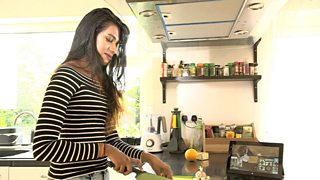
A user puts CAKE to the test, cooking at her own speed and interacting with the presenter
BBC R&D has already run trials of ‘responsive radio’, where audiences could listen to a 12-minute or 24-minute version of the same documentary - or anything in between, depending on how much time they had.
The team has built object-based weather forecasts, capable of being tailored “on the fly” according to the sophistication of the receiving device and even tested a video drama whose narrative and mood can be shaped in real time to match the viewer’s personality - an example of ‘visual perceptive media’.
As our first end-to-end object-based execution, CAKE is the next step up. And at IBC, the demo put audiences at the centre of a highly personalised, IP-delivered media experience, in entirely new ways. I think it was a compelling proposition, for producers and budding chefs alike.
Our next challenge is to make production tools and develop workflows that mean making object-based experiences is just as easy as linear broadcast. I’d also like CAKE to work flawlessly with speech control and get it into the hands of as many people as possible via BBC Taster.
There is a lot more information about the CAKE project and how object-based broadcasting works on the BBC R&D website.
What is responsive web design – and what does it mean for journalists?