How a mobile-first documentary about online ‘shaming’ is reaching millions

Daniel Adamson
Digital producer, BBC World Service @danielsilas
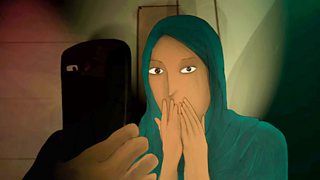
Amal's animated story of sexual abuse and blackmail in Tunisia has been viewed 7 million times
In the last few years, news organisations have become pretty good at making 90-second videos for social media. But how do you make a serious documentary - the kind of investigation that would conventionally have been presented as 60 minutes of television - for mobile phones and the social web?
For the documentaries team at BBC Arabic, that’s an urgent question, because a significant chunk of our audience has turned away from TV over the last few years. Around 65% of Arabs - more than 200 million people - are under the age of 30, and get the vast majority of their news via a social feed on a mobile phone. Our challenge, then, is to get compelling, in-depth investigative journalism onto those phones.
Our first attempt to meet that challenge is a digital documentary, released last month, called Shame - Sex, Honour, and Blackmail in an Online World.
Shame investigates a new and disturbing phenomenon: the use of sexually explicit images to threaten, blackmail, and shame young people, mainly girls and women, in some of the most conservative societies in the world.
This is an issue that darkens thousands of young lives across the Middle East and South Asia. But, not surprisingly, few of the women who fall victim to ‘honour blackmail’ want to talk about it on camera.
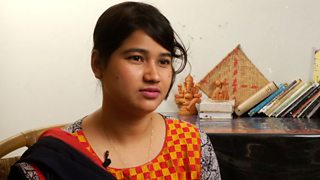
Purnima, from Bangladesh, told how she was shamed on social media for surviving rape
To find the stories that made up this series, our team had to get inside a Tunisian prison, visit safe houses for abused women in Jordan and Iraq, and gain access to the criminals who run a multi-million-dollar ‘sextortion’ racket from rural Morocco. Colleagues from across the BBC World Service went out to remote villages in India and Pakistan, and interviewed victims of online abuse everywhere from Afghanistan to Bangladesh.
Many of the most promising leads went cold, retreating behind walls of taboo and silence. But after months of investigation, we had collected ten personal stories, each giving a glimpse into this hidden epidemic of abuse. In eight out of these ten cases, we had no video footage at all.
Illustrators and animators filled that gap, allowing us to transform first-person testimonies into short videos and, in one case, a comic strip. One of the animations tells the story of a young Tunisian woman who was sexually assaulted, photographed naked, blackmailed, and pushed to the point where she murdered her rapist with a meat cleaver. This video has been watched more than seven million times in English alone, showing that animation can be used to treat even the most disturbing of subjects.
The more difficult task was to bring these films together into a single, coherent investigation. How could we take all these videos and features, each of which was made to stand alone on social media, and turn them into a something more than a scattering of unrelated stories that would be swept away in the stream of Facebook?
To do that we designed a mobile-first website for Shame that mimics the look and feel of a phone app, and which was embedded into BBC Taster, the BBC’s most experimental online space.
The first tab, Intro, offers a global overview of the subject, presented as a series of 18 vertical slides that viewers swipe through on their phones - a format that is intuitive to users of Snapchat, Twitter Moments, or Instagram Stories. This introduction sets the personal stories into a global context, and highlights the main findings of the investigation.
The second tab, Stories, contains all the videos and feature articles. The third tab is a Live page on which we built a curated social media feed on the subject of ‘shame.’ This feed brings together the social conversation - Facebook comments, tweets, YouTube videos, and Instagram posts - into a single timeline of insight and discussion. It also invited the audience to contact us via Telegram, WhatsApp, or Facebook Messenger with their own stories and opinions.
The live page transformed Shame into a two-way conversation with young viewers across the Middle East, allowing us to bring their voices - including critical voices - into the BBC’s journalism without giving space to misogynists and trolls. The page was updated every few hours over the week that the Shame project was rolled out.
All of the video and text was produced in English and Arabic, and the entire site switches between languages at the touch of a button.
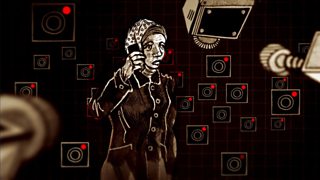
An illustration of Jordanian teacher Samah, photographed and blackmailed by her own husband
The response to Shame has exceeded our most ambitious expectations. The stories were promoted across the BBC’s websites and social media feeds in English, Arabic, and more than 15 other languages. We’re still gathering the data on the reach of these stories, but already we can see that more than 25 million people watched or read some part of the series in English alone.
The longer films and articles were among the most widely viewed and shared stories. Facebook data shows that these videos – some as long as five minutes – held people’s attention all the way to the end, a finding that corroborates our editorial instinct to let the stories breathe rather than crush them into a 90-second attention span.
Facebook analytics also shows that the people most interested in these videos were women between the ages of 18 and 29, an audience the BBC often struggles to reach.
Shame is the first project from BBC Arabic’s new digital documentaries team. Future investigations might take an entirely different form - we’re now looking at stories that could be crowd-sourced on social media, told using Virtual Reality, or presented as interactive data visualisations or news games. Whatever comes next, we think the basic format of Shame could be developed into a template for in-depth, mobile-first storytelling across the BBC, because it provides a way to take the kind of atomised, short-form stories that flourish on social media and bring them together into a coherent, explorable, permanent project.
Almost any major subject - the crisis in Syria, for example, or the north-south divide in the UK, or the rise of far-right politics in the western world - could be broken down into a swipe-through overview, a series of powerful videos and features, and a curated live feed of debate and analysis from the social web.
This is a format that works perfectly on a mobile phone, and that can be adapted to include data visualisation and motion graphics as well as video, audio, and text.
You can explore all the stories that make up Shame here.
Shame was produced by Daniel Adamson, Mamdouh Akbiek and Eloise Dicker for the documentaries team run by Marc Perkins at BBC Arabic, in collaboration with colleagues from across the BBC’s South Asian language services. The interactive website was built by the digital journalism studio Kiln, and integrated into the BBC by the team at BBC Taster led by Will Saunders.
Detailed data on the performance of the Shame stories will be available to BBC staff in December, when the publication of the stories across the World Service is complete.
How a graphic novel style can tell the most powerful of human stories
Student animators get creative with one-minute World Service stories