In a previous post, Alex Freeman described the complex production cycle behind BBC Two’s Trust Me I’m a Doctor. Here she answers questions about on-air results and off-air response:
What have been the programme’s most surprising experiments?
We’ve been pretty lucky over five series with our results, although a lot of that is down to careful planning. We usually measure quite a few different things to give us a greater chance of seeing something change significantly, and we also tend to choose subjects where any outcome is interesting. (Does cider vinegar live up to its health claims? A ‘yes’ is just as interesting as a debunking ‘no’.)
The most surprising results we’ve had, though, are the ones just in for our big turmeric experiment (8pm, 22September, BBC Two). This was a bit of a personal story for me as I’d wanted to look into some of the health claims around turmeric for some time. There have been thousands of research papers published and particularly about the active ingredient in the spice, curcumin, but very few of them involving people - mostly rats or simply in vitro.
Those that have been in people have generally been looking at its effects on disease, and in high doses. We wanted to investigate particularly the big claim that it can help prevent cancer. I was wondering exactly what test we could use to measure cancer risk. Cancer is always said to be caused by mutations in our DNA, but I was thinking about the statistics that show that your risk of cancer can go DOWN - for instance if you give up smoking.
To me that implied that the increased/decreased risk was caused by some temporary change, rather than a permanent mutation in the DNA. I know that there are temporary changes in genes caused by something called DNA methylation. So I did a very quick literature search for ‘DNA methylation’ and ‘cancer’ and came across a team at UCL who had recently published research showing exactly that - that DNA methylation changes tended to happen to cells before they became cancerous.
They were in fact developing a way to measure people’s DNA methylation changes and give them personalised advice on their cancer risk. So we contacted them to see whether they thought their method could help us look at our volunteers’ cancer risk before and after taking turmeric for six weeks. They jumped at the chance, and we managed to get help from a charity to fund the research – all in the space of a week.
It was a long shot. No one had ever looked at DNA methylation patterns in a study like this before, and it required a lot of special analysis of blood samples. Six weeks of taking turmeric was also a really short time to expect to see changes.
The results came in just the morning of filming, and they were beyond anyone’s expectation. There were no significant changes in the methylation patterns of our placebo group, or a group taking turmeric supplements. But those cooking with the same amount of turmeric as a powder showed a really significant change in the methylation of one gene in particular - a gene already known to be associated with cancer, as well as depression and asthma, all three conditions that turmeric is supposed to help.
I was not only extremely relieved to have such a great pay-off for a fairly risky undertaking, but also hugely pleased to have been involved in getting such a study underway. Without our trial, and spotting the potential to use DNA methylation testing, this is a breakthrough that would never have happened. Now the team at UCL expect to be able to use the same method again and again to study all sorts of foods, drugs and exercises to see how they affect disease risk through changing methylation patterns.
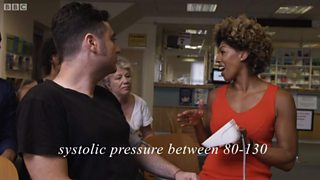
GP Zoe Williams road tests blood pressure monitors in episode two
What have been the top trials in terms of audience response?
Our audiences are generally around 2.7 million per episode, and I don’t think the figures vary too much depending on the subject of the main stories. However, our inbox gets flooded when people have really engaged with a story.
I think the olive oil trial in series 4 (another trial, like turmeric, where we took a big risk and ran a big study with nearly 100 people and a very new technique to measure people’s levels of heart disease) got people most excited. We were able to show for the first time that 20ml of olive oil a day (raw, not cooked) significantly improved people’s heart health - while polyunsaturated oils like sunflower and rapeseed (both also thought to be good for the heart) made no such difference.
We get so many people writing in and asking why we didn’t test more oils, including fish oils. I explain that to see significant results we need at least 25 people in each group, and that every group we test requires a lot more recruitment, a very carefully designed protocol and probably at least another £5,000!
In fact we are now just launching a big fish oil study, all carefully designed, and we will use the same heart disease test - all because of the demand from viewers. As usual, it’s never been done before, so I’m very excited to see the results at Christmas, whatever they are.
You do quite a lot of consumer testing (commercial products, devices). Is that a legal minefield?
Not exactly. We know that if we are testing something that we’re going to name overtly then we have to do it to the highest standards. For example, when we demonstrated that some brands of ginkgo biloba tablets had no ginkgo in them whatsoever, we did the testing with a specialist laboratory in UCL. Even then we couldn’t legally name the brands involved because the testing would have had to have been done in a government-approved specialist testing laboratory.
We replicated and built on a study published in Nature showing that some people have gut bacteria that are seriously disturbed by the artificial sweetener saccharine. There we had to demonstrate that our findings were backed up by those done in the Nature study, and that we had worded everything absolutely appropriately.
BBC lawyers are used to consumer programmes, so they are very good at advising us.
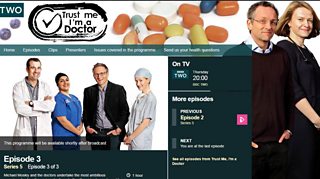
The Trust Me I'm a Doctor website is a top BBC destination while the series is on air
Viewers are always directed to the programme website for more information. How many go there?
The website is our pride and joy. In the weeks that we are on air, it is the BBC’s most visited programme page (excluding iPlayer) - above Strictly, EastEnders and Bake Off.
On series 4, the website had 1.2 million unique users, viewing 4.3 million pages between them. I see our digital presence as vital. Social media and digital videos allow us to take Trust Me content to viewers who wouldn’t watch the BBC Two series.
During the last series, our five first micro-videos made especially for social media reached 14.77 million users and our BBC News articles were read by more than 9.6 million readers. When is it safe to reheat leftovers? was read by 1.7 million on its first day alone, and prompted an extraordinary 9% click-through rate.
We have now teamed up with BBC Three, with BBC Worldwide’s YouTube channels and with Radio 1 Newsbeat to make content especially for younger audiences, and have our own social media accounts and digital producers making material for them.
How do you strike the balance between accurate medicine and watchable TV?
I like to say that we take our science seriously, but ourselves not too seriously. And we’re all about relevance to people’s lives. I think that if people can see that a topic is relevant to them, then they are immediately interested in it - no matter how complex. Having said that, the science that we are presenting is usually very ‘applied’ - we’re talking about what works/doesn’t work much more than the mechanism behind it. So although the findings are often cutting edge, we’re not trying to explain anything in too much depth.
Do you ever worry that you’re feeding people’s hypochondria?
I genuinely feel that we are presenting health information in an un-hyped way, busting myths created by other parts of the media and by those with commercial interests. Because we’re not on air that frequently I think that allows us to do items only when we think there’s a real story to be told - we don’t have to ‘invent’ stories out of single studies or create scare stories.
We push back quite strongly on delivering more episodes of Trust Me because of that. We don’t want to become something more like a weekly health show because there simply wouldn’t be enough genuinely new or important things to say.
Episode three of Trust Me I'm a Doctor, 8pm, 22 September, BBC Two and on BBC iPlayer.
Alex Freeman describes how the series takes shape in Trust Me I'm a Doctor: Anatomy of a primetime medical series.
Reporting science: Professor Colin Blakemore