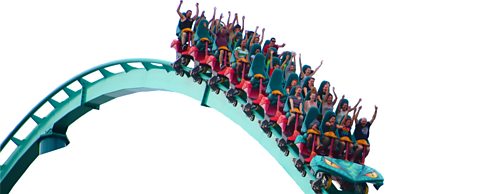
Did you know that roller coasters don't have engines? That’s because they don’t need them!
Gravity is the force that pulls things to the ground. Roller coasters rely on gravity to take them to the end of the track. This involves two types of energy, potential energy and kinetic energy.
What goes up, must come down
The funfair is a summertime staple. But for your average alien, it might seem a bit unusual.
It’s not like there are roller coasters in space. And not everyone has gravity like ours either. Gravity is the force that attracts a body towards the centre of the earth; otherwise we’d all just float away.
The roller coaster is pulled to the top of the first hill by a motor. Once at the top, the conversion of potential energy to kinetic energy is what drives the roller coaster to the end. Kinetic energy is what the roller coaster creates due to its motion.
You experience this all the time, in a car, on a bike… or even some kind of intergalactic spaceship for that matter. As the roller coaster gets higher in the air, gravity and the momentum can pull it down a greater distance. And at a higher speed! The energy created is released as kinetic energy and makes the roller coaster fly!
Gravity takes over and pushes the coaster cars downward and the tracks channel this force. So if the cars are facing downwards, it accelerates and if it tilts up, it decelerates.
The dreaded loop! The energy already created pushes the coaster to the top of the loop where gravity pulls it down. The changes in acceleration and the twists and turns make roller coasters so much fun.
The reservoir of energy created at the first hill helps move the roller coaster. This is almost empty when it comes to the end of the track…a bit like some of its passengers. A roller coaster completes its journey by converting potential energy to kinetic energy with the help of gravity.
Some people have to learn the hard way.
Potential energy is the energy an object has because of where it is in relation to other objects.
Kinetic energy is what makes the object move.
Many rides use the transfer of potential energy to kinetic energy to move along the track. As the motor pulls the cars to the top, lots of potential energy is built up. This is released when the roller coaster reaches the top.
The amount of kinetic energy in the object depends on its speed and mass.
When the roller coaster moves downwards, kinetic energy is generated. The maximum kinetic energy generated is when the roller coaster is at the bottom of the track. When it begins to go up, the kinetic energy converts to potential energy.
Floating at the funfair!
Why does it feel like you're floating when you're on some rides?
Click on the image below and hit each of the labels to discover what makes a pendulum ride so exciting.
Take the test!
More on Forces
Find out more by working through a topic
- count2 of 9
- count3 of 9
- count4 of 9
- count5 of 9