How to subtract two-digit numbers
You can find the difference between two numbers in more than one way.
You can count up from the smaller number to the larger number.
Or, you can count back from the larger number to the smaller number.
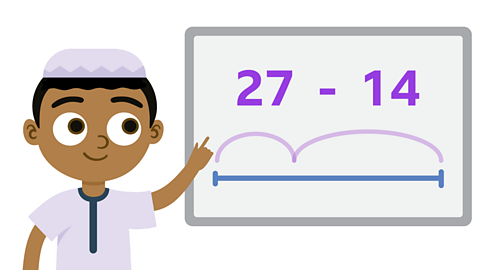
You can make this easier by taking away smaller amounts that add up to bigger numbers.
Activity: How to subtract two-digit numbers
Discover all about subtracting two-digit numbers with this interactive activity, then put your knowledge to the test.
Using subtraction
There are two ways to find the answer to subtraction calculations.
First, you could start on the smaller number and count up to reach the bigger number. This works if the two numbers are close together.
Empty number lines can help you work out the difference between the two numbers.
For example, if you want to work out 72 - 64, you begin on 64 and count up. Like this:
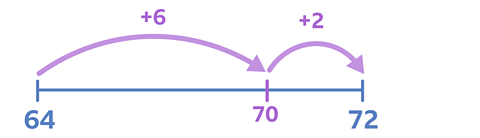
You could count up in ones or you could use number bonds to help you.
Counting on 6 from 64 will take you 70, then it's just 2 more to get to 72.
So, you make a jump of 6 and a jump of 2 on the number line. Altogether, that's a jump of 8 to get from 64 to 72. Therefore:
72 - 64 = 8
This method for subtraction is best when the numbers are close together.
You can also find the answer to subtraction calculations by starting with the larger number and then taking away the smaller number.
For example, if you want to work out 72 - 5, you can see there is a big difference between these numbers, so it would take a long time to count up from 5 to 72.
So, it is better to count back 5 from 72.
Let's us a number line again.
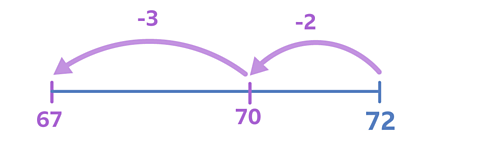
Counting back 2 from 72 takes you to 70 on the number line, then another jump of 3 takes you to 67. Therefore
72 - 5 = 67
You can use part-whole diagrams to show subtraction too.
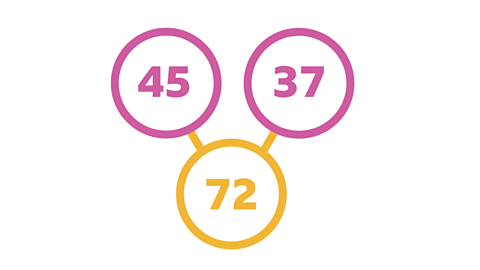
If you take away one of the parts from the whole, you can work out the other part.
This part-whole model shows two calculations:
72 - 45 = 37
72 - 37 = 45
Example 1
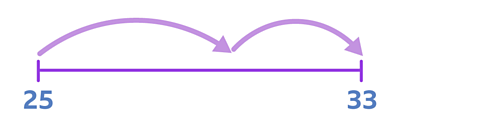
Can you use this empty number line to count up and find the answer?
33 - 25 = ?
✓ As the numbers are close together, you can count up from 25 to 33.
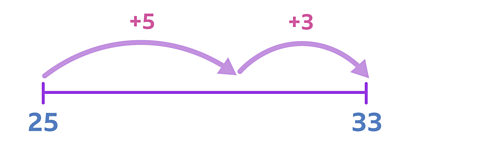
On the empty number line, you first jump from 25 to 30. That's a jump of 5.
Next, you jump from 30 to 33. That's a jump of 3.
In total you have jumped 8.
33 - 25 = 8
Example 2
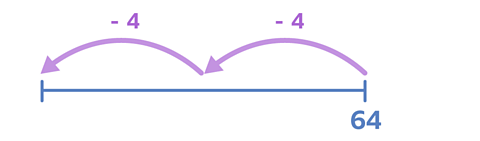
Now, can you count backwards to find this answer?
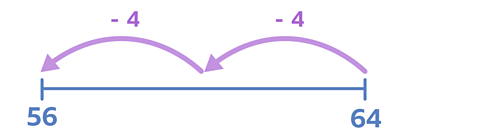
64 - 8 = ?
✓ The second number is small in this calculation.
You can begin at 64 and count back 8.
You count back one jump of 4 to get to 60.
Then, another jump of 4 to 56.
Altogether, you have jumped back 8.
Example 3
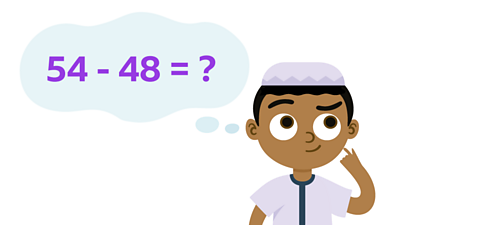
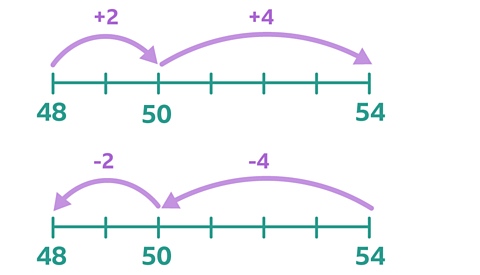
If counting down from 54 to 48 gives you an answer of 6.
What do you get by counting up from 48?
✓ You get the same answer either way.
54 and 48 are close together, so it's easier to count up from the smaller number.
54 - 48 = 6
NEW! Play Karate Cats Maths - the winter update. game
Deck the dojo in the Christmas update and unlock festive outfits for your Karate Cats. Available for a limited time only!

More on Adding and subtracting
Find out more by working through a topic
- count8 of 8
- count1 of 8
- count2 of 8

- count3 of 8