Imagine turning on your radio to hear reports of aliens from outer space attacking the country with death rays.
Outside, your neighbours are running to safety and the emergency services are doing their best to deal with a situation they’ve never experienced before.
It sounds like the opening episode of a new big budget sci-fi show, but this really happened in 1930s America! One of the earliest examples of broadcasting fake news, it’s still talked about today - when a piece of disinformation was presented as a radio drama.
What was the Orson Welles’ War of the Worlds broadcast?
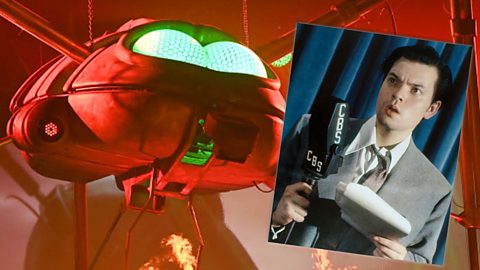
The actor Orson Welles is best known for Citizen Kane, the 1941 film where he was director and star. A few years earlier, he appeared in a live radio adaptation of HG Wells’ novel The War of the Worlds as part of a series called Mercury Theatre on the Air. It would become one of the most notorious radio broadcasts in history. Instead of dramatising it as a story, Welles and producer John Houseman decided to present the first part of the play as a real-life news report, updating the listeners of an ongoing alien invasion at Grovers Mill in the state of New Jersey. It caused a sensation as people believed they were listening to genuine news. Houseman and writer Howard Koch said producing the play in the regular Mercury Theatre style and adapting the book in the usual way would have made for "a very boring show".
The fake news bulletins, broadcast live on 30 October 1938, suggested that humankind had no hope against the invading Martians. Although it was claimed that this led to millions of people going into a panic - Orson Welles recalled that people were driving away from their homes: "at 125 miles per hour" - there is no definite proof. It could be that concerned listeners calling in to police stations, newspaper offices and radio stations was misinterpreted as something bigger in news reports the next day. Orson Welles himself made the front pages as he attempted to explain why the broadcast had been presented as fake news.
Why was The War of the Worlds presented as fake news?
In 1955, Orson Welles made a claim on a BBC TV show about the real reason it had been presented as fake news: “When the radio came, and I suppose now television, anything that came through the new machine was believed. So, in a way, our broadcast was an assault on the credibility of that machine. We wanted people to understand that they shouldn’t take any opinion… and they shouldn’t swallow everything that came through the tap, whether it was radio or not.”
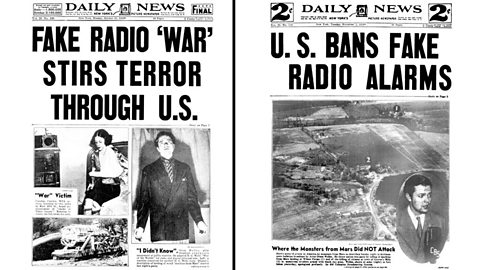
This is an example of disinformation, where a story known to be false is deliberately shared in the hope of making people think in a certain way - in this case, that they shouldn’t believe everything they hear on the radio. You may still see examples of this today in online stories and social posts, where fake stories are created about politicians, celebrities or news events that fit in with views the creator wants to share.
BBC World Service takes a closer look at The War of the Worlds radio broadcast in an episode of Witness History, which features memories from John Houseman and Howard Koch. The public reaction led to a ban on radio stations broadcasting fake information about a catastrophe or major incident in this way ever again.
Was The War of the Worlds the first fake news on the radio?
One of the inspirations for this style of storytelling is said to be a BBC radio play from 1926. In a letter to the Radio Times, Leonard Miall, who worked for the BBC in the USA, explained more: “[John] Houseman, as a boy, had been in school in England and had remembered a production he had heard on April 16, 1926, just before the general strike. This was Father Ronald Knox's famous broadcast about a fictitious riot of the unemployed in London. Although it was not dramatised, Knox's account… was so vivid that it caused a major alarm all over the country. Houseman was therefore well aware of the kind of panic really effective broadcasting could create.”
Because he knew how a fake news story could take hold - John Houseman, according to Miall, made sure there was an announcement before the show that listeners were tuning in to a piece of fiction. He pointed out in his letter that people joining the Orson Welles broadcast after this announcement had no idea they weren’t listening to genuine news.
Fake events on TV and radio didn't end with The War of the Worlds, though. There have been others, including Ghostwatch - shown on BBC One on Hallowe'en night 1992 - and led some people to believe that evil spirits had invaded a live show about the paranormal. Social media also presents fake news - for example, in 2020 there were claims that the Covid-19 vaccine would be used to put microchips into people and that it could alter DNA. The claims went viral, but were later debunked as fake news.
If you're ever unsure if something you see or hear is real news or not, have a look at this guide to fact-checking the stories you see online.
- Find out more from Witness History at BBC Sounds.
This article was published in October 2025

Not sure if the news you’re seeing on social media is true or false? Can you always tell if the things you see online are real or fake? Learn how to get the other side of the story with our quizzes, videos and explainers.
The monthly AI or Real quiz: October 2025
Which of these images are genuine? Test yourself in our regular quiz

What can The Celebrity Traitors teach us about unconscious bias?
How prior knowledge and experiences may be influencing the players' votes